




| IN A NUTSHELL |
|
The world of drone technology is advancing at a rapid pace, with researchers continuously pushing the boundaries of what these unmanned aerial vehicles can achieve. A recent breakthrough by a team at Westlake University in China represents a significant leap forward. Their innovative system, known as FlyingToolbox, enables drones to swap tools mid-air with remarkable precision. This development marks the first successful execution of multi-rotor drones performing precise docking and tool transfers while airborne, overcoming the challenging phenomenon known as downwash—a turbulent airflow produced by the drones’ propellers.
Solving the Downwash Challenge
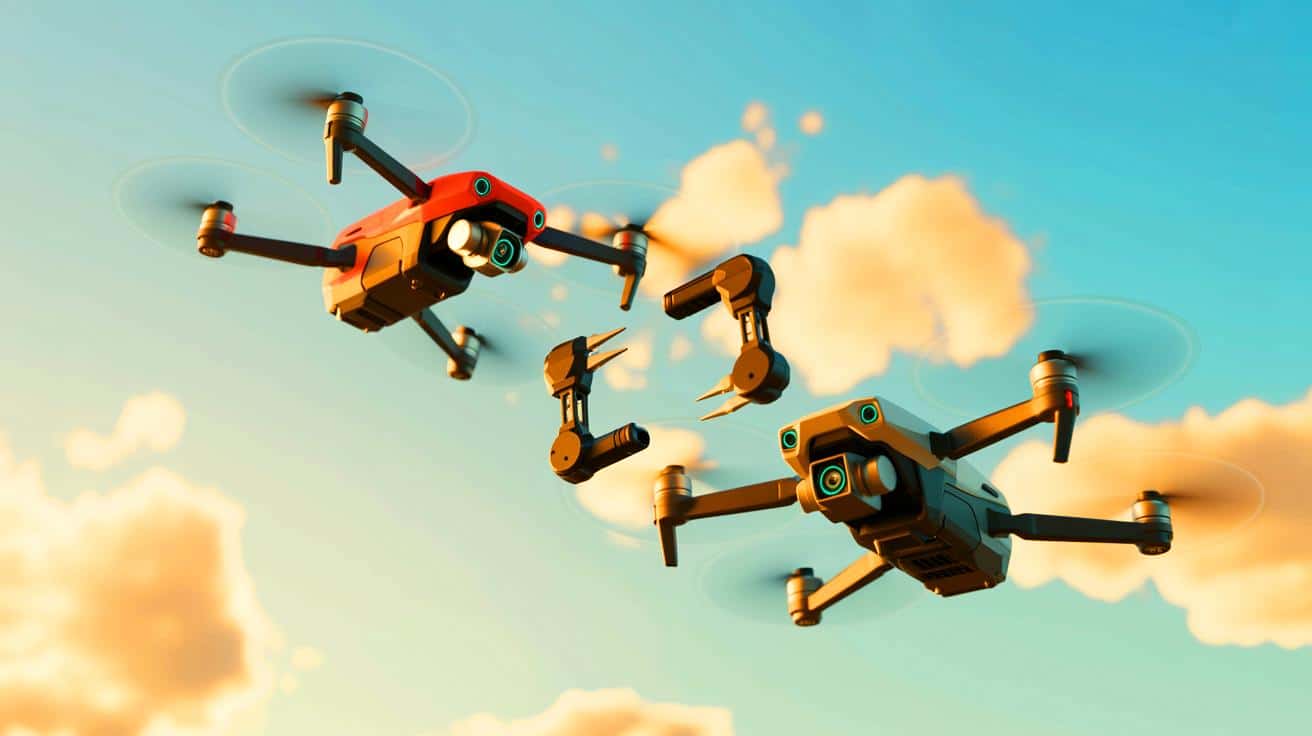
The FlyingToolbox system addresses the downwash issue by utilizing a combination of two types of drones. The lower drone, referred to as the “toolbox drone,” carries various tools. Meanwhile, the upper “manipulator drone” employs a robotic arm to pick up and return tools mid-flight. This setup mimics the coordinated efforts of a surgeon and nurse exchanging instruments during surgery.
To ensure stability and precision, the system incorporates real-time airflow prediction, magnetic docking mechanisms, and onboard visual tracking. A sophisticated neural network predicts the downwash’s strength and direction, allowing the lower drone to adjust its position automatically. Additionally, QR code tracking helps the drones align with sub-centimeter precision, even when navigating turbulent air.
Precision and Reliability Achieved
In a series of experiments, the drones demonstrated impressive precision with an average docking accuracy of less than one centimeter. The tests involved 20 consecutive dockings, all successfully completed despite the presence of strong airflows. The design also facilitated multi-stage tool-switching sequences performed by multiple drones hovering closely together.
The docking mechanism is a critical component of the system’s success. The manipulator drone’s arm features a cavity with an embedded metal plate, while the toolbox drone has conical magnetic connectors mounted on elastic cords. When the two drones align, the magnets automatically engage, and the elastic cords absorb minor alignment errors. These advancements represent a significant improvement over previous aerial docking systems, which typically achieved accuracies of six to eight centimeters. The Westlake team’s approach offers a level of control and repeatability that could enable drones to undertake more complex collaborative missions in the future.
Expanding the Scope of Drone Applications
The FlyingToolbox system exemplifies how drones can progress beyond simple inspection or filming roles to perform actual aerial work. These flying manipulators could be deployed in environments where sending humans would be dangerous, such as disaster zones, high-rise maintenance, or industrial inspections. While current testing has been limited to controlled indoor environments, the researchers plan to adapt the system for outdoor use. Efforts are underway to develop robotic arms with more degrees of freedom and improved perception systems to handle more complicated manipulations.
The team believes this progress could transform how drones are used for cooperative tasks. By enabling them to share tools and divide labor, drones could function as coordinated aerial workforces capable of executing missions far beyond their individual capabilities.
The Future of Collaborative Drone Missions
The study, published in the journal Nature, highlights the potential for drones to revolutionize various industries through cooperative missions. The ability to perform complex tasks autonomously opens new possibilities for the application of drone technology. As the researchers continue to refine and adapt the FlyingToolbox system for more diverse environments, the potential for drones to perform tasks traditionally reserved for humans becomes increasingly plausible.
As innovation in drone technology continues to accelerate, it raises intriguing questions about the future of work and the role of automation. How might these advancements impact industries reliant on manual labor, and what new opportunities could emerge from the integration of collaborative drone systems?


Wow, this is like something out of a sci-fi movie! Can’t wait to see these drones in action. 🚁
Wow, these drones are like something out of a sci-fi movie! 🚀
How reliable is the real-time airflow prediction system? 🤔
How do they ensure the drones don’t crash into each other while swapping tools?
Can these drones be used for delivering pizzas mid-air? 🍕😂
This is amazing! But how safe is it really to have drones swapping tools in the sky?
This is amazing! But what happens if the neural network fails or makes an error?
Impressive technology! But what about the energy consumption? Does it drain the battery too fast?
Are they planning to use this technology for medical purposes, like surgeries?
I’ve always thought drones were noisy. Does this system make them even louder? 🤨
Thank you for this insightful article! It’s fascinating to see how far drone technology has come.
So cool, but I hope these drones have a good battery life. Nothing worse than a drone running out of juice mid-task. 😂
Could this be the end of human jobs in aerial maintenance? 😟