





| IN A NUTSHELL |
|
In a groundbreaking development, Chinese scientists have pioneered a method to control bees using ultra-light electronic chips. This fusion of biology and technology allows these “cyborg bees” to map and monitor environments in ways previously thought impossible. While this innovation promises new possibilities in exploration and surveillance, it also raises ethical concerns about animal bio-control and the limits of scientific research. As technology continues to blur the lines between nature and machines, questions about the ethical implications and potential impacts on natural ecosystems become more pressing. How far can we push the boundaries of bio-technology before stepping into morally ambiguous territory?
Innovative Technology: Controlling Bees with Ultra-Light Chips
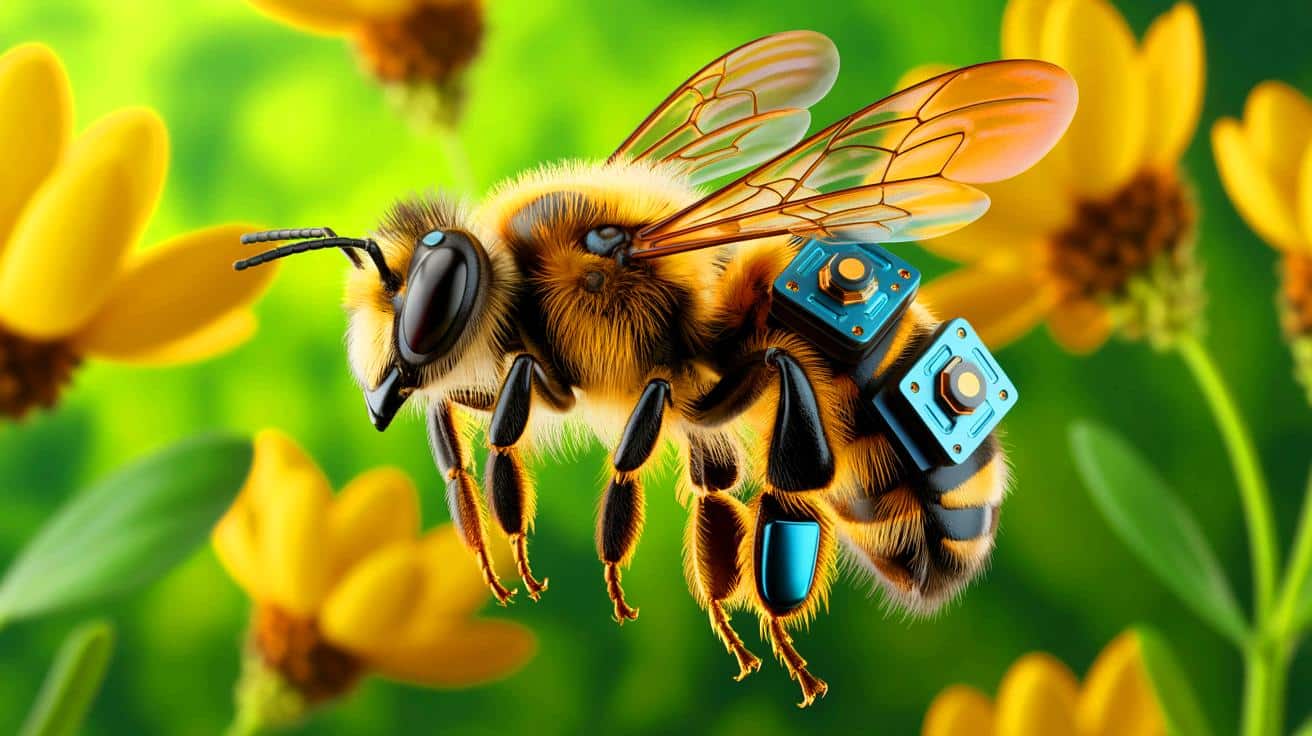
Imagine a bee, not just collecting nectar, but actively mapping a disaster zone on command. This is the reality in China, where scientists have successfully directed bees remotely using ultra-light chips. The challenge was immense: attaching an electronic device to a bee without hindering its flight. The solution came in the form of a flexible printed circuit weighing just 74 milligrams, developed at the Beijing Institute of Technology. This weight is less than that of a grain of rice, ensuring that the bees remain unhindered in their natural flight patterns.
The technological marvel connects to the bee’s brain via three micro-needles, which send electrical signals that mimic the natural ones received by the insect. As a result, in 90 percent of cases, the bees follow the given commands, performing actions like turning, reversing, and accelerating. Compared to earlier experiments on cockroaches, the bees maintain their agility, speed, and lightness. This technological advancement not only showcases the potential of microelectronics but also highlights the seamless integration of technology with biological systems.
Bees: The Perfect Explorers Where Drones Fail
Why bees? These insects are extraordinary biological machines. They can fly several miles, carry up to 80 percent of their body weight, and maneuver through tight spaces. This makes them ideal candidates for exploration and rescue missions in areas inaccessible to conventional drones. The Chinese device surpasses previous attempts, such as the Singaporean prototype, which was three times heavier and forced insects to crawl. The chip’s thinness allows it to mimic the wing’s flexibility, and it even includes an infrared receiver for wireless command transmission.
This innovation means that bees can literally “receive” light-based orders, offering a more dynamic and versatile approach to mapping and surveillance. The ability to navigate through debris, enter collapsed buildings, or survey urban environments undetected provides a strategic advantage that traditional drones cannot match. As technology evolves, the use of bees for exploration and surveillance could revolutionize how we approach disaster management and urban planning.
Elon Musk Claims AI Will End Work and Poverty: Can We Trust His Vision for Our Future?
Ethical Dilemmas: Bioethics, Manipulation, and Surveillance
The potential applications of cyborg bees are vast, from mapping collapsed buildings to detecting heat pockets and discreet urban surveillance. However, these possibilities come with ethical dilemmas. Transforming an animal into a tool blurs the line between scientific innovation and manipulation. The Chinese team claims that the bees do not suffer and return to their normal lives post-experimentation. Yet, the balance between innovation and intrusion remains fragile. As with many military technologies adapted for civilian use, moral boundaries are quickly shifting.
The ethical considerations extend beyond the immediate implications for the bees. There is a broader dialogue about the role of living organisms in technological applications and the potential consequences on ecosystems. As scientists push the limits of what is possible, society must grapple with the ethical responsibilities that accompany such advancements.
A Paradigm Shift: Nature as the Intelligent Sensor
This development signals a paradigm shift. No longer are robots merely imitating life; life itself is becoming a platform for robotics. Imagine a swarm of cyborg bees modeling city pollution in real time or searching for survivors in earthquake rubble. Nature becomes an intelligent sensor, more efficient, agile, and energy-efficient than traditional drones. The success of Chinese researchers marks a global first and serves as a signal that the boundary between nature and machine is dissolving.
This shift challenges our understanding of what it means to “control” a living organism. As the lines blur, the implications for future technological applications and the natural world must be carefully considered. How will these advancements shape our cities, ecosystems, and ethical frameworks in the years to come?
The integration of technology and nature presents both exciting possibilities and complex ethical challenges. With cyborg bees leading the way, the potential for innovation in urban planning, disaster response, and environmental monitoring is vast. However, as we navigate this new frontier, society must carefully consider the ethical implications and potential impacts on the natural world. What responsibilities do we hold as we continue to merge the boundaries between the biological and the technological?

Wow, cyborg bees! What’s next, robotic butterflies? 🦋
Wow, cyborg bees sound like something out of a sci-fi movie! How do they even work? 🤖🐝
I’m impressed by the innovation, but aren’t we playing god a bit too much here?
This is fascinating but also a bit scary. Are there any risks of these bees going rogue?
Thank you for highlighting the ethical questions. It’s important to consider all angles! 😊
This sounds like something out of a sci-fi movie. Are we sure it’s real?
Thanks for the article! It’s amazing to see how technology can aid urban planning.
Great article! I wonder how these bees will impact natural ecosystems?
Not sure how I feel about manipulating animals for technology. Isn’t this a bit unethical?
How do they ensure the bees don’t suffer? I’m really curious about that part.
These bees could be a game-changer for urban mapping! But at what cost?
Can these bees really replace drones in surveillance missions? Seems like a stretch.
I’m all for innovation, but this feels a bit Black Mirror-esque. 😬
I’m in awe of the technological advancements! Go China! 🚀
What happens to the bees after the experiment? Do they continue their normal lives?