





| IN A NUTSHELL |
|
During the tumultuous years of World War II, the Soviet Union embarked on a daring military experiment that intertwined technological ambition with strategic necessity. The concept was audacious: to deploy tanks onto the battlefield, not by the traditional ground routes, but through the sky. This led to the creation of the Antonov A-40 “flying tank,” a concept that, despite its ingenuity, proved to be more of a spectacle than a practical solution. The endeavor was representative of a period when military innovation often outpaced operational logic, leaving behind a legacy that is both fascinating and cautionary.
The Soviet Quest for Airborne Armor
In the 1930s and 1940s, Soviet military strategists faced a daunting challenge: how to swiftly transport light tanks to the front lines without relying on long ground journeys fraught with risks like ambushes, mechanical failures, and strategic delays. The skies seemed to offer a solution. Initially, the Soviets experimented with suspending ultra-light tanks, such as the T-27, beneath massive Tupolev TB-3 bombers. However, this approach was fraught with issues. The aircraft were vulnerable to enemy fire, the tanks were ineffective in combat, and parachuting crews separately posed significant risks of disorientation and delayed deployment.
As traditional methods proved inadequate, a more radical idea emerged: transform the tank itself into a glider, equipped with wings and a tail. This concept embodied the Soviet penchant for bold innovation, albeit with substantial technical and logistical challenges.
The Antonov A-40: A Flying Tank Experiment
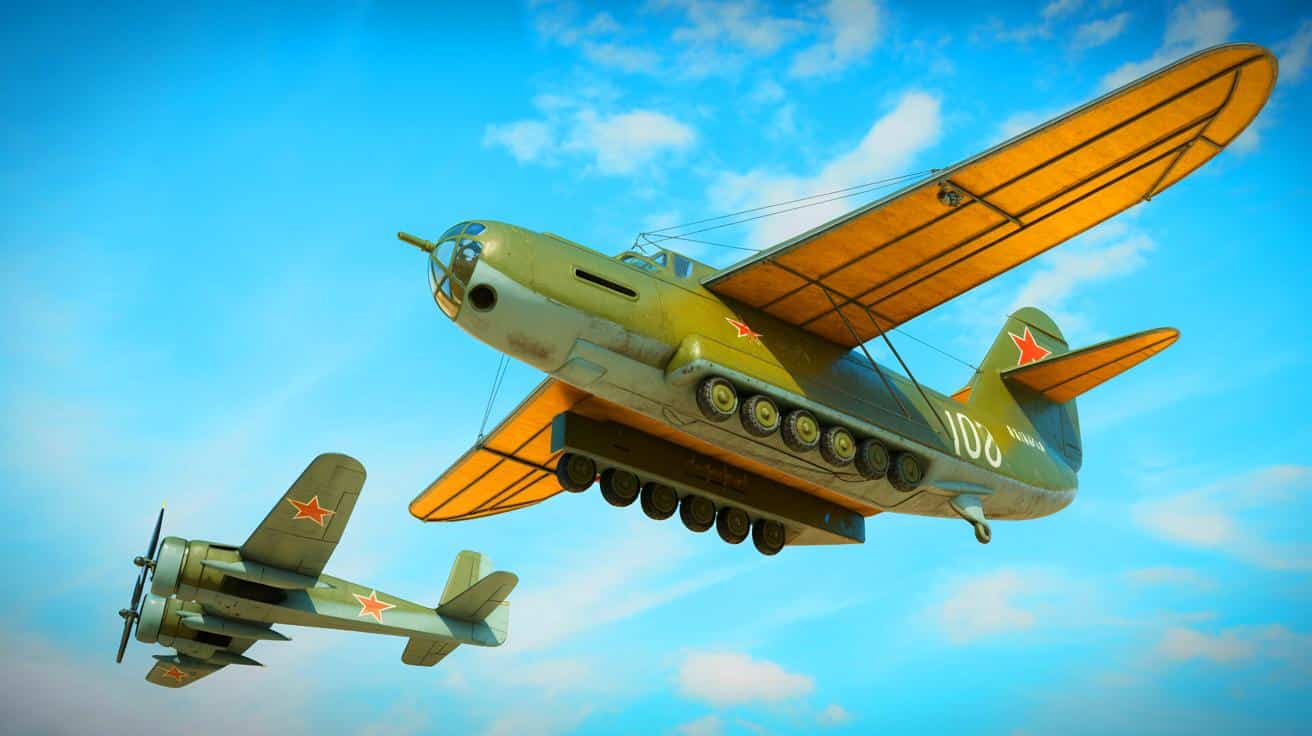
In 1942, Soviet engineers unveiled the Antonov A-40 Krylya Tanka, a striking hybrid of tank and glider. This remarkable vehicle was essentially a stripped-down T-60 tank, augmented with wooden wings spanning 59 feet and a stabilizing tail. Designed to be towed by a bomber and released mid-air, the A-40 was meant to glide seamlessly to the battlefield.
The maiden test flight occurred in September 1942, with a TB-3 bomber struggling to maintain speed while towing the tank. The A-40 was released prematurely, yet pilot Sergei Anokhin managed a successful landing in a field. He then detached the wings, started the engine, and drove back to base. Despite this technical success, the experiment was deemed militarily unviable. The tank had to be stripped of essential components, including ammunition and fuel, diminishing its combat effectiveness. Moreover, there was a scarcity of bombers capable of towing such a contraption, leading to the project’s abandonment after a single flight.
The Challenges and Legacy of Airborne Tanks
The Soviets were not alone in their pursuit of flying tanks. The United Kingdom also experimented with similar concepts, although with limited success. Across all attempts, the core issues remained: the lack of aerodynamics, excessive weight, and vulnerability of the vehicles. These projects reflect a unique period in military history, where the drive for innovative tactics often outpaced practical considerations.
The Antonov A-40 remains a fascinating artifact of military history, a singular example of a “flying tank” that actually took to the skies. Although the project did not lead to a viable military application, it serves as a testament to the extremes of wartime ingenuity and ambition. The A-40’s story is a reminder of how, in the throes of conflict, even the most outlandish ideas can be pursued in the quest for an advantage.
Lessons from the Era of Bold Military Experiments
The era of flying tanks is emblematic of a time when military innovation was driven by a desperate need for strategic superiority. These experiments, though ultimately unsuccessful, underscore the lengths to which nations will go to gain the upper hand in warfare. They also highlight the risks of prioritizing technological ambition over practical functionality.
Today, the A-40 stands as a historical curiosity, illustrating the allure and perils of revolutionary military concepts. It prompts reflection on the balance between innovation and feasibility, a balance that remains crucial in contemporary military strategy. As we consider modern advancements, from autonomous drones to cyber warfare, the lessons of the A-40 remind us to weigh bold ideas against their operational viability.
Reflecting on the audacious yet impractical endeavor of the flying tank, we are left to ponder the future of military innovation. How can modern military strategists balance the pursuit of cutting-edge technology with the need for practical and sustainable solutions on the battlefield?

Wow, a tank that flies! What will they think of next? 🚀
Fascinant article! Les soviétiques étaient vraiment audacieux avec leurs “tanks volants” 😂
Pourquoi n’ont-ils pas essayé de rendre le tank plus léger au lieu de le transformer en planeur ? 🤔
Merci pour cet article fascinant, je n’avais jamais entendu parler du Antonov A-40 avant !
J’ai toujours cru que les tanks volants étaient une légende urbaine. Merci pour cet éclairage historique.
L’idée des tanks volants est géniale mais tellement impraticable ! 😅
Is it just me, or does the idea of a flying tank sound like something out of a science fiction movie?
Pourquoi les soviétiques n’ont-ils pas poursuivi ce projet après la guerre ?
Imaginez le choc des ennemis en voyant un tank descendre du ciel 😅
La tentative de combiner char et planeur semble un peu tirée par les cheveux. Un vrai défi logistique !
Même si le projet a échoué, il montre bien l’ingéniosité humaine face aux défis de la guerre.
La logistique devait être un cauchemar pour ces projets, non ?
Les soviétiques avaient vraiment des idées hors du commun pour l’époque.
Je me demande si d’autres nations ont tenté quelque chose de similaire après la guerre ?
Quelle audace d’avoir essayé de faire voler un tank ! Mais était-ce vraiment nécessaire ?
Je n’aurais jamais cru que quelque chose d’aussi fou aurait été tenté en temps de guerre ! 😲