





| IN A NUTSHELL |
|
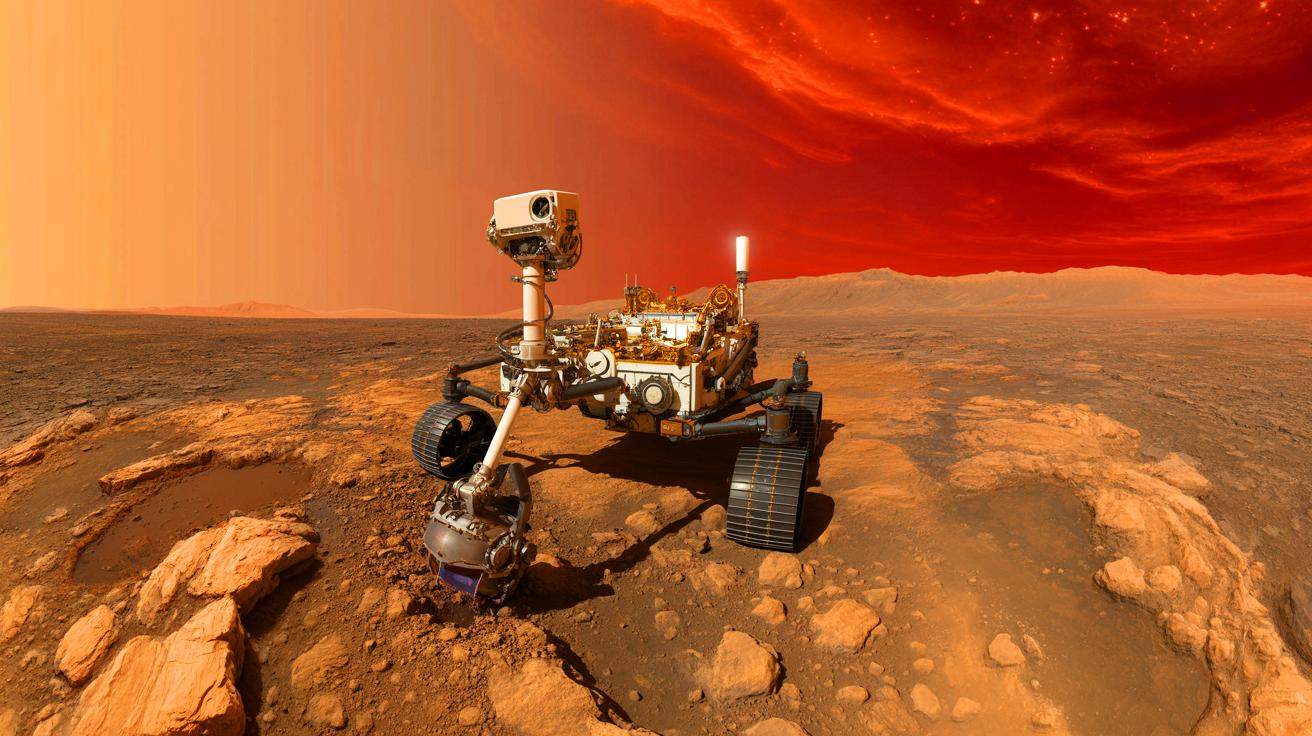
The discovery of potential signs of ancient microbial life on Mars has sparked intrigue and debate within the scientific community. NASA’s Perseverance rover, exploring the Jezero Crater, has collected a sample that may contain evidence of past life. This discovery, if validated, might support the “Great Filter” theory, which posits that intelligent life is rare or doomed to extinction. Such a finding could reshape our understanding of life’s existence in the universe. Yet, scientists urge caution, as further analysis is necessary to confirm these preliminary findings.
Examining the Sample from Jezero Crater
NASA’s Perseverance rover has made a potentially groundbreaking discovery by collecting a sample from the Jezero Crater on Mars. The sample, named “Sapphire Canyon,” was extracted from a region known as the Bright Angel formation. This area is of particular interest due to the presence of two unusual minerals: vivianite and greigite. Vivianite is a phosphate of iron, while greigite is a sulfide of iron. Both of these minerals could hint at the presence of ancient microbial life.
According to Joel Hurowitz, a planetary scientist at Stony Brook University and the lead author of the study published in Nature, the presence of these minerals may result from chemical interactions between sediments and organic matter. These interactions are similar to those observed on Earth in environments where microbes are present. On our planet, microorganisms consume organic matter, producing vivianite and greigite as metabolic byproducts. This parallel raises intriguing questions about the potential for life beyond Earth.
Potential Implications of the Discovery
The presence of vivianite and greigite in the Jezero Crater sample could have profound implications for our understanding of life in the universe. If these minerals were indeed formed through biological processes, it would suggest that life may have once existed on Mars. This discovery would not only provide insights into the history of Mars but also offer a new perspective on the conditions necessary for life.
However, the possibility of purely chemical processes explaining the formation of these minerals cannot be ruled out. Planetary scientists emphasize the importance of maintaining scientific rigor and caution. A definitive answer requires further analysis, ideally conducted in laboratories on Earth. The potential for contamination and the limitations of current technology necessitate a careful approach to interpreting these findings.
The “Great Filter” Theory and Its Relevance
The potential discovery of ancient life on Mars brings the “Great Filter” theory into the spotlight. This theory suggests that the development or survival of intelligent life is exceedingly rare or fraught with obstacles. If life once existed on Mars but failed to persist, it could imply that the path to intelligent life is riddled with challenges. This notion could have profound implications for humanity’s future and our place in the cosmos.
Understanding where the “Great Filter” lies is crucial. If it occurs after the emergence of intelligent life, Earth’s civilizations might face existential risks. Conversely, if the filter is before intelligent life, the universe could be teeming with simple life forms. The discovery of ancient microbial life on Mars could provide valuable clues about the likelihood of intelligent life elsewhere in the universe.
The Need for Further Exploration and Analysis
While the findings from Perseverance’s sample are promising, the scientific community agrees that more research is needed. Bringing samples back to Earth for detailed analysis could provide definitive answers. Such missions are challenging and require substantial resources, but they are essential for advancing our understanding of Mars and the potential for life beyond Earth.
International collaboration and investment in space exploration will be crucial for future discoveries. As technology advances, the ability to conduct more comprehensive analyses and explore more distant regions of the solar system will enhance our knowledge. The pursuit of these goals not only satisfies human curiosity but also holds the potential to answer fundamental questions about our existence.
The discovery of potential signs of life on Mars is a tantalizing prospect that challenges our understanding of life’s prevalence in the universe. As scientists continue to analyze the data and plan future missions, the question remains: Are we alone in the universe, or is life a common occurrence awaiting discovery?

Wow, life on Mars! This changes everything! 😊
Wow, ça c’est une découverte incroyable! Est-ce que ça veut dire qu’un jour on pourra rencontrer des petits hommes verts? 👽
Je reste sceptique. Ça pourrait juste être des processus chimiques qu’on ne comprend pas encore bien.
How reliable are the findings? Could it just be a chemical reaction? 🤔
Super article! Merci de nous tenir informés des dernières découvertes spatiales. 🚀
Finally, some good news from space exploration! Thanks, NASA!
Les micro-organismes martiens, c’est peut-être la clé pour comprendre notre propre origine. Fascinant! 🤔
Quelles sont les prochaines étapes pour confirmer ces découvertes? J’espère que la NASA a un plan!
Est-ce que ça veut dire qu’on va bientôt coloniser Mars ? 😄
J’ai toujours su qu’on n’est pas seuls dans l’univers. C’est juste une question de temps avant qu’on trouve quelque chose de plus grand. 🌌
Je suis sceptique. On a déjà eu des fausses alertes par le passé.
Je me demande si ces découvertes influenceront les théories actuelles sur la vie extraterrestre.