






| IN A NUTSHELL |
|
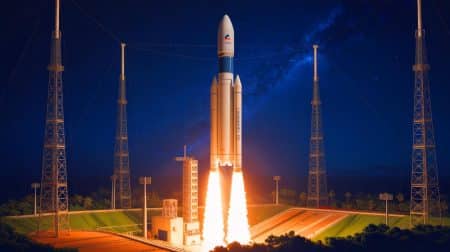
In a remarkable achievement for SpaceX, the eleventh test flight of its Starship rocket was successfully completed on October 13. This marks the second consecutive successful test for the massive spacecraft, a crucial step for the ambitious program. The launch took place at the Starbase site in South Texas, with the rocket soaring to new heights and achieving all its objectives. Both the Super Heavy booster and the Starship upper stage were able to execute splashdowns in the Gulf of Mexico and the Indian Ocean, respectively. This accomplishment signifies a major milestone as SpaceX prepares for the next generation of its Starship vehicles.
Key Milestones Achieved
The recent test flight of SpaceX’s Starship achieved several critical milestones that are instrumental for its future missions. The journey began with the ignition of all 33 Raptor engines on the Super Heavy booster, marking a significant achievement in itself. Following this, the Starship upper stage conducted a hot-staging maneuver, where its six Raptor engines were ignited to propel the spacecraft further into space. This complex sequence demonstrated the vehicle’s ability to transition smoothly between stages.
After stage separation, the Super Heavy booster executed a boostback burn using 12 out of its 13 planned engines. This maneuver guided it to a predetermined splashdown location off the coast of Texas. In addition to these feats, the Starship upper stage successfully performed a deorbit burn, relighting a Raptor engine for the third time while in space. This capability is vital for future missions, as it allows for precise control of the spacecraft’s return trajectory. Furthermore, the deployment of eight Starlink dummy payloads showcased the rocket’s potential for carrying substantial cargo.
Focus Shifts to Future Variants
With the successful completion of the eleventh test flight, SpaceX is now shifting its focus to the development of future Starship variants. These new models are at the core of CEO Elon Musk’s vision to establish a human settlement on Mars. Additionally, NASA has selected the Starship to be the first crewed lander for the Artemis 3 mission, which aims to return humans to the Moon in 2027.
Despite the recent triumphs, the Starship program has faced its share of challenges. Earlier in the year, three consecutive test flights ended in failure, with the upper stage being lost prematurely. However, SpaceX has continued to innovate, with the next version of the Starship expected to be taller than the current 403-foot model. Version 3 is projected to reach approximately 408 feet, while a future variant, teased by Musk, could stand at a towering 466 feet. This new version will also feature an enhanced propulsion system with 42 Raptor engines, further extending its capabilities for deep-space missions.
Technological Innovations and Challenges
SpaceX’s Starship program represents a significant leap forward in space travel technology. The spacecraft’s ability to conduct complex maneuvers, such as the hot-staging and boostback burn, highlights the technological advancements being made. These innovations are critical for achieving SpaceX’s long-term goals of creating a fully reusable spacecraft capable of carrying humans and cargo to the Moon, Mars, and beyond.
However, the path to these achievements is not without its challenges. The development of such advanced technology requires rigorous testing and iteration. SpaceX has faced setbacks, such as the aforementioned failed test flights, which underscore the difficulties of developing a reusable spacecraft. Yet, these challenges are part of the iterative process that SpaceX embraces as it continues to refine and improve its Starship design.
The Road Ahead for SpaceX
Looking forward, SpaceX is preparing for the next phase of its Starship program, which includes orbital flights and operational missions. The company is actively building multiple vehicles to be tested in the coming months. These iterations will play a pivotal role in achieving a fully reusable spacecraft, capable of servicing Earth orbit, lunar missions, and eventually, Mars expeditions.
Elon Musk, who witnessed the recent test launch, expressed his enthusiasm for the program’s progress. The innovations and achievements of the Starship program are not only paving the way for future space exploration but also opening new possibilities for human settlement beyond Earth. As SpaceX continues to push the boundaries of technology, the question remains: How will these advancements shape the future of space travel and exploration?

Wow, this is huge! 🚀 How soon can we expect trips to Mars?
Wow, this is incredible news! 🚀 Can’t wait to see what’s next for SpaceX and Mars!
How long until we see humans on Mars, realistically?
Finally, something worked as planned! 😂
Elon Musk is truly a visionary. Thank you SpaceX for pushing the boundaries!
I’m still skeptical. Space travel is so unpredictable, anything could go wrong. 🤔
Does this mean we can start booking tickets to Mars soon? Asking for a friend.
This is a huge achievement! Congrats to the SpaceX team! 🎉
How does the hot-staging maneuver work exactly? Fascinating stuff!
When’s the next test flight scheduled? Can’t wait to watch it live!
Did anyone else read this and think of all the sci-fi movies coming to life?
Great job SpaceX! Keep pushing the boundaries. 👏
I wonder what the environmental impact of these launches is… 🤔
Not to be a skeptic, but how sustainable are these missions in the long run?
Great article! Keep us updated on SpaceX’s progress!
Does this mean we might see a Mars colony in our lifetime?
Elon is really making sci-fi a reality. Love it! 🤖
Is it just me, or does 466 feet sound absolutely massive? 😮