





| IN A NUTSHELL |
|
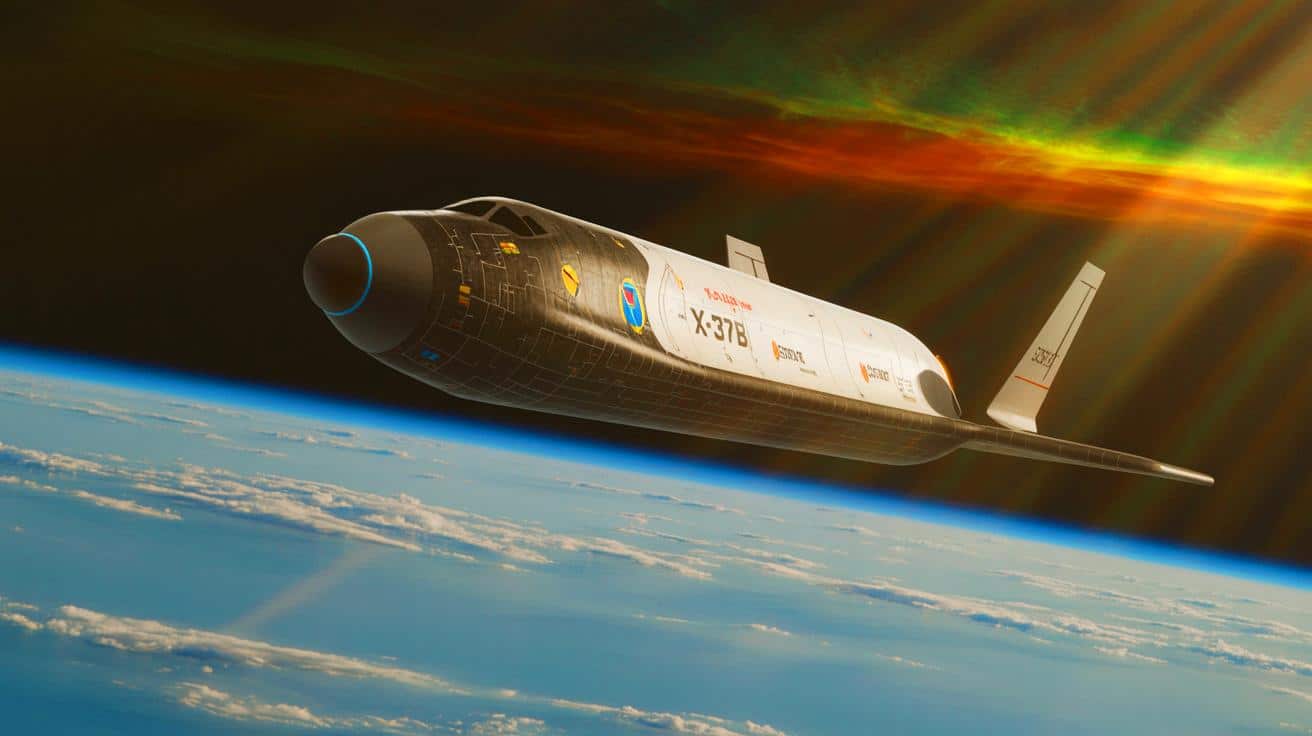
The U.S. military’s X-37B spaceplane recently completed a significant mission, marking another milestone in its operational history. This uncrewed, reusable vehicle, developed by Boeing, landed at NASA’s Kennedy Space Center after spending 908 days in orbit. The mission, known as OTV-6, was the longest yet for the X-37B. The Pentagon has been notably reticent about the details of its payloads. However, the mission involved several government-led studies, showcasing the increasing role of space technology in national security and scientific exploration. The spaceplane’s capacity to transport and test emerging technologies in orbit represents a crucial step forward in space experimentation.
The X-37B’s Design and Purpose
The X-37B, often compared to NASA’s retired Space Shuttle, stands out due to its smaller size and distinct purpose. Unlike its predecessor, the X-37B is not designed to carry humans. Instead, it features a payload bay comparable in size to a pickup truck, facilitating unmanned experiments and technology demonstrations. This design allows it to return data and research objects to Earth, aiding scientists and engineers in further analysis.
During its recent mission, the spaceplane for the first time carried a service module, enabling it to host more experiments than previous flights. This addition underscores the vehicle’s adaptability and its capacity to support various experimental payloads. Such capabilities highlight the strategic advantage of the X-37B in advancing military and scientific research.
These missions are pivotal as they enable the testing of new technologies in space, a domain increasingly viewed as a critical frontier for national security. The vehicle’s propulsion capabilities allow it to alter its orbit, offering flexibility in testing and potential applications in satellite maintenance or repositioning.
Significant Achievements and Implications
The X-37B’s latest mission achieved several milestones, including the longest duration in orbit and carrying the most payloads to date. One of the mission’s notable accomplishments was the demonstration of a space-based solar power transmission system. This experiment, conducted by the Naval Research Laboratory, involved the Photovoltaic Radio-Frequency Antenna Module (PRAM).
The PRAM experiment focused on converting solar energy into a radio frequency microwave beam, which could potentially transmit power to Earth. This breakthrough has significant implications for the National Security Strategy and National Defense Strategy, particularly concerning clean energy initiatives. If operationalized, this technology could provide alternative energy sources for military operations, especially in remote or challenging environments.
The success of this mission also aligns with broader governmental goals of exploring sustainable energy solutions, potentially giving the U.S. an edge in space-based energy technology. The experiment’s success marks a significant step forward in developing space-qualified technologies that could transform future military and civilian applications.
The Educational and Research Contributions
Beyond its technological advancements, the X-37B mission supported educational and research initiatives. The spaceplane delivered the Air Force Academy’s Falcon-SAT-8 into orbit, providing valuable training opportunities for future Space Force guardians. This satellite remains operational, offering hands-on learning experiences in spacecraft design and operations.
Additionally, NASA experiments conducted during the mission examined the effects of long-duration space exposure on seeds. This research aims to inform future crop production strategies for potential permanently inhabited bases in space. Such studies are crucial as they lay the groundwork for sustaining human life beyond Earth.
NASA’s Materials Exposure and Technology Innovation in Space (METIS-2) experiment was also part of the mission. It provided data to help scientists understand how space environments affect various materials. This information is essential for developing durable materials for spacecraft and other space applications, ensuring the longevity and safety of future missions.
International and Strategic Considerations
The developments surrounding the X-37B have not gone unnoticed internationally, particularly by nations like China, which are also advancing their space technologies. The Pentagon’s focus on the X-37B underscores the strategic importance of space as a domain for future military operations.
While the spaceplane’s capabilities may suggest potential offensive applications, experts argue that its primary role remains experimental. The U.S. military’s emphasis on testing and developing space technologies aligns with its broader defense strategy, which views space as a critical frontier for maintaining national security.
Despite the speculation about its potential as a space weapon, there is no indication that the X-37B is being developed for offensive purposes. Instead, the focus remains on using its capabilities to enhance technological readiness and support defensive and exploratory missions in space.
The X-37B spaceplane continues to push the boundaries of space technology and experimentation. As the latest mission concludes, questions remain about the future of this program and its potential applications. How might the advancements made by the X-37B influence future space exploration and military strategy in an increasingly competitive space environment?

Wow, 908 days in space! What kind of snacks do you think the X-37B had onboard? 🍕😄
Wow, 908 days in space! Does this mean we finally have a solar power solution for Earth? 🌞
I’m a bit skeptical about the whole “secret mission” angle. Why not be more transparent?
It’s amazing what space technology can achieve. Thanks for sharing such an informative article!
Interesting read! Thanks for sharing this fascinating piece of technology news. 😊
So, when do we get our hands on space-based solar power? It sounds too good to be true.
Quelqu’un a-t-il des détails sur le coût de cette mission ?
Isn’t it risky to keep such technology so secretive? What if it falls into the wrong hands?
Another step towards a sci-fi future! Can’t wait to see what they come up with next. 🚀
Space-based solar power sounds like science fiction. How realistic is it really?
Typo alert! I think you meant “complète” instead of “completed” in the first paragraph.
This is both exciting and terrifying at the same time. The future is here!
Interesting read, but I wonder how this impacts international relations, especially with China.
How do they plan to use this technology for military purposes? It’s a bit concerning.
Finally, some good news about renewable energy! 🌍
Are we sure there’s no little green man hiding in the X-37B? 👽
I’m all for scientific advancements, but shouldn’t there be more public oversight?
Did anyone else notice the similarity to the “Space Shuttle”? Nostalgia hit hard!
This could change everything we know about energy consumption.
Are there any plans to share this technology with other countries?
Honestly, I’m a bit worried about the military implications of this.
Feels like we’re entering a new space race. Who will win this time?
Thank you for the detailed breakdown of the mission. Really enlightening!
Is it just me, or does this sound like something out of a sci-fi movie? 😄
What are the ethical implications of using space for military advantage?
The future of energy looks bright, literally! 🌞
Can’t wait to see the next mission’s results. Keep up the great work!
How long before we see commercial applications of this technology?
This is a game changer for renewable energy! 👏
Is there any way the public can get involved or learn more about this project?
Why keep these advancements so secretive if they’re for the greater good?
I’m impressed by the potential, but where do we draw the line?
What happens if this technology is weaponized? That’s a scary thought.
How does this affect the current energy market? Big changes ahead?
Why isn’t there more media coverage on this incredible achievement?
With such potential, this could be a major turning point for humanity. 🌍
Merci pour cet article! J’ai appris beaucoup de choses sur cette technologie spatiale.
Isn’t it ironic that we’re using military tech for energy solutions? 🤔
How does this compare to other countries’ space programs?
I’m excited to see what this means for future space exploration missions!
The X-37B is like the underdog of spacecraft, always surprising us!
Could this lead to new jobs in the space industry? That would be amazing! 🌌
What’s the timeline for making this technology available to the public?
I hope this leads to more peaceful applications rather than military ones.
Does this mean we’re one step closer to colonizing other planets? 🚀