





| IN A NUTSHELL |
|
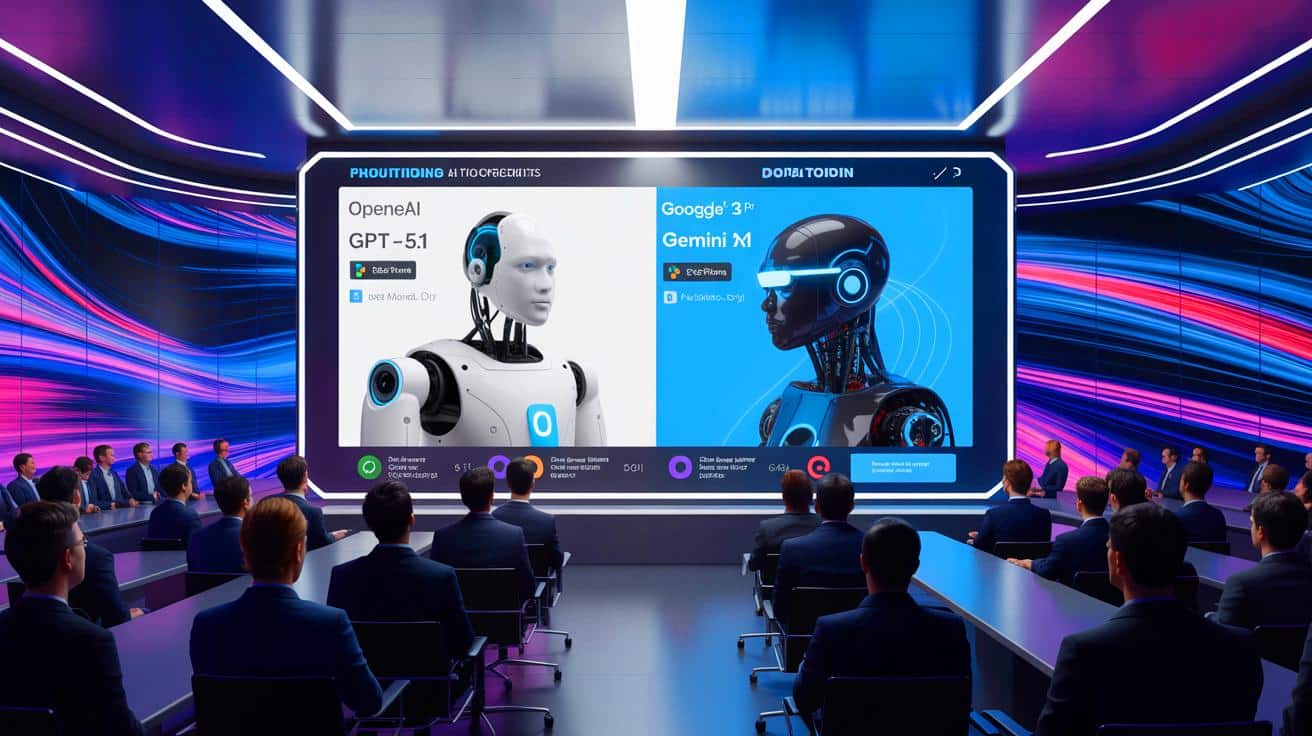
In the ever-evolving landscape of artificial intelligence, major players like Google and OpenAI are locked in a battle for dominance. The recent release of Google’s Gemini 3 Pro has set a high standard, capturing the public’s attention with its seamless integration across Google’s services. Not to be outdone, OpenAI has responded with its own high-end offerings, GPT-5.1-Pro and GPT-5.1-Codex-Max, aimed at demanding professionals. These new models are designed to showcase OpenAI’s commitment to innovation and performance in specialized AI applications. The contest between these tech giants highlights a critical question: what do users truly need from AI?
Google’s Mainstream Advantage Meets OpenAI’s Specialized Approach
On November 18, 2025, Google unveiled its Gemini 3 Pro model, making a significant impact by incorporating it into all its services. This integration offers a seamless user experience, reinforcing Google’s position as a leader in consumer-friendly AI. OpenAI, however, launched GPT-5.1-Pro and GPT-5.1-Codex-Max a day later, targeting a different demographic: professionals who require powerful, specialized tools.
While Google focuses on broad accessibility with its integrated approach, OpenAI is betting on depth and specialization. The two companies are pursuing different strategies to capture the market. OpenAI’s models are designed to deliver high performance at a cost, appealing to users willing to invest in advanced capabilities. This strategic divergence raises questions about the future landscape of AI: will the market favor universal accessibility, or will specialized, high-performance tools prevail?
AI Receives One Million Suicidal Confessions Weekly, Revealing Deepening Struggles Within Humanity
GPT-5.1-Pro: A Powerhouse for Intensive Use
GPT-5.1-Pro is positioned as OpenAI’s flagship model, available through a ChatGPT Pro subscription priced at approximately $240 per month. Designed to succeed the previous GPT-5-Pro, it offers enhanced capabilities in reasoning, writing, scientific problem-solving, and business management. This model is not intended for casual users; it requires significant computational resources, but in return, provides superior analytical and generative quality.
The high price point reflects OpenAI’s target audience—those seeking top-tier AI performance. Despite its strengths, GPT-5.1-Pro faces a major challenge: Google’s Gemini 3 Pro is offered for free. This pricing disparity highlights a fundamental difference in business models. Google’s ability to integrate its AI across its services without additional costs underscores its control over its technological ecosystem, whereas OpenAI relies on external resources to deliver its premium models.
GPT-5.1-Codex-Max: Targeting Developers in a Competitive Landscape
“New model is out in Codex. Gets to same quality of solution faster and raises the ceiling for how complex of a tasks are achievable.”
GPT-5.1-Codex-Max represents a significant evolution in OpenAI’s toolkit for developers. This model is designed to compete with Google Antigravity and Anthropic’s Claude Code, both offering natural language coding environments. Codex-Max stands out by enabling autonomous coding sessions, database restructuring, and complex project management with minimal oversight.
One of its standout features is “compaction,” which allows the model to summarize its thought processes in real-time. This innovation results in an expanded context window and improved management of long projects, with a 30% reduction in computational tokens. For developers, these enhancements could be decisive in choosing OpenAI over its competitors. As AI continues to evolve, the ability to handle complex tasks efficiently is becoming increasingly crucial, particularly for those in tech development roles.
The Strategic Stakes in the AI Race
With GPT-5.1-Pro and Codex-Max, OpenAI is making a strategic statement: performance is at the core of its vision. Although Google has gained an edge in distribution and public image, OpenAI maintains a strong technical expertise. This rivalry has led to a segmented market: Google focuses on universal accessibility, while OpenAI emphasizes functional elitism.
Despite the impressive capabilities of these advanced models, most users do not require such extreme performance. The pursuit of AI power intrigues, yet everyday use often remains more modest. For businesses, researchers, and intensive coders, these tools herald a new era. The question is shifting from “who is the best?” to “which model is best suited for your needs?” This strategic competition not only pushes the boundaries of AI but also prompts users to assess their own requirements in this dynamic field.
As the AI sector continues to evolve, the competition between Google and OpenAI underscores the diverse needs of users across different domains. While Google’s approach aims to democratize AI access, OpenAI is carving out a niche with its high-end models. This ongoing battle raises important questions about the future of artificial intelligence: will the industry lean towards inclusivity and widespread access, or will the demand for specialization and high performance drive the next wave of innovation?



Wow, GPT-5.1-Pro sounds impressive! Can’t wait to see it in action. 😊
Wow, OpenAI is really stepping up its game! Can’t wait to see how GPT-5.1-Pro performs against Google’s Gemini 3 Pro. 🤖
Do you think the high price of GPT-5.1-Pro will deter potential users?
Are these models available globally, or is it limited to certain regions?
Finally, some serious competition in the AI space! This is going to be interesting. 😄
OpenAI better watch out; Google doesn’t play around. 😜
So, how does Codex-Max compare to Google’s Antigravity? Any developers here who have tried both?
Why is GPT-5.1-Pro so expensive compared to Google’s offerings?
I’m curious if GPT-5.1-Pro’s capabilities in scientific problem-solving are as good as they claim. Has anyone tested it yet?
Finally, some real competition for Google. Go OpenAI! 🎉
With all these new AI models, will there be enough power to run them? 😅
Codex-Max for developers? Sounds like a game-changer!
Thank you, OpenAI, for pushing the boundaries of what AI can do!
What are the hardware requirements for running GPT-5.1-Pro?