





| IN A NUTSHELL |
|
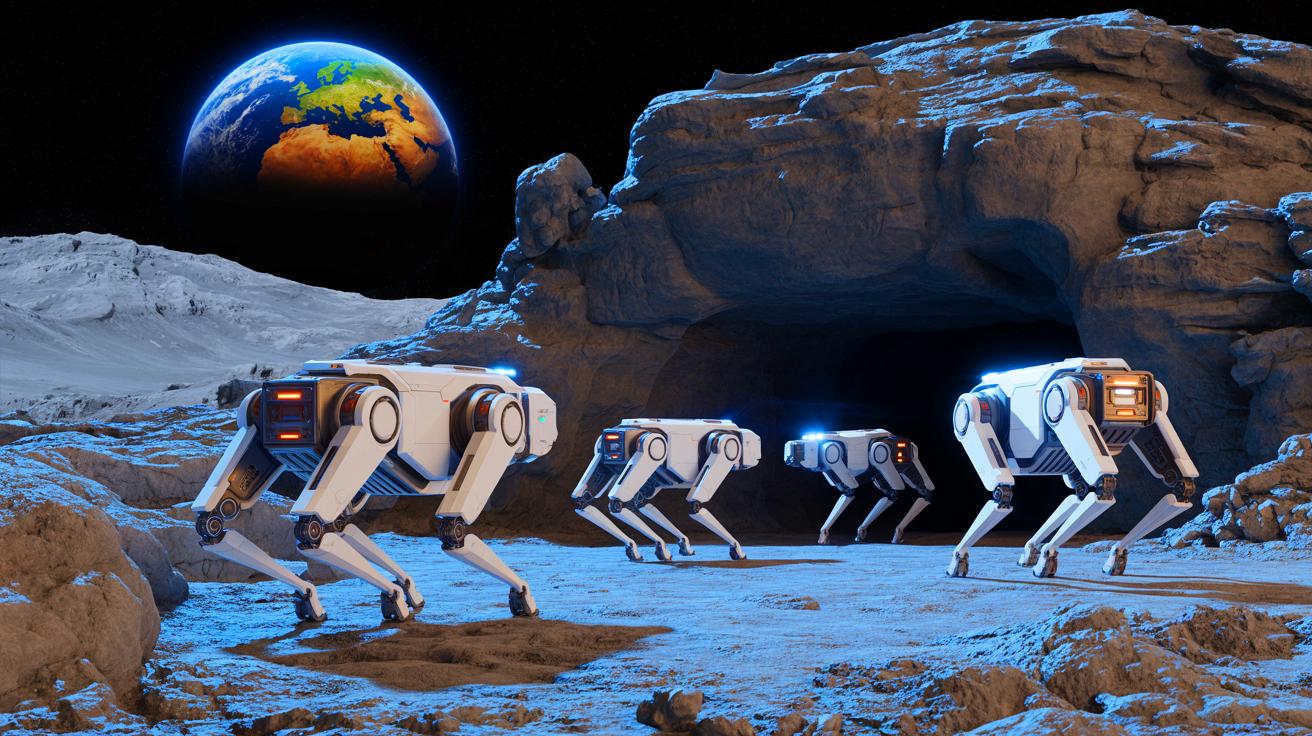
In a groundbreaking initiative, a team of researchers from Peking University is leading efforts to delve into the moon’s hidden secrets using innovative robotic technology. These robotic dogs, designed specifically for lunar exploration, represent a significant leap in space technology. They are intended to navigate and analyze lunar lava tubes—underground tunnels formed by ancient volcanic activity. These structures could potentially house future moon bases, offering protection from harsh conditions such as radiation and micrometeorites. Testing has already begun in a geologically similar cave near Jingbo Lake in China’s Heilongjiang province. This development not only signifies progress in space exploration but also in the field of robotics and artificial intelligence, promising new methods of exploring uncharted territories.
Robotic Pioneers for Lunar Exploration
The concept of using robotic dogs for lunar missions is a strategic response to the challenges posed by the moon’s environment. These robots are designed to serve as scouts in areas that are inaccessible or too hazardous for human explorers. According to Zhang Shanghang, a researcher involved in the project, these robotic explorers are equipped with autonomous navigation capabilities. This means they can move and make decisions independently, without the need for direct human control.
One of the standout features of these lunar robots is their ability to avoid obstacles. They are fitted with advanced sensors that allow them to detect and bypass potential hazards in their path. This functionality is crucial for navigating the uneven and unpredictable terrain of the moon’s lava tubes. Additionally, the robots are capable of 3D mapping, thanks to sophisticated onboard technology. This enables them to create detailed digital models of their surroundings, providing valuable data for researchers.
Furthermore, these robots incorporate embodied intelligence, blending physical movement with artificial intelligence. This allows them to adapt in real-time to the complex and changing lunar landscape, enhancing their effectiveness as exploratory tools.
Significance of Lunar Lava Tubes
Lunar lava tubes hold particular interest for scientists and space agencies because of their potential to support future human activity on the moon. These natural formations are seen as ideal locations for establishing moon bases. They offer natural shielding from the moon's harsh surface conditions, including extreme temperatures, micro-meteorite impacts, and harmful radiation. By exploring these structures, researchers hope to find viable sites for long-term human habitation.
The robotic dogs' mission is to navigate these tubes, assessing their size, condition, and suitability for future use. The information gathered by the robots will be instrumental in planning future lunar missions and the eventual establishment of a sustainable human presence on the moon. The use of robotic technology in this context underscores a shift towards more autonomous and technologically advanced methods of space exploration.
Testing and Development in Geosimilar Environments
The testing of these robotic dogs in a lava tube-like cave near Jingbo Lake is a crucial step in their development. This site was chosen because its geological features closely resemble those expected on the moon. By operating in this environment, researchers can evaluate the robots' capabilities and make necessary adjustments to enhance their performance.
According to a statement from a researcher affiliated with the Beijing Artificial Intelligence Research Institute, testing in such a realistic setting has been invaluable. It allows the team to refine the robotic technology, ensuring it is well-suited for the demands of lunar exploration. This real-world testing phase is essential for identifying potential challenges and iterating on solutions before deployment in space.
The insights gained from these trials will not only benefit lunar exploration but also have broader implications for the development of autonomous robotic systems. These advancements could pave the way for future missions to other celestial bodies, such as Mars, where similar exploratory challenges exist.
The Future of Lunar Exploration and Beyond
The deployment of robotic dogs on the moon is a promising development in the broader context of space exploration. As the international space community sets its sights on a return to the moon and beyond, technologies like these will play a crucial role. They offer a safer, more efficient means of exploration, reducing the risks associated with human space travel.
Moreover, the success of this initiative could spur further innovation in robotic and AI technologies. It highlights the potential for collaboration between different fields of research, leading to advancements that benefit not only space exploration but also other industries. As these technologies evolve, they may open new possibilities for exploring and understanding our universe.
Looking ahead, the question remains: How will the integration of advanced robotics and artificial intelligence continue to transform our approach to exploring the unknown reaches of space?


Wow, des chiens robots sur la Lune ? On dirait le début d’un film de science-fiction ! 😄
Wow, des chiens robots sur la lune ? C’est comme un épisode de Black Mirror ! 🐶🚀
Je me demande comment ces robots vont gérer les tempêtes de poussière lunaire. Est-ce qu’ils sont équipés pour ça ?
Comment ces robots sont-ils alimentés en énergie sur la lune ?
Superbe initiative, mais pourquoi des “chiens” robots et pas d’autres formes ? 🤔
Pourquoi utiliser des “chiens” robots plutôt que d’autres formes robotiques ? 🤔
C’est incroyable comment la technologie progresse si vite. Merci pour cet article fascinant !
Les avancées en IA sont incroyables. J’espère qu’ils trouveront des solutions pour notre planète aussi !
C’est fascinant, mais est-ce que ces robots coûteront moins cher que d’envoyer des astronautes ?
Je suis sceptique. Est-ce que ces robots sont vraiment prêts pour les conditions lunaires extrêmes ?
Les robots peuvent-ils résister aux températures extrêmes de la lune ?
Quel est le coût de ces missions robotiques pour explorer la lune ?
Est-ce que d’autres pays travaillent sur des technologies similaires ?
Les robots seront-ils capables de communiquer en temps réel avec les scientifiques sur Terre ?
Super article ! J’espère que nous verrons bientôt des bases lunaires grâce à ces avancées. 🌕
La lune n’a pas de fromage, mais elle a maintenant des chiens robots ! 🧀🐾
Quand prévoient-ils d’envoyer ces robots sur la lune ?
Est-ce que ces robots pourraient être utilisés pour explorer d’autres planètes comme Mars ?
Fascinant ! Ces robots pourraient-ils aussi aider à découvrir des ressources sur la lune ?
Est-ce que ces robots peuvent fonctionner pendant de longues périodes sans intervention humaine ?
Bravo à l’équipe de chercheurs pour cette innovation impressionnante !
Pourquoi ne pas envoyer des robots araignées à la place ? Ils pourraient grimper plus facilement.
Je me demande si ces robots pourraient trouver de l’eau dans les tubes de lave ? 💧
Les robots auront-ils un moyen de revenir à leur base s’ils se perdent ?
Est-ce que les chiens robots aboyeront s’ils trouvent quelque chose d’intéressant ? 😂
Merci pour l’article, c’est très instructif et prometteur pour l’avenir de l’exploration spatiale.
Les chiens robots se déplacent-ils plus vite que les rovers déjà sur la lune ?
Quelles sont les implications éthiques de l’utilisation de robots pour explorer l’espace ?
Ces robots sont-ils résistants aux impacts de micrométéorites ?
Espérons que ces robots ne deviennent pas fous là-haut… 😅
C’est génial de voir la Chine innover ainsi dans le domaine spatial !
La prochaine étape, des chats robots sur Mars ? 🐱🚀
Est-ce que ces robots peuvent envoyer des images en direct de la lune ?
Les robots ont-ils été testés dans des conditions simulant le vide spatial ?
Je suis impatient de voir ce que ces robots découvriront sur la lune !
Ces chiens robots pourraient-ils un jour aider à construire des bases lunaires ?