




| IN A NUTSHELL |
|
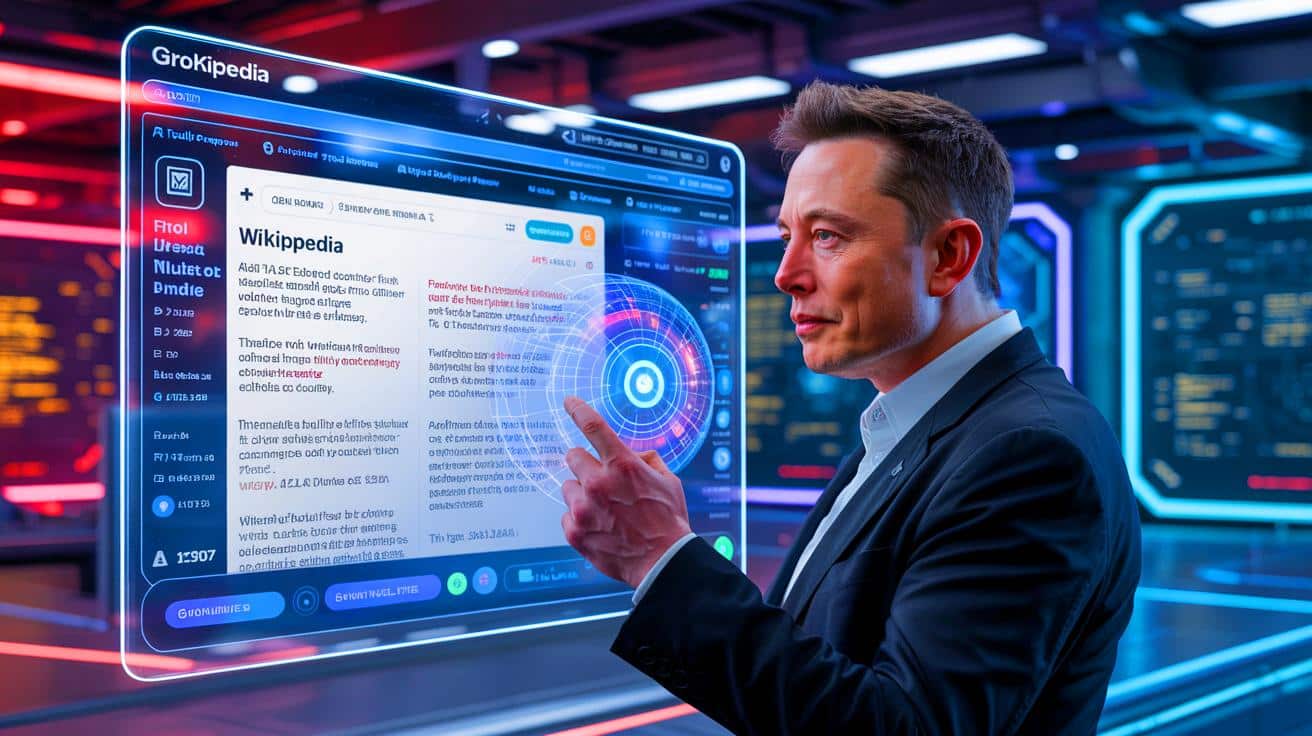
Elon Musk, the tech mogul known for his ambitious projects, has recently unveiled Grokipedia, a new knowledge platform aimed at providing a more “honest” alternative to Wikipedia. Promising accuracy verified by AI, Grokipedia seeks to challenge what Musk perceives as Wikipedia’s biases. However, a closer examination reveals that Grokipedia heavily relies on Wikipedia’s content, often replicating it word for word. This paradox raises critical questions about originality, credibility, and the future of knowledge dissemination in the digital age.
Musk’s Vision for Grokipedia: A New Era of Knowledge
Elon Musk’s mistrust of Wikipedia is no secret. He argues that the platform is riddled with biases and influenced by interest groups or activists. To counteract this, Musk has launched Grokipedia, which he claims is a more “honest” platform, leveraging AI from his xAI initiative. The aim is to provide users with information that is not only accurate but also devoid of the perceived partiality that plagues Wikipedia.
Yet, upon exploring Grokipedia, users quickly notice that many articles are remarkably similar to those found on Wikipedia. In some cases, such as the entry on the MacBook Air, the content appears to be directly lifted from Wikipedia, with only a disclaimer noting its adaptation under Creative Commons licensing. This reliance on the very platform he critiques presents an ironic twist in Musk’s narrative of offering “the truth” by recycling the base information he derides.
Wikipedia’s Response: Transparency and the Threat of Declining Traffic
The Wikimedia Foundation, which oversees Wikipedia, has not taken Grokipedia’s emergence lightly. In a statement shared with The Verge, the foundation expressed its intent to understand how Grokipedia operates. The foundation also took the opportunity to highlight its unique model of volunteer-driven content, constantly reviewed without the aid of AI.
Despite its principled stance, Wikipedia faces challenges. The foundation acknowledges a decline in traffic, as more users turn to conversational AI or explanatory videos for quick information. This decrease could undermine Wikipedia’s model by reducing both the number of contributors and the donations vital to its operation. As AI-driven platforms like Grokipedia rise, Wikipedia must adapt to maintain its relevance and support its community of volunteer contributors.
Wikipedia Traffic Decline: AI Summaries and Social Videos Reshape How We Search and Engage Online
Collaborative Knowledge Versus Algorithmic Truth
The tension between Musk and Wikipedia underscores a deeper issue: what form of knowledge should we pursue in the future? Wikipedia represents a human-centric, decentralized project, while Grokipedia embodies a technological, AI-verified vision where truth is faster and presumably purer.
However, can these two paradigms truly be pitted against each other? Even Grokipedia relies on Wikipedia’s content to train its AI responses. This interdependence suggests not a battle but a necessary coexistence. Musk has promised a standalone version of Grokipedia by the end of 2025, yet until then, distinguishing between a breakthrough and a rehash remains challenging.
Implications for Readers: Navigating Information Sources Wisely
At the heart of this encyclopedia battle lies a crucial question of usage. For readers, the real revolution isn’t about choosing between Wikipedia and Grokipedia, but about learning to decipher sources, cross-check information, and maintain curiosity.
While Wikipedia has its limitations, it also boasts a vibrant community. Grokipedia, though promising, remains somewhat nebulous. The ideal approach? To navigate both platforms while keeping a critical mind. Ultimately, neither AI nor volunteers should have the final say; it is our collective intelligence that should guide us in evaluating the information we consume.
The emergence of Grokipedia marks a significant moment in the evolution of digital knowledge platforms. As users, we must question how these changes affect our understanding of truth and authority online. Will platforms like Grokipedia reshape how we perceive and interact with information, or will the collaborative spirit of Wikipedia continue to hold sway? How we answer these questions will shape the future of knowledge sharing in an increasingly digital world.



Wow, Musk is at it again! Can’t wait to see how Grokipedia turns out. 😄
So, Grokipedia is basically Wikipedia with a new coat of paint? 🤔
Isn’t it ironic that Grokipedia relies on Wikipedia but claims to be more “honest”? 🤔
Thank you, Musk, for adding another layer of confusion to my search for truth online! 😅
What exactly does Musk mean by “honest” encyclopedia? Isn’t truth subjective?
Will Grokipedia also be free like Wikipedia, or is there a subscription plan hiding somewhere?
The idea of AI verifying facts sounds interesting, but can it really be unbiased?
Recycling Wikipedia content doesn’t sound very original to me. 😅
It seems ironic that Musk criticizes Wikipedia’s biases but uses its content extensively. 😂
How does Grokipedia plan to address the biases it claims Wikipedia has?
Is Musk’s real goal to improve knowledge sharing, or is this just another business venture?
Does anyone else find it amusing that Musk is challenging Wikipedia with its own content?
Thank you, Elon, for always pushing boundaries, but is this the right direction?
Grokipedia sounds interesting, but how will it ensure the accuracy of AI-verified information?
What measures will Grokipedia take to ensure accuracy? 🤔