





| IN A NUTSHELL |
|
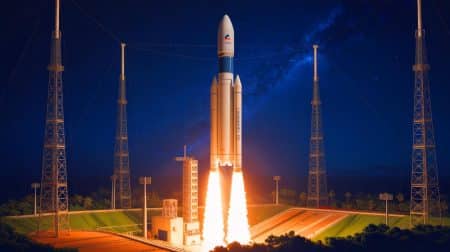
The latest test flight of SpaceX’s Starship program marks a significant milestone as the company prepares for the next generation of its spacecraft. On Monday, SpaceX successfully completed a near-perfect flight of its Starship V2, showcasing advancements in technology and engineering. The stainless steel spacecraft, powered by 33 methane-fueled Raptor engines, launched from South Texas, covering half the globe before splashing down in the Indian Ocean. This achievement provides SpaceX with valuable data to refine the Starship design further as they anticipate the arrival of Version 3, which promises even greater capabilities and advancements.
The Eleventh Flight: A New Chapter
The recent launch marks the eleventh full-scale test flight of Starship and the final flight of its second-generation configuration, known as Version 2 or V2. This series of tests has faced its fair share of challenges, but SpaceX has worked diligently to overcome them. Earlier flights in January, March, and May encountered propulsion issues and fuel leaks, while another test in June ended in an explosion. Despite these setbacks, the August test flight demonstrated success by achieving a splashdown, providing insights into the spacecraft’s performance.
One of the key improvements in this flight was the modification of Starship’s heat shield. Engineers added a soft “crunch wrap” material to fill gaps between the ceramic tiles, preventing super-heated plasma from reaching the rocket’s skin. This adjustment proved effective during reentry, with SpaceX reporting no significant damage to the heat shield or flaps. The success of this innovation is crucial for SpaceX’s goal of reusing the vehicle and its components without extensive refurbishment.
Innovations and Firsts in Flight
During its time in space, Starship V2 demonstrated several notable capabilities. The spacecraft deployed eight Starlink satellite mockups, simulating the launch of SpaceX’s next-generation Starlink satellites, which will rely exclusively on Starship for deployment. Additionally, the spacecraft performed a brief engine maneuver to set its reentry trajectory, further showcasing its versatility.
The heat shield’s performance during reentry was a critical test. The spacecraft encountered temperatures of up to 2,600° Fahrenheit (1,430° Celsius), and the onboard cameras captured vivid footage of the orange and purple plasma enveloping the rocket. This successful reentry without apparent damage is a promising sign for SpaceX’s ambition to create a reusable spacecraft capable of enduring multiple missions. Elon Musk, SpaceX’s founder, has emphasized the importance of this capability in determining Starship’s overall success.
Looking Forward to Starship V3
As SpaceX concludes the Starship V2 chapter, attention now turns to the next generation: Starship V3. This version will feature larger propellant tanks, upgraded Raptor 3 engines, and an enhanced payload compartment to accommodate real Starlink satellites. The new design aims to increase the rocket’s lifting capacity and support orbital refueling experiments, a critical step toward achieving SpaceX’s long-term goals.
Orbital refueling is essential for missions beyond low-Earth orbit, including SpaceX’s aspirations to send spacecraft to Mars and the Moon. NASA has contracted SpaceX to develop a human-rated Starship for lunar landings as part of the Artemis program, with orbital refueling as a vital milestone. The upcoming Starship V3 flights will play a pivotal role in advancing these objectives and fulfilling NASA’s lunar mission timeline.
Expanding Launch Capabilities
SpaceX is actively preparing for the launch of Starship V3, with technicians assembling the next Super Heavy booster and Starship vehicle. The new configuration will undergo cryogenic and static-fire testing before its first launch. The company is also enhancing its launch infrastructure, including the construction of a second launch pad tailored for the taller V3 rocket.
As SpaceX plans to ramp up Starship launches, additional launch pads are in development at Cape Canaveral and Kennedy Space Center in Florida. These facilities will support more frequent launches, eventually scaling up to monthly, weekly, and daily flights. This expansion underscores SpaceX’s commitment to advancing space exploration and achieving its ambitious goals.
The successful test flight of SpaceX’s Starship V2 marks a pivotal moment in the company’s quest to revolutionize space travel. With the imminent arrival of Starship V3, SpaceX is poised to push the boundaries of innovation and exploration further. As the company prepares for the next phase of testing and development, one question looms large: How will these advancements shape the future of space exploration and humanity’s reach into the cosmos?
Wow, SpaceX is really pushing the limits with Starship V2! 🚀 Can’t wait to see what V3 will bring.
Wow, un vol presque parfait! Est-ce que ça veut dire qu’on est vraiment proche d’un vol vers Mars? 😊
Quel est l’impact des innovations de SpaceX sur les autres acteurs du secteur spatial ?
C’est vraiment impressionnant, mais qu’en est-il de l’impact environnemental de tous ces lancements?
This is a game-changer! Does this mean we might see humans on Mars sooner than expected?
Merci SpaceX pour nous inspirer à rêver plus grand chaque jour !
Si Starship V2 a prouvé sa capacité de rentrée, que doit-on attendre de la version 3? Plus grand, plus rapide, plus… spaciale?
Do you think the heat shield technology could be used on other spacecrafts?
The success is great, but I’m curious about the environmental impact of these launches. 🤔
Est-ce que quelqu’un sait quand SpaceX prévoit de commencer les tests de Starship V3?
J’espère que la V3 sera aussi réussie que la V2 !
Elon Musk is truly a visionary. How does he manage to keep innovating?
Bravo à SpaceX pour cette réussite! J’espère qu’ils partageront bientôt des vidéos de l’intérieur de la capsule pendant le vol.
How many test flights are planned for Starship V3?