





| IN A NUTSHELL |
|
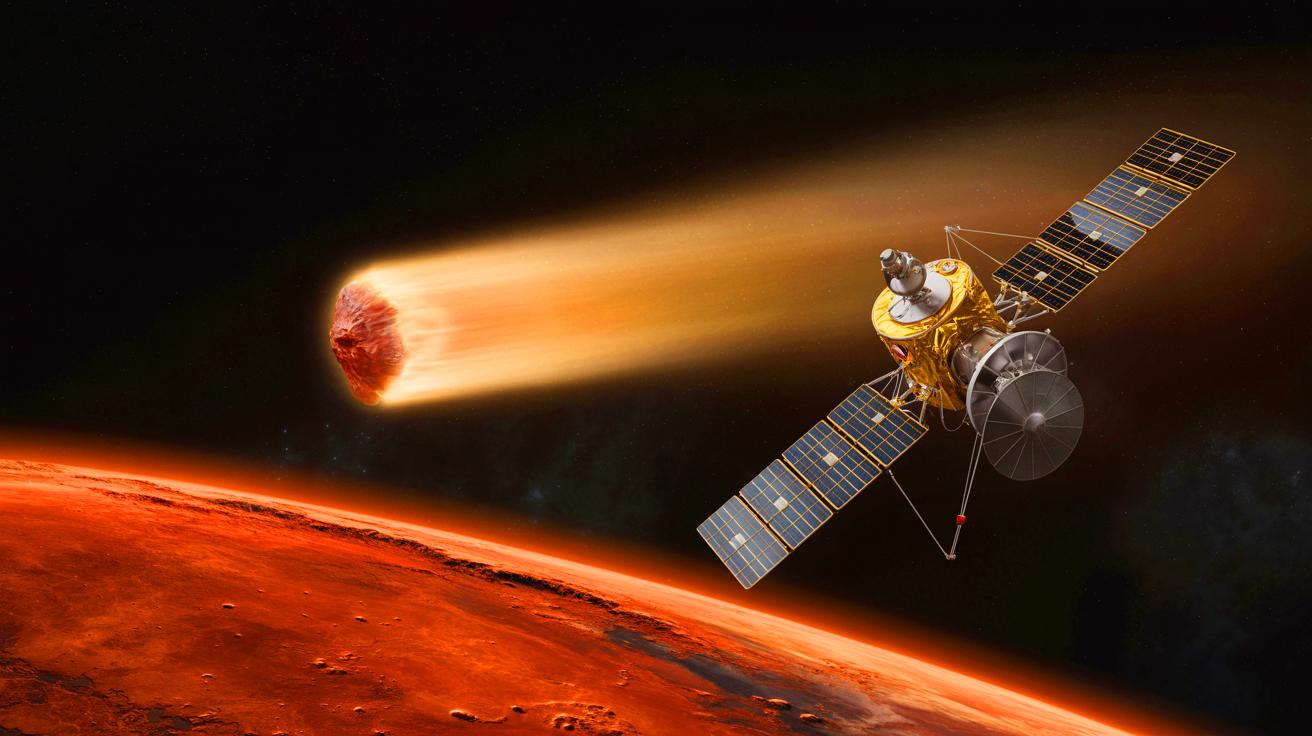
In a fascinating development, European Space Agency (ESA) spacecraft orbiting Mars have captured images of a rare interstellar visitor, the object known as 3I/ATLAS. On October 3, the ExoMars Trace Gas Orbiter (TGO) and the Mars Express spacecraft snapped photos of this mysterious celestial body during its closest approach to Mars, at a distance of over 18 million miles. This event marks an exciting chapter in space exploration, offering glimpses into the nature of an object believed to be a comet with a coma several thousand miles across. With ESA’s spacecraft not initially designed for such tasks, the images come as a remarkable achievement in adapting technology to meet unexpected challenges.
The Challenge of Capturing 3I/ATLAS
The task of photographing 3I/ATLAS was far from straightforward. The ESA faced significant challenges due to the spacecraft being equipped primarily for Martian observations rather than imaging faint interstellar objects in the night sky. Despite these obstacles, the ExoMars TGO’s Color and Stereo Surface Imaging System (CaSSIS) succeeded in capturing the comet, showcasing its glowing coma. This achievement highlights the adaptability and ingenuity of space missions in repurposing existing technology to explore unforeseen phenomena.
Using a time-lapse approach, CaSSIS recorded the movement of the comet as a bright spot across the dark backdrop of space. The images revealed the vast size of the coma, which forms as a comet nears the Sun, causing sublimation or evaporation of its core materials. This results in an expansive halo of gas and dust surrounding the nucleus, which remains elusive due to its comparatively minuscule size.
Nick Thomas, the principal investigator for CaSSIS, acknowledged the difficulty of this observation, noting that the comet was significantly fainter than their usual targets. The successful capture of 3I/ATLAS is a testament to the instrument’s capabilities and the team’s persistence in pursuing this challenging target.
Analyzing the Data: What Lies Beneath the Coma
While the coma of 3I/ATLAS was visibly recorded, the nucleus remains undetected in the CaSSIS images. The ESA explained that capturing the nucleus, less than a mile across, would be as difficult as spotting a mobile phone from Earth to the Moon. Despite this limitation, the data gathered offers invaluable insights into the comet’s composition and behavior.
The Mars Express also attempted to capture the comet, albeit with a shorter exposure time, and scientists are still analyzing those images. These efforts underscore the challenges faced in space exploration and the constant quest to push the boundaries of what is currently possible. The data collected from these observations will be pivotal in understanding the chemical makeup of this interstellar visitor, which differs significantly from the comets found within our solar system.
The scientific community eagerly anticipates further analysis, hoping to unlock secrets about 3I/ATLAS’s origins and journey. With its unique chemistry, including a high carbon dioxide to water ratio, the comet offers a rare glimpse into the materials that might be found in distant star systems.
Speculation and Skepticism: The Role of Public Discourse
The excitement surrounding 3I/ATLAS has led to a flurry of speculation and debate among scientists and the public alike. Notably, Harvard astronomer Avi Loeb has been vocal about the comet’s potential significance, even suggesting extraterrestrial involvement. However, this idea faces skepticism from other experts in the field.
David Kipping, known for his work on exoplanets, challenged the notion that NASA’s Perseverance rover captured an image of the comet, proposing instead that the streak seen in its images was likely Phobos, Mars’ innermost moon. This perspective was supported by astrophotographer Simeon Schmauß, who pointed out that the moon’s appearance as a cylindrical shape was due to the long exposure of the image.
Such public discourse helps highlight the importance of scientific rigor and cautious interpretation of space phenomena. As with any groundbreaking discovery, differing opinions and interpretations drive further investigation and fuel the curiosity that propels scientific advancement.
The Future of Interstellar Exploration
The discovery of 3I/ATLAS as only the third known interstellar object to visit our solar system marks an important milestone in our understanding of the cosmos. This ancient object, believed to be over seven billion years old, has traveled through the Milky Way, offering a unique opportunity to study materials from beyond our solar neighborhood.
As the ESA continues to analyze data from 3I/ATLAS, plans are underway to capture additional observations using the Jupiter Icy Moons Explorer (Juice). These future endeavors aim to study the comet as it becomes most active following its closest approach to the Sun. Such missions hold the potential to transform our understanding of interstellar objects and the formation of star systems.
These efforts reflect the ongoing commitment to pushing the boundaries of space exploration. As we gather more data from 3I/ATLAS, questions remain about what other secrets the universe holds and how these discoveries might reshape our understanding of the cosmos.
As scientists delve deeper into the mysteries of 3I/ATLAS, the quest to understand interstellar objects continues to captivate the imagination. What other cosmic wonders await discovery, and how might they challenge our perceptions of the universe?

Wow, this is incredible! How did they manage to capture it without the spacecraft being specifically designed for that? 🚀
Wow, imagine the ESA spacecraft going above and beyond! 🚀 What an achievement!
How can a spacecraft designed for Mars suddenly capture an interstellar comet? 🤔
Can someone explain what a “coma” is in terms of comets? I’m a bit lost here.
This is incredible! Thank you, ESA, for pushing the boundaries of space exploration! 🌌
This is amazing but reminds me of a sci-fi movie. Are we sure it’s a comet and not an alien spacecraft? 😂
Wait, are we sure it’s not one of Elon Musk’s roadsters out there? 😆
Thank you for the detailed breakdown. It’s fascinating to see what technology can achieve with a bit of ingenuity.
Why is the comet called 3I/ATLAS? Is there a connection to the ATLAS experiment?
Is there any chance we’ll be able to send a spacecraft to study 3I/ATLAS up close?
I’m curious, how does the comet’s high carbon dioxide to water ratio impact its study?
I find it hard to believe they could capture something 18 million miles away with equipment not meant for this. 🤔