





| IN A NUTSHELL |
|
The unveiling of Northrop Grumman’s concept image for the F/A-XX sixth-generation fighter plane offers a rare glimpse into the future of U.S. naval aviation. While details remain sparse, the image provides a tantalizing look at a potential successor to the F/A-18E/F Super Hornet and EA-18G Growler. This revelation comes amidst ongoing debates about the necessity of new fighter aircraft in an era increasingly dominated by drone warfare and budget constraints. As the competition with Boeing heats up, Northrop Grumman’s commitment to securing the F/A-XX contract underscores the strategic importance of this advanced fighter for the U.S. Navy.
Design and Stealth Features
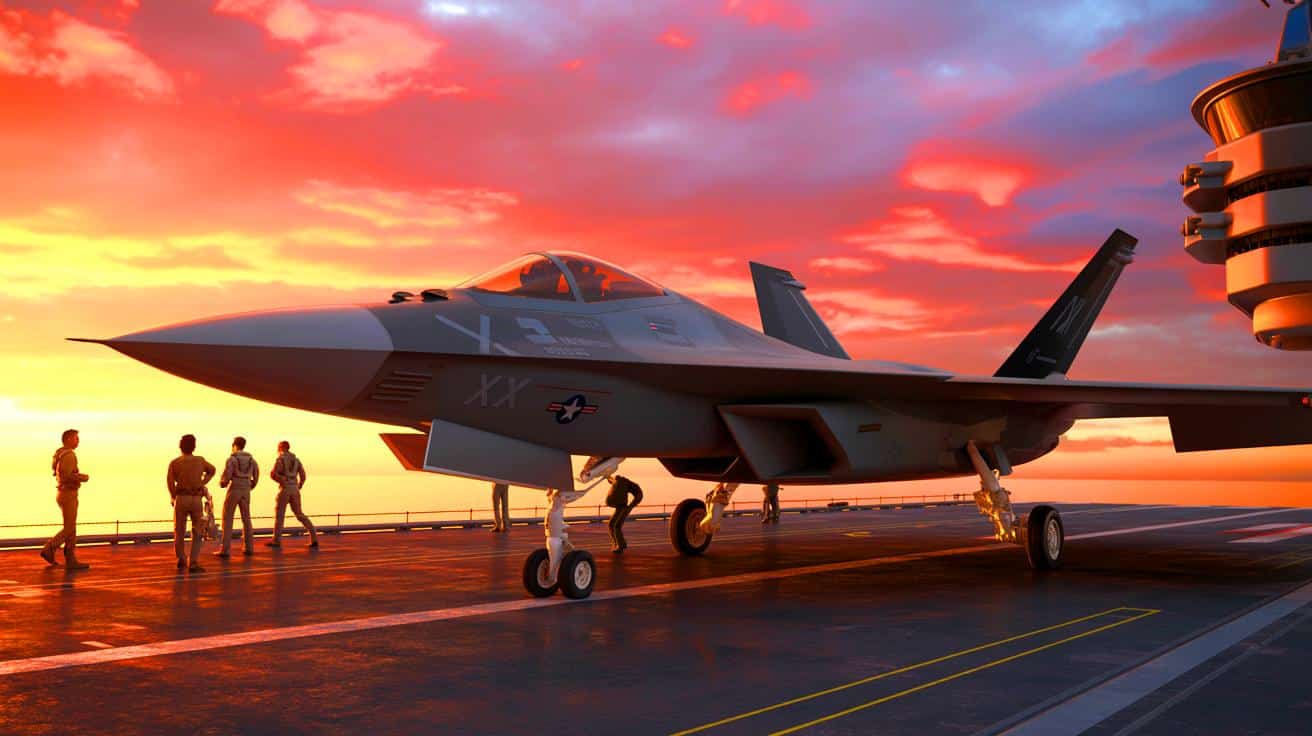
The concept image released by Northrop Grumman showcases a design that draws inspiration from its YF-23 model, with key modifications aimed at enhancing stealth capabilities. The sharp nose and prominent chine are designed to blend the wings seamlessly into the fuselage, optimizing the aircraft for stealth. This is further enhanced by a top-mounted air intake, which reduces the aircraft’s sensor profile and makes it less detectable.
Another notable feature is the aircraft’s heavy-duty undercarriage with twin wheels, indicating its capability for carrier operations. This design choice reflects the Navy’s requirement for a fighter that can withstand the harsh conditions of landing on an aircraft carrier. The concept also suggests a large interior volume, allowing for more fuel, weapons, and other payloads. These features collectively highlight the emphasis on creating a versatile and stealthy multi-role fighter.
Strategic Necessity and Mission Requirements
The F/A-XX program is driven by the Navy’s unique mission requirements, which differ from those of the Air Force. While the Air Force focuses on air superiority, the Navy’s priorities lie in surface warfare, including attacking ships and ground targets. This distinction underscores the necessity of a dedicated carrier-based aircraft, rather than a variant of the Air Force’s planned F-47 NGAD.
The geopolitical landscape further necessitates the development of the F/A-XX. With rising tensions in the Pacific Ocean, particularly concerning China’s ambitions, the Navy requires longer-range fighters capable of operating effectively in this region. The F/A-XX is expected to have a 25% greater range than the F-35C, translating to approximately 964 miles. This expanded range and capability for aerial refueling from the MQ-25 Stingray tanker drone are crucial for maintaining a strategic advantage.
Technological Advancements and Capabilities
The F/A-XX is not just about stealth and range; it is set to incorporate cutting-edge technology that will redefine aerial combat. The aircraft is expected to be faster than current U.S. combat aircraft, though specific speed metrics remain undisclosed. Advanced sensors and artificial intelligence will play a significant role in enhancing its combat capabilities.
One of the most exciting features is the ability to engage in manned-unmanned teaming (MUM-T) with Collaborative Combat Aircraft, commonly known as Loyal Wingmen. This capability will allow the F/A-XX to operate alongside unmanned aircraft, providing strategic and tactical flexibility on the battlefield. The integration of these technologies underscores the Navy’s commitment to maintaining a technological edge in modern warfare.
Challenges and Future Prospects
The F/A-XX program faces significant challenges, not least of which are budgetary constraints and inter-service rivalry. Congress frequently questions the need for two advanced fighter aircraft programs, especially when drone warfare is becoming more prevalent. Budget cuts and shifting priorities add further complexity to the program’s future.
Despite these challenges, Northrop Grumman remains optimistic. The company’s determination to stay in the race against Boeing highlights the strategic importance of this program. If funding continues, a decision on the contract is expected by 2028, with the aircraft potentially entering service in the 2030s. The outcome of this competition will shape the future of U.S. naval aviation and could redefine the capabilities of carrier-based fighters for decades to come.
As the U.S. Navy and defense contractors navigate the complexities of developing the F/A-XX, the program’s success will hinge on balancing technological innovation with budgetary realities. The outcome will not only impact military strategy but also influence the broader aerospace industry. How will the Navy’s approach to the F/A-XX shape the evolution of air combat in an era of rapid technological change?


Wow, this sounds like something out of a sci-fi movie! 🚀
Wow, the F/A-XX looks like something out of a sci-fi movie! 🚀
How does this compare to the F-35? Are there any distinct advantages?
How does the F/A-XX compare to the F-35 in terms of stealth capabilities?
Boeing should definitely be worried; Northrop Grumman is stepping up their game!
Is it just me, or does the concept image look like a flying shark? 😂
Great article! Thanks for the detailed breakdown of the F/A-XX’s features.
Can we trust AI to handle combat situations efficiently? 🤖
Is it just me, or does “F/A-XX” sound like a new video game console? 😄
Budgetary constraints always seem to be an issue. Will this project even take off? 🤔
The integration of unmanned systems is the future. Exciting times ahead!
How will the F/A-XX handle the increasing role of drones in modern warfare?
I’m curious about the range. How does it compare to current aircraft?
Thanks for the detailed insight into the F/A-XX, very informative!
I wonder how Boeing is reacting to this reveal. They must be sweating! 😅
Why is there so much emphasis on stealth? Are other countries not focusing on it?
Wouldn’t it be better to invest in drones instead of manned aircraft?
Northrop Grumman really knows how to create suspense with these reveals!
Carrier operations are no joke; I hope this design can withstand it.
The geopolitical climate in the Pacific makes this project crucial. 🌏
Is there any information on the cost per unit for this fighter?
The design reminds me of something from Star Wars! May the force be with them! 😄
Good luck to Northrop Grumman. The competition with Boeing will be fierce!
Will this fighter program see the same fate as others that were canceled?
The future of aerial combat is here, and it looks incredible.
Can the F/A-XX operate in extreme weather conditions?
Stealth, range, AI—sounds like a recipe for success. 🛫
I’m skeptical about the budget. How realistic are these prospects?
Looks like Boeing needs to up their game. This is impressive.
AI and sensors are game-changers. Can’t wait to see them in action!
What are the environmental impacts of developing and deploying this aircraft?
Is the manned-unmanned teaming concept already in use?
Love the idea of a stealthy multi-role fighter. Versatility is key.
With all these advancements, how secure are these systems from cyber threats?
The Navy’s requirements always seem unique. Makes sense for such a project.
Excited to see how this shapes up by 2028! Marking my calendar. 📅
How long until we can expect to see this in active service?
Budget cuts are a constant battle. Let’s hope the program survives. 💸
Are there any international collaborations involved in this project?
What does this mean for the future of naval aviation globally?
Love the tech innovations, but will they be reliable in combat? 😬
Does this mean a potential job boom in the aerospace sector?
Hope this pushes forward the envelope of innovation in military tech!
The design looks sleek, but how does it perform? Only time will tell.
Can someone explain how the top-mounted air intake works for stealth? 🤷♂️