





| IN A NUTSHELL |
|
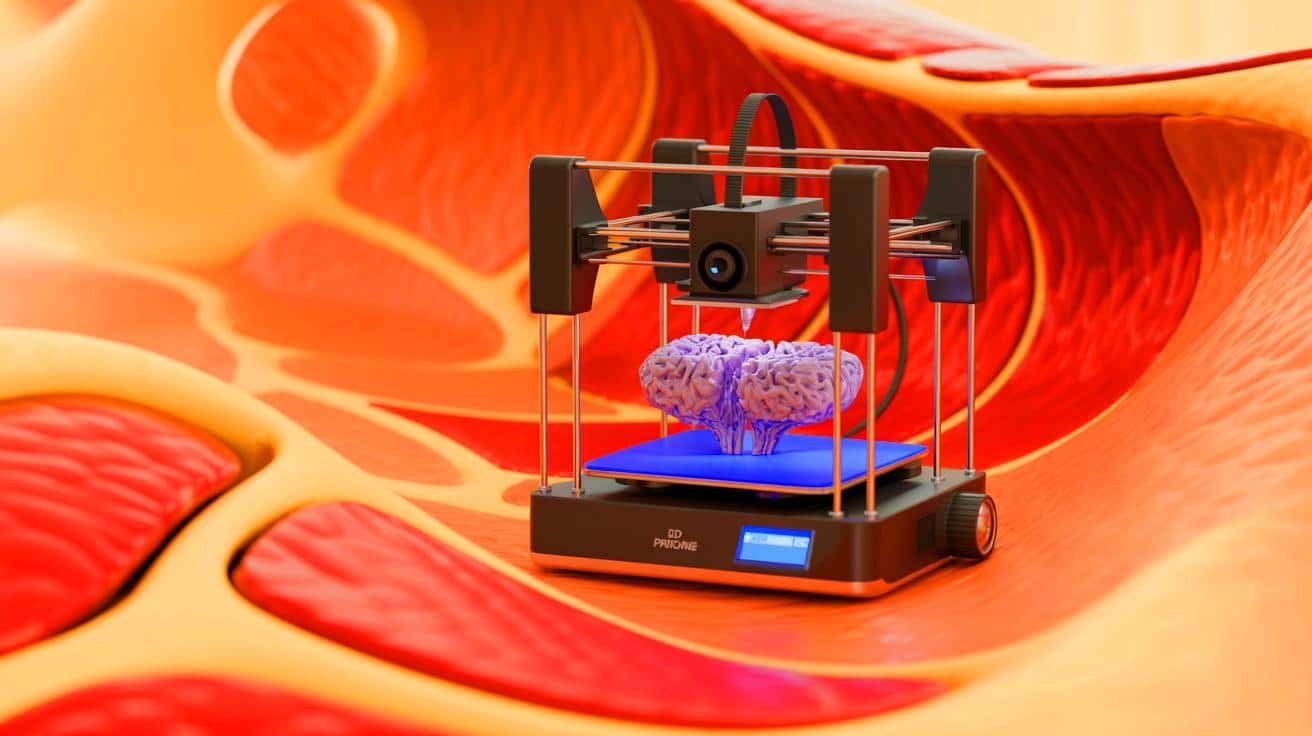
In a groundbreaking development that could redefine the future of regenerative medicine, researchers in Germany have introduced a mini 3D printer capable of creating biological tissue inside the human body. This innovative device uses bio-inks to construct complex cell structures, offering a promising avenue for tissue repair and regeneration. Spearheading this project is Andrea Toulouse, PhD, an expert in micro-optics and fiber-based 3D printing, from the Institute of Applied Optics at the University of Stuttgart. Funded by a $2 million grant from the Carl Zeiss Foundation, the project, named 3D Endoscopic Microfabrication (3DEndoFab), aims to integrate photonics, biotechnology, and precision engineering to revolutionize tissue repair methodologies.
Revolutionizing Tissue Repair
Traditional bioprinting has made strides in creating tissues like cartilage and muscle. However, the challenge lies in the implantation of these tissues within the human body. Conventional printers are often too large and lack the precision needed for in-body operations. The team led by Toulouse is addressing these limitations through the miniaturization of 3D printing technology. By utilizing a thin optical fiber, this innovative approach allows for the direct printing of complex structures precisely where needed, eliminating the necessity of transplanting pre-grown tissue.
The technology involves a glass fiber thinner than a pencil lead, guiding light-based 3D printing. A tiny 3D-printed lens, no larger than a grain of salt, sits at the fiber’s tip to focus laser light, curing bio-inks layer by layer into living tissue. This advancement aims to print complex tissue structures in 3D with micrometer resolution, matching the scale of human cells.
Advancing from Laboratory to Clinical Applications
The 3DEndoFab team collaborates with Michael Heymann, PhD, from the university’s Institute for Biomaterials and Biomolecular Systems, to refine both the printing process and the development of bio-inks compatible with human biology. Prior research under the EndoPrint3D project demonstrated the feasibility of using ultrashort femtosecond laser pulses to 3D-print structures through optical fibers. Toulouse’s team now strives to achieve micrometer-scale printing resolution using biodegradable materials that integrate seamlessly with living cells.
The integration of 3DEndoFab into the Bionic Intelligence Tübingen Stuttgart (BITS) research network aims to facilitate the transition to clinical applications. This network connects advanced robotics, bioengineering, and AI to drive health innovation. The team is also exploring the potential of microscopic scaffolds in guiding human cell growth, with hopes of stimulating the body to complete tissue regeneration upon printing initiation.
Exploring the Potential of Bio-Inks
Bio-inks are a critical component of this innovative 3D printing approach, enabling the creation of complex tissue structures. The research team is focusing on developing bio-inks that not only support cell growth but also integrate into the body without adverse effects. These inks must be biodegradable and compatible with living cells to ensure successful tissue formation and integration.
The challenge lies in balancing the mechanical properties of the bio-inks with their biological functionality. The inks need to be strong enough to maintain their structure during the printing process, yet flexible enough to accommodate cell growth and movement. This delicate balance is essential for the successful application of 3D-printed tissues in medical treatments.
The Future of Regenerative Medicine
The advancements made by Toulouse and her team represent a significant leap forward in the field of regenerative medicine. By focusing on in-body tissue repair, the mini 3D printer could potentially transform how medical professionals approach tissue damage and loss. This technology offers a less invasive and more efficient alternative to current methods, which often involve complex surgeries and lengthy recovery periods.
As research progresses, the potential applications of this technology are vast. From repairing damaged organs to creating new tissues for transplants, the possibilities are both exciting and numerous. The integration of this technology into clinical settings could revolutionize patient care and improve outcomes for countless individuals worldwide.
The mini 3D printer developed by Andrea Toulouse and her team at the University of Stuttgart stands as a testament to the power of innovation and interdisciplinary collaboration. As the project moves closer to clinical application, one can only wonder: how will this technology reshape the landscape of modern medicine and improve the quality of life for patients in the years to come?


Wow, a 3D printer that works inside the body? That’s like science fiction come true! 😊
Wow, c’est incroyable! Une imprimante 3D mini qui imprime des tissus à l’intérieur du corps? Quelle avancée! 😮
Est-ce que cette technologie est déjà utilisée dans des hôpitaux ou c’est encore en phase de test?
Est-ce que cela veut dire que les futures chirurgies pourraient être moins invasives?
Could this potentially replace organ transplants in the future?
Le projet semble prometteur, mais qu’en est-il des risques potentiels pour la santé?
Je me demande comment ils évaluent la sécurité de ces nouvelles bio-encres pour le corps humain.
I’m amazed by the progress in medical technology. Kudos to the researchers involved! 👍
C’est incroyable! Mais comment gèrent-ils le risque d’infection pendant l’impression?
Merci à l’équipe derrière ce projet, ça pourrait changer tant de vies! 🙌
Will we be able to print entire organs one day? That would be revolutionary! 😮
Comment s’assurent-ils que les bio-encres sont compatibles avec tous les types de tissus?
Je suis un peu sceptique. Comment s’assurent-ils que l’impression dans le corps ne cause pas de complications? 🤔
The future of medicine is looking bright with innovations like these!
Est-ce que cette technologie sera abordable pour les systèmes de santé ou restera-t-elle coûteuse?
Si ce projet réussit, on pourrait vraiment dire adieu à certaines chirurgies traditionnelles!
Juste curieux, combien de temps cela prend-il pour imprimer un tissu dans le corps?