





| IN A NUTSHELL |
|
A groundbreaking innovation in 3D printing technology is set to redefine the landscape of aerospace, propulsion, and e-mobility manufacturing. A team of bachelor’s students from Switzerland has developed a high-speed, multi-material metal printer capable of simultaneously fusing two different metals. This innovation, completed in just nine months, promises to significantly reduce production times while enhancing the capabilities of metal additive manufacturing. The implications for industries reliant on complex metal parts, such as aerospace and automotive, could be profound.
Revolutionizing Metal Additive Manufacturing
The newly developed 3D printer, created by a group of six undergraduate students in their fifth and sixth semesters, tackles significant challenges faced by traditional metal additive manufacturing. The need for faster production speed and the capability to use multiple materials simultaneously has long been a barrier. Traditional laser powder bed fusion (LPBF) printers operate by applying and fusing each layer in a sequential, stop-start manner, which can be time-consuming and inefficient.
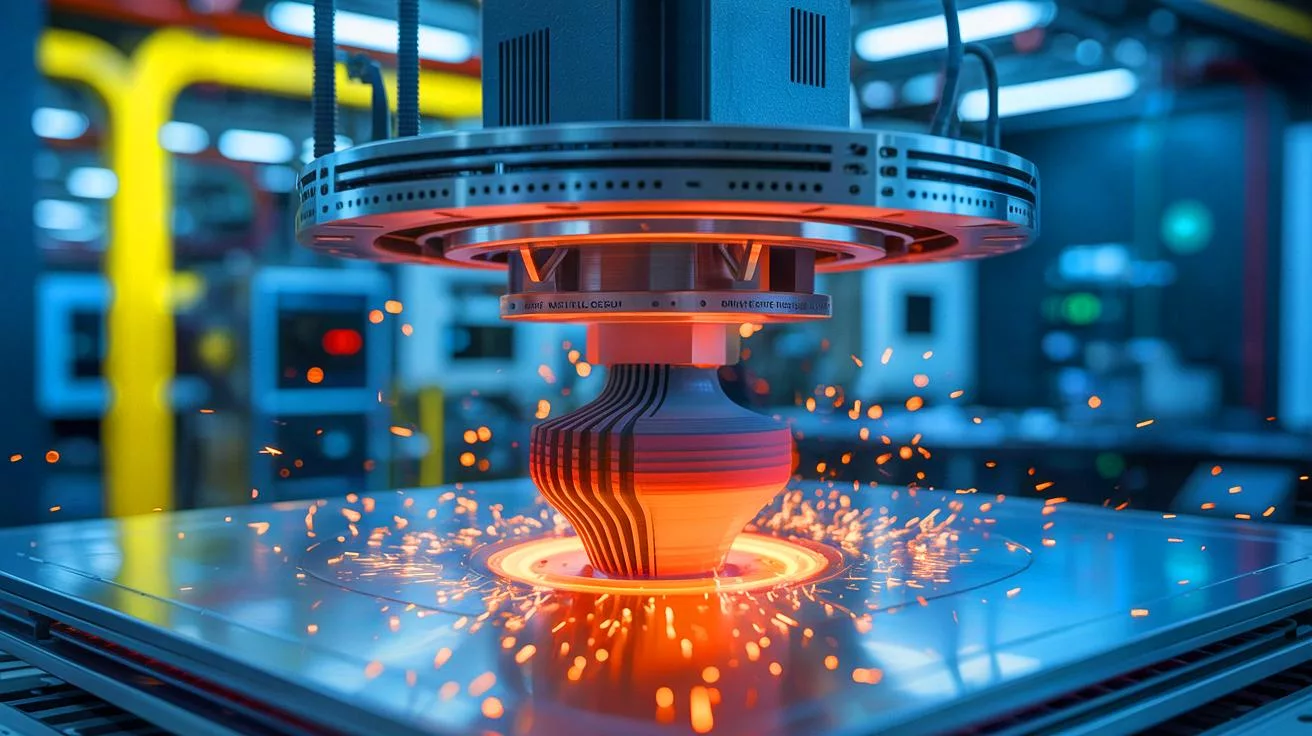
However, the students’ innovative design incorporates a rotating printing platform. This allows for the continuous deposition and fusion of metallic powders, drastically reducing the time required to produce cylindrical components by more than two-thirds. Moreover, the ability to print with two different metals simultaneously is a significant advancement, eliminating the need for multiple stages or complex post-processing.
Named RAPTURE, this project was initially conceived to aid the Swiss Academic Space Initiative (ARIS) in building bi-liquid-fueled rocket nozzles capable of withstanding spaceflight conditions. ARIS aims to reach the Kármán Line, the recognized boundary of space, which lies 62 miles above Earth’s surface. This technology could be pivotal in achieving that goal.
Enhanced Quality Through Innovative Design
One of the key features that sets this 3D printer apart is its rotating powder delivery and gas flow system. This mechanism plays a crucial role in maintaining the quality of the printed parts. By blowing inert gas across the fusion zone, the system prevents oxidation during the printing process, ensuring higher integrity of the final product.
Soot, spatter, and other by-products are efficiently extracted through a dedicated outlet, contributing to a cleaner build environment. As Michael Robert Tucker, a lecturer at the Department of Mechanical and Process Engineering, noted, “At first we underestimated the extent to which the gas flow mechanism affects product quality. Now we know it’s crucial.” The university has filed a patent for this technology, underscoring its potential applications in the aerospace, automotive, and energy sectors.
The prototype has already demonstrated its capabilities by producing turbine stators up to 7.8 inches in diameter. The team is currently focused on scaling up the process and seeking partnerships with industry players to bring this technology to market.
Implications for Aerospace and Beyond
The ability to print components with a copper core and a nickel-alloy exterior in one seamless step opens up new possibilities for industries reliant on complex, high-performance metal parts. This process is particularly suited to rocket nozzles and rotating engines, which typically require large diameter components with very thin walls. Such parts are essential in the aerospace industry, where precision and performance are critical.
The rapid production capability and multi-material functionality of this printer could reduce manufacturing costs and lead times, making it an attractive option for smaller players in the industry. As Tucker highlighted, “For small players like our student rocket team, this sort of multi-material technology has up to now been too complex and too expensive, putting it out of reach.”
This advancement in 3D printing technology could democratize access to high-quality, multi-material manufacturing, enabling more innovation and competition within the aerospace and automotive sectors.
Scaling Up and Looking Forward
The achievement of these students in developing a functioning prototype within nine months is nothing short of remarkable. The next steps involve scaling up the process and forming partnerships with industry leaders to explore the full potential of this technology. The students’ success underscores the transformative power of innovation and collaboration in advancing technology.
As industries continue to seek more efficient and sustainable manufacturing solutions, this development in 3D printing offers a glimpse into the future of production. The potential to revolutionize manufacturing practices across multiple sectors cannot be overstated. With a patent in place and industry interest growing, the journey of this groundbreaking technology is just beginning.
This innovation raises important questions about the future of manufacturing. How might industries adapt to incorporate such technology, and what new opportunities could arise from the ability to rapidly produce complex, multi-material components?


Bravo les étudiants! Comment ont-ils réussi ça en seulement 9 mois? 🤔
Wow, des étudiants ont vraiment fait ça en seulement 9 mois? Impressionnant! 😮
Incroyable! Mais est-ce que cette technologie est déjà disponible pour d’autres industries?
Est-ce que quelqu’un sait si cette technologie sera commercialisée bientôt?
Je ne savais pas que 3D printing pouvait être aussi rapide. Allez les Suisses! 🇨🇭
Je suis impressionné! Les étudiants suisses sont vraiment innovants! 🚀
Bravo à ces étudiants pour cette innovation majeure. 👏
Peuvent-ils aussi imprimer du chocolat suisse? 😄
Comment font-ils pour éviter l’oxydation pendant le processus d’impression?
L’article mentionne une réduction de 67% du temps de production. C’est énorme !
C’est cool, mais est-ce que ça coûte cher à produire? 💸
Ça fait plaisir de voir les jeunes réussir de tels exploits. 😊
J’ai toujours pensé que le 3D printing était lent, mais maintenant je dois revoir mon jugement!
Quelqu’un a déjà vu cette imprimante en action?