





| IN A NUTSHELL |
|
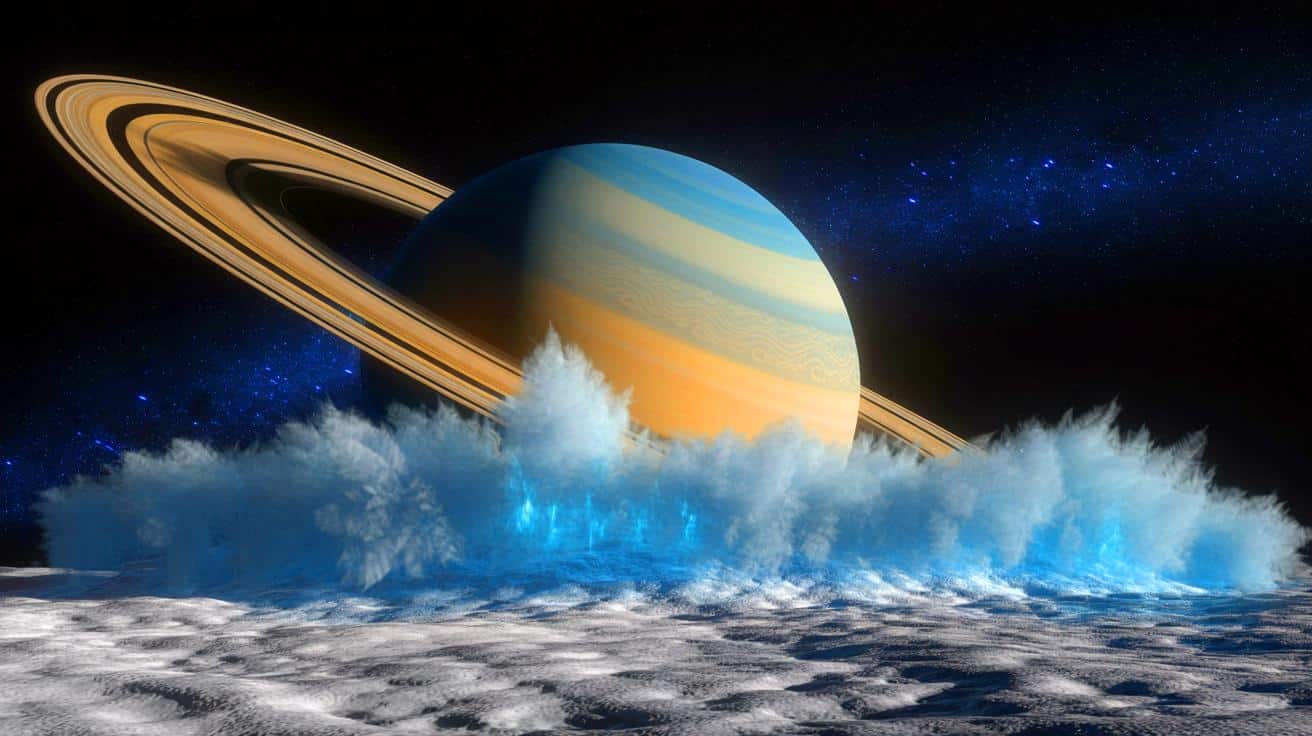
Saturn’s icy moon Enceladus, a captivating celestial body, has long intrigued scientists. Its surface erupts with water ice plumes, hinting at the secrets hidden beneath its icy crust. Recent findings suggest that these plumes may harbor signs of life, sparking a renewed interest in the moon’s subsurface ocean. The European Space Agency (ESA) has announced its ambitious plans to explore Enceladus further as part of its Voyage 2050 program. This mission aims to uncover the mysteries of the moon’s hidden ocean and search for extraterrestrial life within our solar system.
Europe’s Long-term Enceladus Plans
The European Space Agency has laid out an ambitious plan to explore Enceladus with a mission that includes both an orbiter and a lander. This dual approach is designed to provide a comprehensive analysis of the moon. Unlike traditional missions that rely solely on passive data collection, the orbiter will actively engage with the environment. It will collect and analyze material from the moon’s water ice plumes, which are known to eject material thousands of miles into space.
In a remarkable observation in 2023, the James Webb Space Telescope recorded a plume stretching over 6,000 miles into space. This highlights the profound potential for discovery. At a recent scientific gathering in Helsinki, ESA revealed that preparations for this mission have been underway since March, focusing on identifying the scientific and technological requirements necessary for success.
The mission, tentatively scheduled for launch in 2042, will involve two launches using the largest variant of Europe’s Ariane 6 rocket. The journey to Enceladus is expected to take over a decade, with the spacecraft anticipated to arrive in 2053. The lander will then make its descent onto the moon’s surface around 2058, following several strategic flybys.
Searching for Life in Our Solar System
The primary motivation behind ESA's focus on Enceladus is the potential to discover extraterrestrial life within our solar system. Enceladus presents a unique opportunity for exploration because it meets three essential criteria for supporting life: the presence of liquid water, the availability of necessary chemical elements, and energy from the Sun.
In a groundbreaking study published in Nature Astronomy in 2021, scientists highlighted the significant amount of methane detected in Enceladus’ plumes. This finding suggests the possibility of life existing in the moon’s subsurface ocean. The researchers argued that no known abiotic process could account for the observed levels of methane. This raises intriguing questions about the presence of microbial life beneath Enceladus’ icy surface.
Analyzing subsurface oceans on icy moons is a complex task, and definitive proof of life may remain elusive for decades. However, missions like those planned for Enceladus and Jupiter’s Europa have the potential to revolutionize our understanding of life in the universe. The discovery of microbial life within our solar system would significantly increase the likelihood that intelligent life exists beyond our cosmic neighborhood.
Technological Challenges and Innovations
Embarking on a mission to Enceladus presents numerous technological challenges. The harsh environment of space and the icy conditions of the moon demand innovative solutions. Developing technology capable of surviving and operating in such extreme conditions is a formidable task. The spacecraft will need to withstand freezing temperatures and radiation while maintaining communication with Earth over vast distances.
One of the most significant technical challenges is designing an instrument capable of analyzing the plumes' chemical composition accurately. This requires cutting-edge technology that can detect even trace amounts of organic compounds. ESA’s mission will leverage advancements in instrumentation and data analysis to achieve its scientific goals. The agency's collaboration with international partners and scientific institutions will be crucial for addressing these challenges and advancing our understanding of Enceladus.
Moreover, the mission will serve as a testing ground for new technologies that could be applied in future explorations of the outer solar system. These innovations will not only enhance our knowledge about Enceladus but also pave the way for more ambitious missions in the coming decades.
The Broader Implications for Humanity
The exploration of Enceladus holds profound implications for humanity’s understanding of life beyond Earth. If the mission succeeds in finding evidence of life, it would mark a historic milestone in human exploration. Such a discovery would challenge our perceptions of biology and our place in the universe. It would also prompt philosophical and ethical discussions about our responsibility toward other life forms.
Beyond the scientific community, the mission to Enceladus has the potential to inspire generations of explorers and innovators. It highlights the importance of investing in space exploration and the pursuit of knowledge. The search for life on Enceladus is not just a scientific endeavor; it is a testament to human curiosity and the drive to explore the unknown.
The mission underscores the collaborative nature of space exploration, uniting scientists, engineers, and researchers from around the world. It exemplifies the power of international cooperation in tackling complex challenges and advancing scientific frontiers.
As the European Space Agency propels its mission to Enceladus, the world watches with anticipation. The prospect of uncovering life forms beyond Earth presents a profound opportunity to expand our understanding of the cosmos. What revelations about life and the universe might this ambitious mission uncover, and how will they reshape our future endeavors in space exploration?
Wow, imagine finding aliens on Enceladus! 👽🌌
Wow, if they find life on Enceladus, it could change everything we know about the universe! 🌌
2042 seems so far away. Why do these missions take so long to launch?
What if the life we find is just space bacteria? Would that still be exciting?
Are there any other moons or planets in our solar system with similar missions planned?
2042 launch? I’ll mark my calendar now! 😂
This sounds like science fiction becoming reality. Can’t wait to see the results! 🚀
Do you think Enceladus could teach us about Earth’s own history?
If we find life, do we have a plan to communicate with it? 🤔
The methane discovery is fascinating. Could it be a sign of life?
Does anyone else think this mission is a bit too ambitious? What if we find nothing?
Les défis technologiques sont énormes. Bon courage à l’ESA! 🚀
I’m really excited to see what the lander discovers on Enceladus’ surface!
Why is it always moons and not planets that get all the attention?
Pourquoi Enceladus et pas une autre lune comme Europe? 🤔