




| IN A NUTSHELL |
|
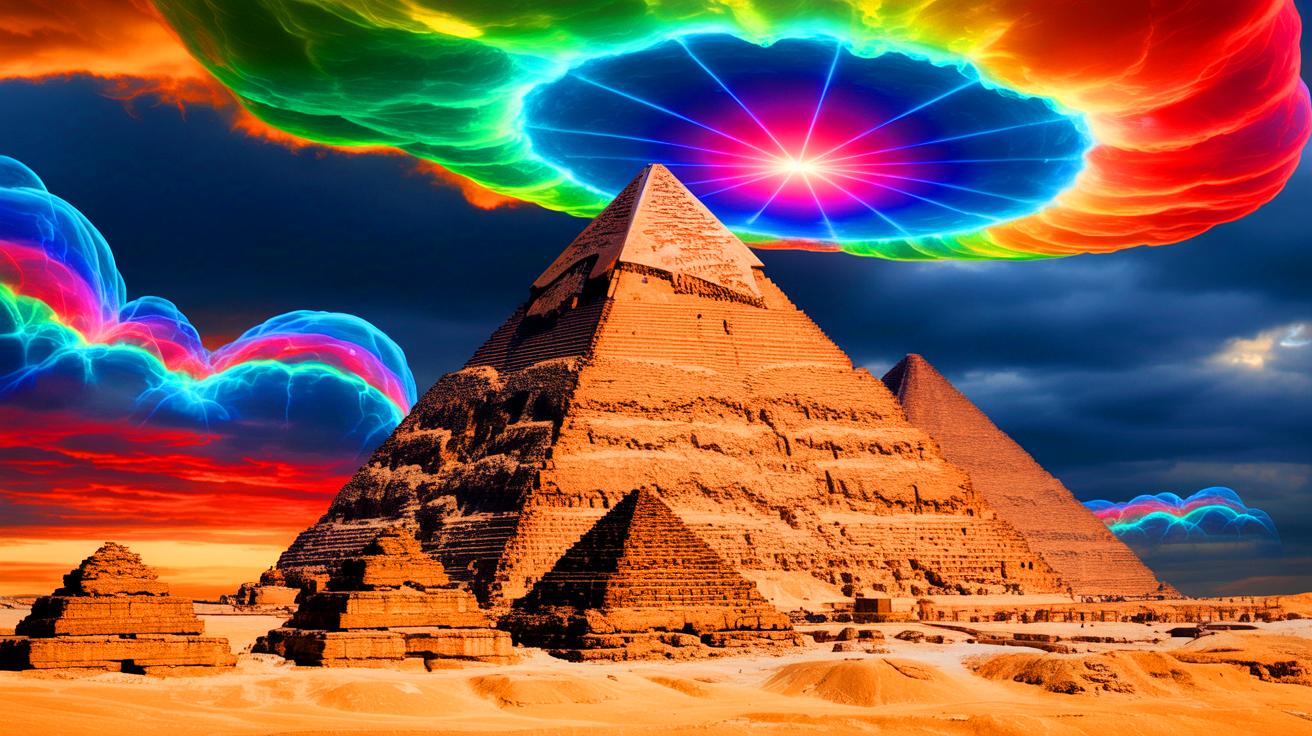
In a remarkable technological breakthrough, Chinese scientists have detected plasma bubbles over Egypt’s Pyramids from a radar station located nearly 5,000 miles away. This discovery, made from Hainan Island, underscores significant advancements in monitoring space weather. Plasma bubbles, invisible disturbances in the ionosphere, pose challenges to global communication systems. Their detection from such a distance offers promising avenues for preemptive measures. This new capability is not just a feat of technology but also a crucial step in protecting vital satellite communications and navigation systems from space weather disruptions.
What Are Plasma Bubbles and Why Do They Matter?
Plasma bubbles are cavities in the Earth’s ionosphere, formed after sunset, and are depleted of electrons. These bubbles can stretch for hundreds of miles and follow the planet’s magnetic field lines. Although they are invisible to the naked eye, their presence can disrupt communication and navigation systems significantly. The irregular walls of plasma bubbles scatter radio signals, leading to interference in GPS systems, satellite television, and even errors in stock-market time stamps.
The unpredictability of these bubbles makes them a unique challenge for space weather forecasting. They can emerge suddenly and impact areas lacking ground-based sensors, especially across vast tropical oceans. The newly developed radar system from the Chinese Academy of Sciences offers a solution by providing real-time monitoring of these bubbles. By tracking their formation and spread, scientists can substantially improve predictions and mitigate their effects on essential communication networks.
The Role of LARID Radar in Detecting Plasma Bubbles
The Low Latitude Long Range Ionospheric Radar (LARID) represents a significant leap in radar technology. Unlike conventional systems that cover local areas, LARID employs phased-array technology to send high-frequency pulses into the ionosphere. These pulses can detect disturbances almost 6,000 miles away. This advanced capability was demonstrated when LARID identified a plasma bubble over Egypt during a geomagnetic storm.
The radar’s success is attributed to enhancements in its software and ionospheric modeling. The system, equipped with 40 antennas, captured echoes from the ionosphere during the disturbance caused by a geomagnetic storm. This confirmation was supported by GPS data from Africa detecting changes in electron content. Such capabilities underscore LARID’s potential in offering real-time insights into space weather phenomena, aiding in the protection of global communication systems.
How Space Weather Affects Our World
The implications of detecting plasma bubbles extend far beyond scientific interest. Industries relying on satellite-based technologies, particularly GPS systems, are vulnerable to these disturbances. Reliable GPS is crucial for aviation, maritime navigation, and financial systems requiring precise time-stamping. The sudden formation of plasma bubbles can jeopardize these systems, leading to potential safety risks and financial discrepancies.
Understanding and predicting space weather disturbances is essential for safeguarding modern infrastructure. An early warning system capable of identifying these bubbles can help mitigate their adverse effects. This is particularly important for maintaining the integrity of communication networks upon which global industries depend daily. As such, advancements in radar technology not only enhance scientific understanding but also fortify critical global infrastructures.
A Step Toward Global Space Weather Monitoring
The ability to detect plasma bubbles from vast distances signals a new era in space weather monitoring. Researchers suggest that a network of radar stations strategically placed around the globe could offer comprehensive monitoring of the ionosphere. Such a network, covering the equatorial belt, could provide real-time tracking of space weather disturbances.
Scientists propose establishing radar stations in key locations such as Brazil, Indonesia, and West Africa. These stations would fill existing gaps, particularly over oceans, allowing for continuous monitoring and early warnings of plasma bubble activity. This global network would not only advance scientific research but also offer practical benefits by ensuring the reliability of global communication and navigation systems.
The detection of plasma bubbles over Egypt’s Pyramids marks a noteworthy advancement in space weather monitoring. As technology progresses, the prospect of a global radar network becomes increasingly feasible. How will these advancements in space weather monitoring shape our ability to protect and maintain the systems we depend on daily?
Wow, who knew the Pyramids were such a hotspot for plasma bubbles? 🤔
Wow, plasma bubbles over the pyramids? Sounds like something out of a sci-fi movie! 🚀
Can someone explain how these plasma bubbles actually affect GPS systems in simple terms?
I’m skeptical. How reliable is this LARID radar system really? Can we trust it with our GPS? 🤨
This is amazing technology! Thank you, China, for advancing our understanding of space weather. 😊
Thank you for the enlightening article! I never realized space weather could impact our daily lives so much.
Is it just me, or does “plasma bubbles” sound like a new drink flavor? 🍹
How accurate are these radar systems in predicting the impact of plasma bubbles?
This sounds like something out of a sci-fi movie! What’s next, alien communication? 👽
Could this technology help prevent airplane accidents due to GPS failure?
How often do these plasma bubbles occur, and can we predict them accurately now?
Next thing you know, they’ll find aliens using this radar! 👽
Interesting read, but why is China leading in this technology? What about other countries?
Wow, 5,000 miles away! Technology these days is truly mind-blowing. 🚀
Amazing how technology can detect things 5,000 miles away, but I still lose my Wi-Fi signal at home.