





| IN A NUTSHELL |
|
Venus Aerospace has achieved a milestone in propulsion technology through its successful testing of a Rotating Detonation Rocket Engine (RDRE) at Spaceport America in New Mexico. This technological breakthrough could potentially transform the future of high-speed travel by enabling hypersonic vehicles to reach speeds up to Mach 6. Unlike traditional rocket engines, the RDRE utilizes supersonic explosions for thrust, offering higher efficiency. This development holds promise for making high-speed travel more accessible and sustainable for both civilian and military purposes. The test represents a significant step forward in aerospace engineering and opens up new possibilities for the future of transportation.
The Technology Behind Rotating Detonation Rocket Engines
The Rotating Detonation Rocket Engine represents a significant advancement in propulsion technology. Unlike traditional rocket engines, which rely on continuous combustion, the RDRE uses a series of controlled supersonic explosions to produce thrust. This innovative approach involves a combustion chamber where a propellant mix of fuel and oxidizer is detonated. The resulting shock wave travels in a circular path, compressing and consuming the unburnt propellant.
This method generates a high-velocity exhaust, propelling the vehicle forward with increased efficiency. The RDRE boasts higher thrust-to-weight ratios and enhanced combustion efficiency compared to its conventional counterparts. Such breakthroughs could herald a new era in hypersonic travel, allowing vehicles to operate like traditional aircraft while achieving unprecedented speeds.
The RDRE’s development has been in progress since the 1980s, but only now are practical applications coming to fruition. The engine’s design includes an empty cylinder with an opening, allowing the propellant mix to be introduced and detonated. This innovative technology holds the promise of revolutionizing air travel by making high-speed transportation more efficient and practical.
The Role of the VDR2 Air-Breathing Detonation Ramjet Engine
Central to Venus Aerospace’s hypersonic ambitions is the VDR2 air-breathing detonation ramjet engine. This cutting-edge engine design allows test vehicles to attain hypersonic speeds by leveraging the craft’s forward velocity to compress incoming air. The VDR2 engine is characterized by an empty tube with no moving parts, relying on a conical inner body to adjust shock waves and slow airflow to subsonic speeds.
This design is crucial to prevent engine failure due to overheating. One of the challenges with ramjets is the need for high initial speeds to initiate the engine cycle. Typically, this requires a booster rocket or launch from a high-speed aircraft. However, the combination of the RDRE with the ramjet enables a hybrid propulsion system, allowing for conventional runway takeoffs and landings.
The synergy between these technologies has the potential to redefine hypersonic vehicle capabilities, making them more versatile and practical for diverse applications. Venus Aerospace’s innovative approach could pave the way for a new era of high-speed travel, revolutionizing both civilian and military transportation.
Venus Aerospace’s Ambitious Goals for Hypersonic Travel
Venus Aerospace’s recent RDRE test is part of a broader strategy to develop a hypersonic vehicle capable of reaching speeds up to Mach 6. The company’s vision extends beyond military applications, aiming to make high-speed flight accessible and sustainable for civilian use. The ultimate goal is to power the Stargazer M4, a Mach 4 reusable passenger aircraft, with an advanced version of the RDRE.
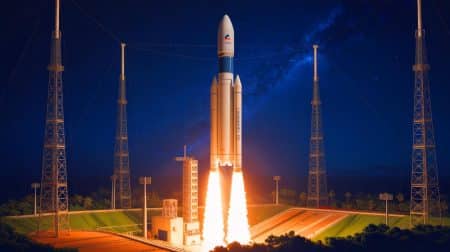
During the May 14 test, a near-vertical launch was conducted to simplify design and flight operations. Future tests will incorporate the VDR2 engine into a drone to further validate the technology under real-world conditions. This progress brings Venus Aerospace closer to realizing its vision of revolutionizing air travel.
CEO Sassie Duggleby expressed confidence in the technology, highlighting its potential to make high-speed flight both affordable and environmentally friendly. As Venus Aerospace continues to innovate, the company aims to transform the aerospace industry by making hypersonic travel a practical reality.
The Implications of Hypersonic Propulsion Technology
The successful test of the RDRE holds significant implications for the aerospace industry and the future of transportation. Hypersonic vehicles powered by such engines could drastically reduce travel times, transforming global connectivity. The ability to take off and land from conventional runways enhances the practicality and accessibility of hypersonic vehicles for commercial use.
Beyond civilian applications, hypersonic propulsion technology is strategically important for military operations, offering rapid response capabilities and improved maneuverability. As Venus Aerospace advances its technology, questions arise regarding the broader adoption and regulatory challenges these innovations may face.
Nevertheless, the company’s achievements represent a promising step towards a future where high-speed travel becomes a reality. As the aerospace industry evolves, these technological breakthroughs will likely reshape the way we perceive and utilize air travel, opening new horizons for global connectivity and communication.
As Venus Aerospace continues to push the boundaries of propulsion technology, the potential for hypersonic travel is becoming increasingly tangible. How will these advancements reshape our world, and what new opportunities will emerge as high-speed travel becomes more attainable and widespread?
Wow, des avions à Mach 6 ! On se croirait dans un film de science-fiction. 🚀
Wow, atteindre Mach 6 avec des explosions, c’est comme de la science-fiction devenue réalité ! 🚀
Je me demande quel est le coût énergétique de ces moteurs à détonation rotative ?
Est-ce que cette technologie sera un jour accessible pour des vols commerciaux ?
Est-ce que quelqu’un sait si ces technologies seront accessibles aux vols commerciaux bientôt ? 🤔
Je suis sceptique… Les explosions supersoniques, c’est sûr ? 🤔
J’espère que les tests de sécurité sont aussi avancés que la technologie elle-même !
Félicitations à Venus Aerospace pour ce pas en avant impressionnant !
Impressionnant, mais je suis un peu sceptique quant à l’impact environnemental de ces moteurs.
Ça fait un peu peur d’imaginer monter dans un avion propulsé par des explosions. 😅
Ils parlent de Mach 6, mais qu’en est-il du confort pendant le vol ?
Pourquoi ça a pris si longtemps pour que cette technologie devienne réalité ?
Bravo Venus Aerospace pour cette avancée incroyable ! 🌟
Les militaires doivent être très intéressés par cette avancée.