





| IN A NUTSHELL |
|
The rapid pace of technological advancement continues to astonish, with each breakthrough promising to transform everyday life in remarkable ways. One of the latest marvels in this arena is a tiny, shape-shifting robot developed by researchers from Tsinghua and Beihang universities in China. This miniature machine, reminiscent of Lego blocks, is designed to navigate challenging environments by flying and driving, offering potential applications in disaster zones and beyond. By leveraging innovative materials and design principles, this microrobot represents a significant leap forward in robotics, showcasing the power of interdisciplinary collaboration.
The Science Behind Shape-Shifting
At the core of this groundbreaking invention is the use of continuously morphable actuators (CMAs), which are tiny robot parts capable of bending and locking into various shapes. These actuators are crafted from unique heat-reactive polymers. The shape memory polymer component provides the stiffness and shape retention, while the liquid crystal elastomer allows for smooth, regulated movement. Both materials are powered by electrothermal energy, making the design not only compact but also highly efficient.
These actuators draw inspiration from biological systems where animals adapt their shapes to move efficiently in different environments. The researchers have mimicked this ability by constructing robots that can transform their configurations, much like building with Legos. By combining these tiny actuator modules, the team has created a versatile range of robot designs, each capable of adapting to different tasks and environments. The potential applications of these actuators extend beyond robotics, potentially revolutionizing the design of advanced exoskeletons and other mechanical systems.
Unveiling the Multimode Microrobot
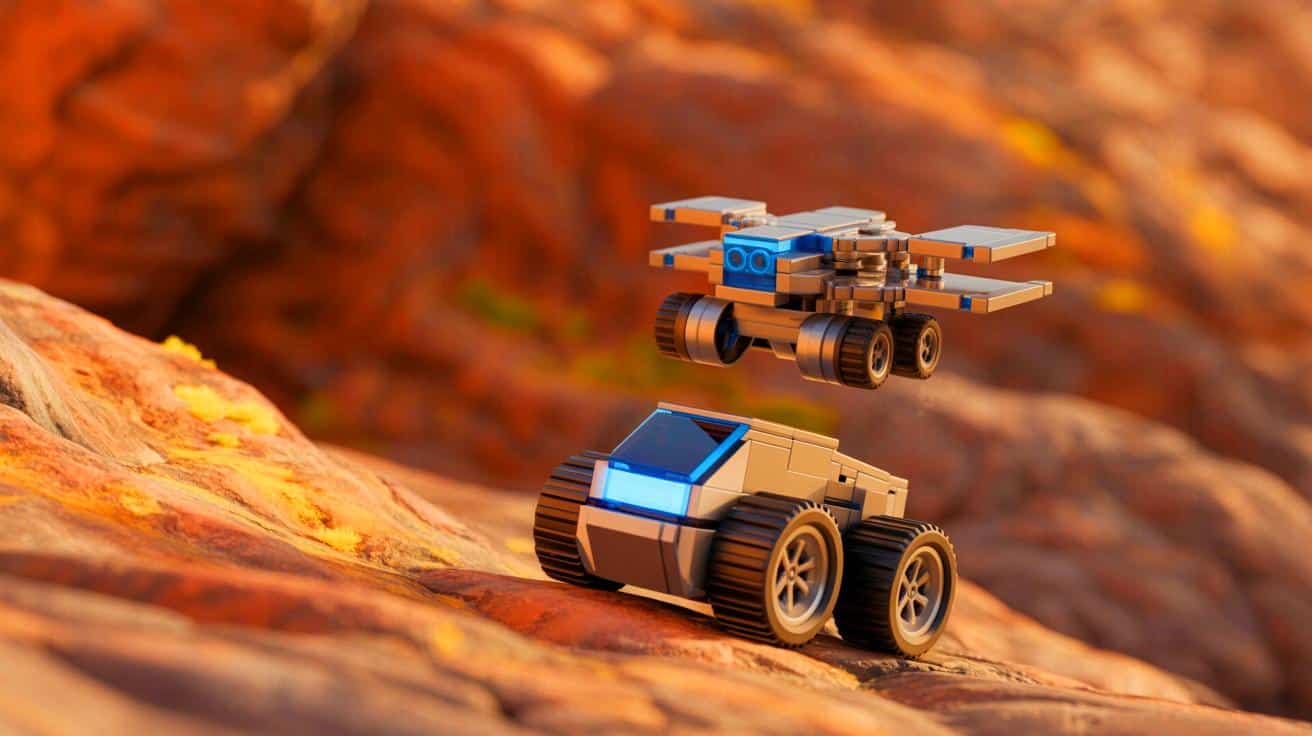
This innovative microrobot, weighing only 25 grams and measuring just 9 centimeters, can seamlessly transition between flying and driving modes. During outdoor tests, it showcased its incredible capabilities by flying over obstacles, landing smoothly, and then transforming to drive across the ground. This adaptability allows it to navigate complex terrains, including slopes, wedge-shaped surfaces, and confined spaces. The robot’s ability to change shape enables it to tackle challenges that are beyond the reach of conventional single-mode robots.
The key to this adaptability lies in the small-scale actuator used in the robot. It operates like robotic muscles, using electrothermal control to morph and lock into various shapes. This capability allows for continuous shape transformations with a single power source, a feat that earlier designs struggled to achieve. The modular design of the microrobot, inspired by Lego construction, enables it to take on various forms, making it suitable for a wide range of applications, from geological research to disaster relief.
Applications that Push Boundaries
The potential applications of this microrobot extend far beyond its immediate capabilities. The researchers have identified several fields where this technology could make a significant impact. For instance, in geological research and environmental monitoring, the robot’s ability to navigate difficult terrains makes it an ideal candidate for exploration and data collection. In disaster relief scenarios, its shape-shifting abilities could prove invaluable for search and rescue missions, as it can crawl through rubble and transition to water mode in flooded areas.
Moreover, the actuator technology holds promise for other sectors, including medical technologies, dynamic 3D display systems, and tactile feedback tools for virtual reality. These applications could lead to the development of intelligent machines capable of adapting to various tasks, ultimately enhancing efficiency and effectiveness in numerous industries. The details of this pioneering research have been published in the journal Nature Machine Intelligence, providing a comprehensive overview of the innovations and their potential implications.
Future Possibilities and Challenges
While the current capabilities of the microrobot are impressive, the journey of innovation is far from over. Researchers continue to explore ways to enhance the robot’s performance and broaden its range of applications. The integration of these tiny robots into everyday technologies could revolutionize how we approach problems in fields as diverse as healthcare, engineering, and environmental science.
However, challenges remain. The miniaturization of components, energy efficiency, and cost-effectiveness are ongoing considerations that researchers must address to bring this technology to a broader market. As we look to the future, one question remains: how will these tiny shape-shifting robots reshape our world and redefine what’s possible in the realm of robotics?


Wow, this flying Lego bot sounds like something out of a sci-fi movie! 🤖
Can it really handle all kinds of terrain, or are there limitations?
I’m curious about how durable this microrobot is in extreme conditions.
Les chercheurs chinois sont vraiment à la pointe de la technologie!
Imaginez un essaim de ces robots en train de sauver des vies lors d’une catastrophe…