




| IN A NUTSHELL |
|
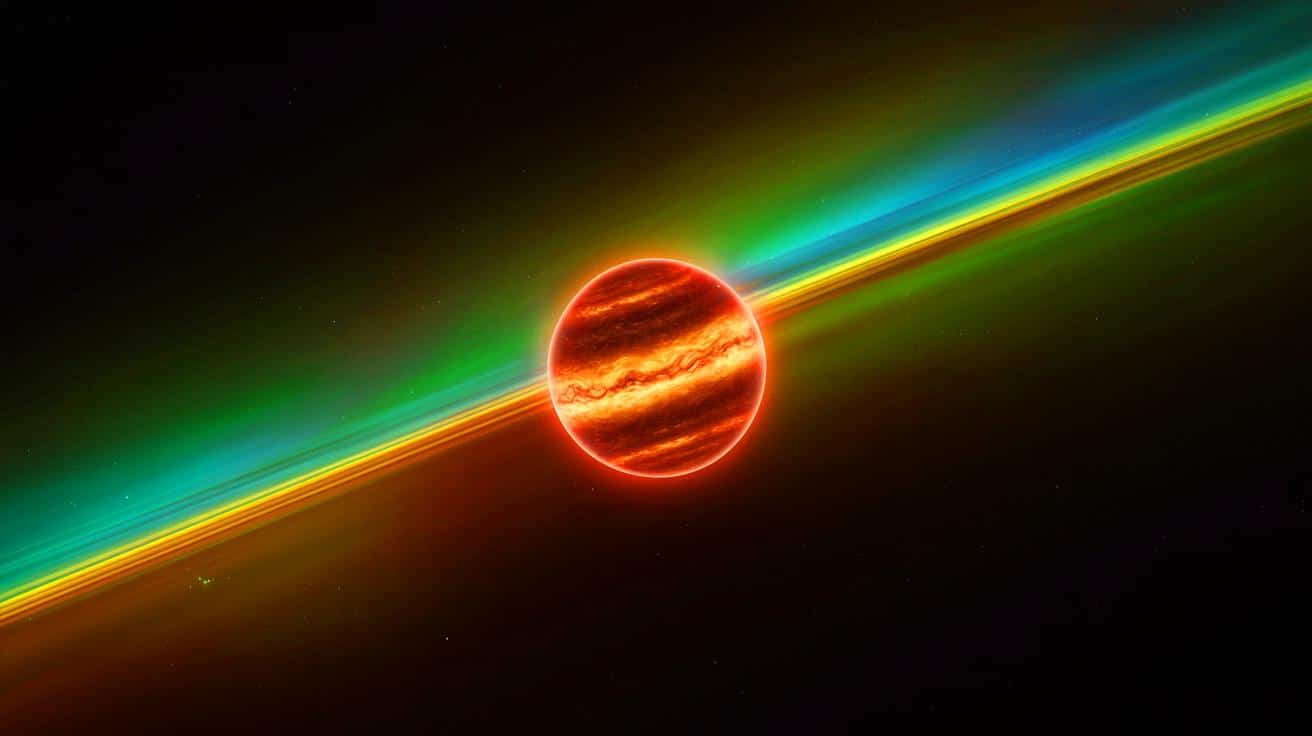
In a recent astronomical breakthrough, the James Webb Space Telescope has turned its focus to an intriguing celestial body: a sunless world known for its intense auroras. This discovery has drawn the attention of scientists eager to understand how a planet-like object, without a sun, can exhibit such vivid natural phenomena. The mysterious body in question is SIMP-0136, a brown dwarf located about 20 light-years away in the Pisces constellation. Brown dwarfs like SIMP-0136 occupy a gray area between planets and stars, offering unique opportunities for study. This article explores the fascinating characteristics of SIMP-0136 and what its study reveals about the universe’s complexities.
Understanding Brown Dwarfs and Their Formation
Brown dwarfs, often referred to as “failed stars,” have puzzled astronomers for decades. These celestial objects are not massive enough to initiate nuclear fusion at their cores, a process that defines true stars. Instead, they exist in a liminal space between planets and stars, possessing attributes of both. The formation of brown dwarfs is still a topic of active research. Some theories suggest they form like planets, accumulating material in a protoplanetary disk. Others propose that they emerge like stars, through the contraction of gas clouds.
SIMP-0136 stands out as a particularly interesting brown dwarf due to its status as a rogue world, meaning it is not gravitationally bound to any star system. This floating nature provides a unique chance for scientists to study an object without the interference of stellar light. Using data from the James Webb Space Telescope, researchers have been able to observe the rotations of SIMP-0136 and gain insights into its atmospheric conditions. The recent findings published in Astronomy & Astrophysics offer a detailed “weather report” for this enigmatic world.
The Enigma of Auroras on a Sunless World
Auroras on Earth are typically caused by interactions between solar wind and our planet's magnetic field. However, SIMP-0136, devoid of a sun, presents a unique case. The study of this rogue world has revealed that its auroras are the result of charged particles moving through interstellar space. These particles interact with the brown dwarf's robust magnetic field, generating intense auroral displays.
The research highlights a significant temperature anomaly in SIMP-0136's atmosphere. Specifically, scientists discovered a layer of air about 570 degrees Fahrenheit warmer than initially predicted. This unexpected warmth is believed to be a product of auroral activity. The brown dwarf's magnetic field is much stronger than Earth's, amplifying interactions with charged particles and heating the upper atmosphere. This contributes to an overall temperature of approximately 2,732 degrees Fahrenheit, despite its classification as one of the coldest star types in the cosmos.
Brown Dwarfs as a Window into the Cosmos
Brown dwarfs like SIMP-0136 offer an unparalleled opportunity for astronomers to study celestial phenomena without the complicating presence of nearby stars. This absence of stellar radiation allows for precise measurements of atmospheric conditions and temperature changes, enhancing our understanding of these mysterious bodies. In the case of SIMP-0136, scientists were able to track atmospheric shifts over a full rotation, providing unprecedented insight into the environmental dynamics of a rogue world.
Dr. Evert Nasedkin, a leading researcher on the project, emphasized the significance of these findings. The precise measurements achieved by the team mark a breakthrough in the study of extra-solar objects. Moreover, the ability to observe atmospheric changes directly opens new avenues for understanding the weather and behavior of alien worlds. As we continue to explore the cosmos, brown dwarfs will remain a focal point for advancing our knowledge of planetary science.
The Broader Implications of Rogue Worlds
The study of rogue worlds like SIMP-0136 extends beyond the realm of academic curiosity. These objects provide insights that could reshape our understanding of planetary formation and the diversity of celestial bodies. By examining the atmospheric and magnetic properties of brown dwarfs, scientists can develop more comprehensive models of other exoplanets and similar objects.
The implications of this research are vast, potentially informing our search for life beyond Earth. By understanding how brown dwarfs and other rogue worlds operate, we can refine our criteria for identifying habitable zones and the potential for life elsewhere in the universe. Moreover, the study of SIMP-0136 and its auroras highlights the intricate interplay of cosmic forces at work even in the absence of a central star.
As our exploration of the universe continues, the study of brown dwarfs like SIMP-0136 remains crucial. These fascinating celestial objects challenge our understanding of planetary science and offer a glimpse into the complex dynamics of the cosmos. What other mysteries might we uncover as we look deeper into the night sky, far beyond the reach of our sun?

Wow, auroras on a sunless world? That’s mind-blowing! 🌌
Wow, auroras on a sunless world? That’s mind-blowing! 😲
Comment ils ont pu détecter des aurores sans soleil? Ça me dépasse un peu, mais c’est fascinant! 🤔
How do auroras form without a sun? This is groundbreaking stuff!
This is just another example of how incredible the universe is! 🌟
The James Webb Space Telescope is truly a game-changer for astronomy. 🌌
Merci pour cet article captivant! Les découvertes astronomiques ne cessent de m’étonner.
Do you think we’ll find life in places like SIMP-0136 someday?
Je me demande quelles autres surprises nous réserve l’espace. 👽
I’m still trying to wrap my head around the idea of a “rogue world”!
Brown dwarfs, rogue worlds… It’s like a sci-fi story come to life!