





| IN A NUTSHELL |
|
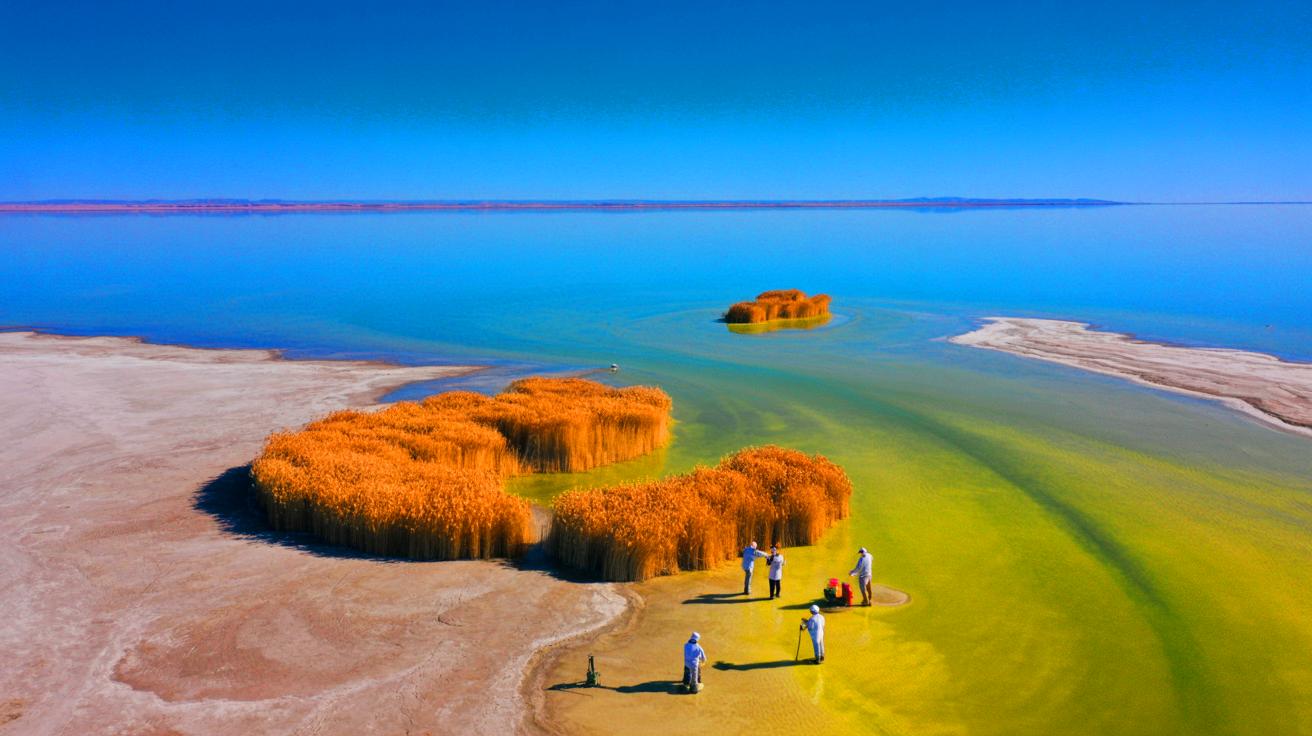
The ever-changing landscape of the Great Salt Lake continues to reveal secrets as its water levels decline. Recent discoveries have unearthed peculiar formations, sparking scientific curiosity and investigation. These formations, resembling reed-filled islands, have emerged from the lake’s drying bed, prompting researchers to delve into the mysteries beneath the surface. University of Utah geoscientists are now exploring these phenomena to understand the intricate subsurface processes at play. As they unravel the secrets of these strange islands, the findings could have profound implications for water management and environmental preservation in the region.
Unveiling Subsurface Mysteries
In recent years, phragmites-covered mounds have appeared on the exposed playa along the southeast shore of the Great Salt Lake. These formations have puzzled scientists, leading to an investigation into their origins. Bill Johnson, a professor at the University of Utah, suspects that these mounds are the result of a complex subsurface plumbing system. This system delivers fresh groundwater under pressure into the lake and its surrounding wetlands.
Johnson and his team, including graduate student Ebenezer Adomako-Mensah, have been diligently recording underground water pressures using piezometers. These instruments, installed at varying depths around the mounds, provide valuable data on the subterranean water dynamics. Their research aims to understand whether the groundwater emerges from upland sources or flows directly into the lake.
“Water in the lake has spent a significant time underground on its way to the lake. But where that happened, we don’t know,” Johnson noted, highlighting the complexity of the groundwater system. The findings from this research could reshape our understanding of the Great Salt Lake’s hydrology and inform strategies for its preservation.
Mapping the Lakebed's Hidden Resources
In February 2025, a major step was taken to uncover the secrets beneath the Great Salt Lake. Johnson enlisted Expert Geophysics, a Canadian firm, to conduct airborne electromagnetic surveys over Farmington Bay. A helicopter equipped with advanced technology flew over the bay, collecting data to locate freshwater deposits lurking under the lakebed.
This cutting-edge equipment generates currents that transmit frequencies deep into the lakebed. The signals bouncing back are recorded, creating a detailed image of the subsurface. Jeff Sanderson, a crew leader with Expert Geophysics, explained that this data would help create a three-dimensional map of the hidden resources.
Understanding the lakebed's hidden resources is crucial, especially with ongoing research indicating that the disturbed lakebed crusts could regenerate when submerged. This finding has significant implications for reducing dust pollution affecting Utah's population centers. Johnson's research also explores the potential of tapping groundwater to restore these crusts, but stresses the importance of careful management to avoid harming the wetlands.
Rethinking Groundwater Contributions
Traditionally, it was believed that groundwater contributed minimally to the Great Salt Lake's water budget. However, recent data suggests otherwise. Chemical mass balance methods indicate that groundwater could account for as much as 12% of the lake's water, challenging previous assumptions.
Johnson's team has discovered fresh water at depth in several offshore locations, defying expectations. This finding suggests that freshwater sources exist far from the lake's periphery, extending deep into the lakebed. The team's investigation has located freshwater in tight sediments up to 30 feet below the surface, with geophysical data indicating depths of up to 10,000 feet.
“We hope to map out the boundary between fresh water and salt water, and find the location of freshwater springs that are discharging groundwater into the lake,”
https://www.rudebaguette.com/en/2025/10/nasa-engineers-call-it-a-historic-first-psyches-laser-message-travels-307-million-miles-and-redefines-future-of-mars-communications/
stated Kip Solomon, a senior geology faculty member involved in the research. These findings have far-reaching implications for understanding the lake's hydrology and its potential as a water resource.
The Future of Water Management
One of the most intriguing aspects of Johnson's research is the presence of a vast underground plumbing system. This system, connecting groundwater to the surface, has created numerous groundwater-fed oases scattered across the lake's exposed playa. Johnson's team is working to uncover the origins and quantity of this hidden water.
While these discoveries are promising, Johnson emphasizes the need for caution. "The last thing we wanted to do is for this to be characterized as a water resource we should be tapping," he warned. The fragile nature of this hidden resource underscores the importance of understanding it fully before considering any exploitation.
The implications of this research extend beyond academic curiosity. They could influence future water management strategies and environmental policies. By comprehensively mapping the freshwater resources beneath the Great Salt Lake, scientists hope to inform sustainable practices that preserve this unique ecosystem while addressing the region's water needs.
As the Great Salt Lake continues to unveil its hidden secrets, the research conducted by Johnson and his team raises important questions about the future of water management in the region. How can we balance the need for water resources with the preservation of delicate ecosystems? What role will this newfound understanding of groundwater play in shaping sustainable practices? These questions remain at the forefront as scientists work to unravel the complexities of the Great Salt Lake's subsurface mysteries.

Wow, these islands sound like something out of a sci-fi movie! 🌍
Wow, who would have thought there was a hidden freshwater network beneath the desert? 🤯
Is it possible that these freshwater deposits could be used to support local agriculture?
Do you think these discoveries could change how we manage water resources in the area?
Thank you for shedding light on this fascinating topic. The Great Salt Lake never ceases to amaze!
Je suis fasciné par les îles étranges qui émergent dans le lac. Merci pour cet article captivant!
Wait, are we talking about Atlantis here? Just kidding, great article! 😂
I’m skeptical. How can they be sure these islands weren’t there before? 🤔
How do the scientists plan to study these islands without disturbing the unique ecosystem?
Thank you for shedding light on this mystery. It’s like finding Atlantis! 😄
Sounds like Mother Nature is full of surprises. More like this, please!
C’est incroyable de penser que de l’eau douce se cache sous le lac salé!
I’m skeptical. How do they know it’s not just a temporary phenomenon?
Could these findings impact the local ecosystem significantly?
Why weren’t these formations discovered earlier? Seems odd!
Great work by the University of Utah. Science never ceases to amaze me!
Les implications pour la gestion de l’eau sont énormes. Espérons que les décideurs politiques écoutent!
How do they measure the underground water pressures with piezo… somethings?
This article makes me want to visit the Great Salt Lake and see it for myself! 😊
The technology they’re using to map the lakebed sounds like something out of a sci-fi movie.
Je suis curieux de savoir comment cela affectera la faune locale.
The idea of a hidden freshwater network is both exciting and a bit unnerving. 😮
Could these findings help reduce dust pollution in the area?
Bravo à l’équipe de recherche pour leur dévouement et leur travail acharné!
Are there any similar discoveries in other salt lakes around the world? 🤔
J’espère que cette découverte ne mènera pas à une surexploitation des ressources en eau.
It’s amazing how much we still don’t know about our own planet!
Could this hidden water be used for agriculture in the future?
The article is a bit long but very informative. Thanks!
La découverte de ces îles étranges me laisse perplexe. Comment est-ce possible?
Isn’t it risky to tap into these hidden water resources? 😬
Great insights on the environmental implications of this discovery!
Ce réseau d’eau souterraine pourrait-il être utilisé pour résoudre les pénuries d’eau locales?
I love the idea of a hidden world under the Great Salt Lake. It’s like a real-life mystery novel! 📚
How will they balance water resource management with preserving the environment?
Y a-t-il d’autres zones dans le désert qui pourraient cacher de telles ressources?
What an incredible discovery! Can’t wait to see what they find next. 😊
The detailed mapping of the lakebed is a monumental task. Kudos to the team!
Cela pourrait-il affecter le niveau du lac à long terme?
I’m always amazed by what lies beneath the surface. Who knew deserts could hide such secrets?