





| IN A NUTSHELL |
|
China is making bold strides to revolutionize its aerospace manufacturing, aiming to rival the United States in launching capabilities. Inspired by the efficiencies of automotive manufacturing, China is implementing a new system known as “final assembly pull.” This approach promises to transform how rockets and satellites are produced, potentially altering the global space race dynamics. With a focus on lean manufacturing principles, the nation plans to scale its production efforts, seeking to close the gap with the U.S., which completed 158 orbital launches in 2024 compared to China’s 68. The implications of this shift could be significant for the future of space exploration and industry.
Scaling China’s Space Industry Manufacturing
As global space activity continues to expand, the need for scalable and efficient manufacturing systems becomes increasingly critical. By 2045, it is estimated that orbital launches will involve an annual payload of 170,000 tons. China aims to meet this demand with its innovative “final assembly pull” system. This approach seeks to mass-produce satellite and rocket parts more cost-effectively, while maintaining high quality standards.
Traditionally, aerospace production has relied on a “push” system, where components are manufactured based on predicted launch schedules. This method often results in delays and excess inventory. Conversely, the “pull” system, inspired by the Toyota Production System, introduces a more flexible approach. It pulls components from suppliers only when they are needed, reducing waste and streamlining manufacturing processes.
This method allows for a reduction in time spent managing and moving excess stock, mitigating bottlenecks and accelerating production times. By applying this system to its space industry, China hopes to enhance the efficiency of its rocket and satellite manufacturing processes.
A Coordinated National Strategy
China’s new manufacturing strategy involves a coordinated effort across various sectors of its space industry. This includes state-owned enterprises, research institutes, and private suppliers working together in a unified national strategy. The China Aerospace Science and Technology Corporation (CASC) describes the initiative as a “systemic and disruptive transformation” of existing manufacturing models.
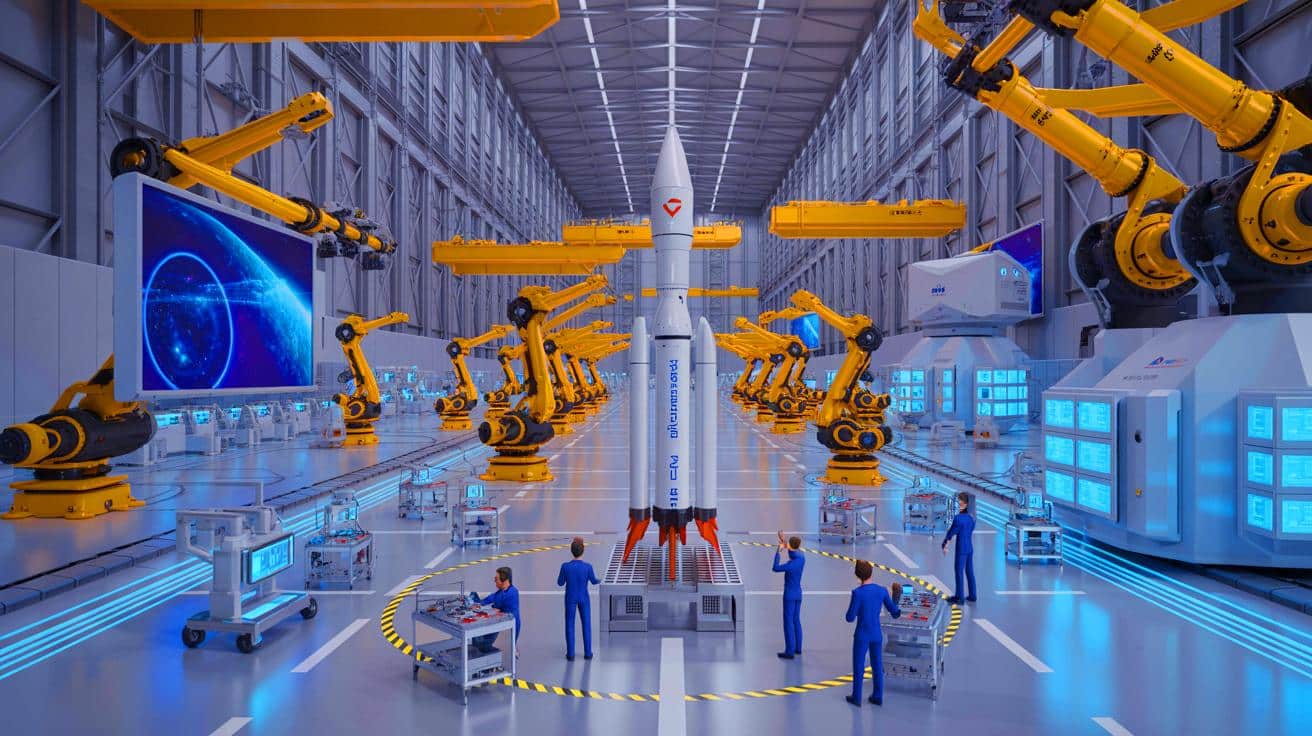
Instead of static production lines, China is embracing modular and flexible assembly systems. These systems utilize AI and robotics to dynamically adjust workflows, creating an adaptable manufacturing environment. A collaborative digital platform further connects different labs, suppliers, and factories, providing managers with a real-time overview of the supply chain through a “digital pull board.”
This integrated approach aims to establish a more agile and efficient supply chain for China’s space industry, enhancing its ability to compete with SpaceX and other global players. The development of satellite mega-constellations such as Guowang, Qianfan, and Hongtu-3 underscores China’s commitment to challenging U.S. dominance in orbital operations.
Implications for the Global Space Race
The shift towards a more efficient manufacturing process in China’s space industry could have far-reaching implications for the global space race. By adopting lean manufacturing principles, China positions itself to significantly increase its launch capabilities and reduce costs. This strategy not only aims to close the gap with the U.S. but also to potentially surpass it in the future.
The new manufacturing model may lead to increased competition in the space sector, driving innovation and potentially lowering costs for space exploration and satellite deployment. As China enhances its capabilities, other nations may feel pressured to adopt similar strategies to maintain their competitive edge.
Moreover, the success of China’s approach could encourage further collaboration between nations and private companies in the space industry. This could lead to more joint ventures and partnerships, fostering a more interconnected and cooperative global space community.
Challenges and Future Prospects
While China’s new manufacturing strategy holds great promise, it also faces several challenges. Implementing such a systemic transformation requires significant investment and coordination across multiple sectors. Ensuring the reliability and quality of mass-produced components will be crucial to the program’s success.
Additionally, the geopolitical landscape may influence how other nations respond to China’s advancements in space technology. As countries strive to protect their interests, the global space industry could become more competitive, with each nation seeking to assert its dominance.
Despite these challenges, China remains committed to its vision of becoming a leading player in the aerospace industry. The country’s efforts to innovate and streamline production processes signal a new era in space exploration, one that could redefine the boundaries of what is possible in the cosmos.
As China continues to advance its aerospace manufacturing capabilities, the world watches with anticipation. The implications of these developments reach far beyond national borders, influencing the future of space exploration and industry. How will other nations respond to China's ambitious strategy, and what impact will these changes have on the global space race?


Wow, China’s really stepping up their game! Do you think the US can keep up? 🤔
Wow, China’s really stepping up their game! 🚀 How will this impact international collaborations in space exploration?
Is this new strategy sustainable in the long term, considering the geopolitical tensions? 🤔
Isn’t it risky to rely so heavily on AI for something as complex as rocket manufacturing?
Thank you for such an insightful article! It’s fascinating to see how AI is being integrated into space manufacturing.
Great article! Thanks for the insights. 😊
So, is this like the “Space Race 2.0”? Seems like history is repeating itself!
This sounds like a fascinating development, but how long before we see real results?
Will these advances make space travel more affordable for the general public?
This sounds a bit too ambitious. Can China really catch up to the US in terms of launch numbers?
Not sure if AI can replace the human touch in rocket science. What do you think?
Are there any environmental concerns with increasing the number of rocket launches?
It’s amazing how much innovation is coming from China these days. Go, China! 🚀
Great read! Looking forward to seeing how the US responds to this challenge. 🇺🇸🛰️
I’m skeptical about these large-scale plans. Are they achievable or just ambitious talk?
158 launches from the US sounds impressive! How many do you think China will manage?
Is “final assembly pull” just a fancy name for cost-cutting measures?
Thank you for the article. It’s incredible how AI is transforming industries. 🤖
Does anyone else feel like we’re living in a sci-fi movie with all these space advancements?
China vs. US space race: who do you think will come out on top in the next decade?
I hope this competition leads to more collaboration in space exploration.
Are there any potential downsides to this new manufacturing strategy?
China’s approach seems promising, but will it lead to tech breakthroughs or just more rockets?
It’s about time someone challenged the US in space exploration! 🌌
I wonder what Elon Musk thinks about this new competition from China. 😄
How does this “digital pull board” work exactly? Sounds intriguing!
Is it just me, or does this space race feel like something straight out of a Cold War era?
China’s focus on efficiency is commendable. Let’s see if they can sustain it.
Really curious to know how private companies like SpaceX will respond to China’s strategies.
Can we expect to see more international partnerships in space due to this development?
Space exploration is getting exciting again, thanks to competition! 🚀
China’s using AI in space tech, and I’m still struggling with my smartphone. 🤷♂️
Will this new strategy affect global space policy or just commercial launches?
Thank you for the detailed analysis! It’s a thrilling time for aerospace enthusiasts.
How sustainable are these new manufacturing techniques in the long run?
It’s going to be interesting to see how the geopolitical landscape shifts with these advancements.
Could this new approach lower the costs of space travel for other countries too?
AI, robotics, and space – the future is now! But is it too much too fast?