





| IN A NUTSHELL |
|
A groundbreaking innovation from Japan is poised to revolutionize the way we deal with space debris, a mounting problem in Earth’s orbit. Researchers at Tohoku University have developed a new propulsion system that could offer a contact-free method for cleaning up space junk. This technology, known as the “bidirectional plasma ejection type electrodeless plasma thruster,” proposes a solution to the risks posed by defunct satellites and spent rocket stages. With the potential to significantly reduce the threat of collisions that could damage operational satellites and disrupt critical space-based services, this innovation could be a game-changer in ensuring the sustainability of human activities in space.
The Mechanics of Plasma Ejection
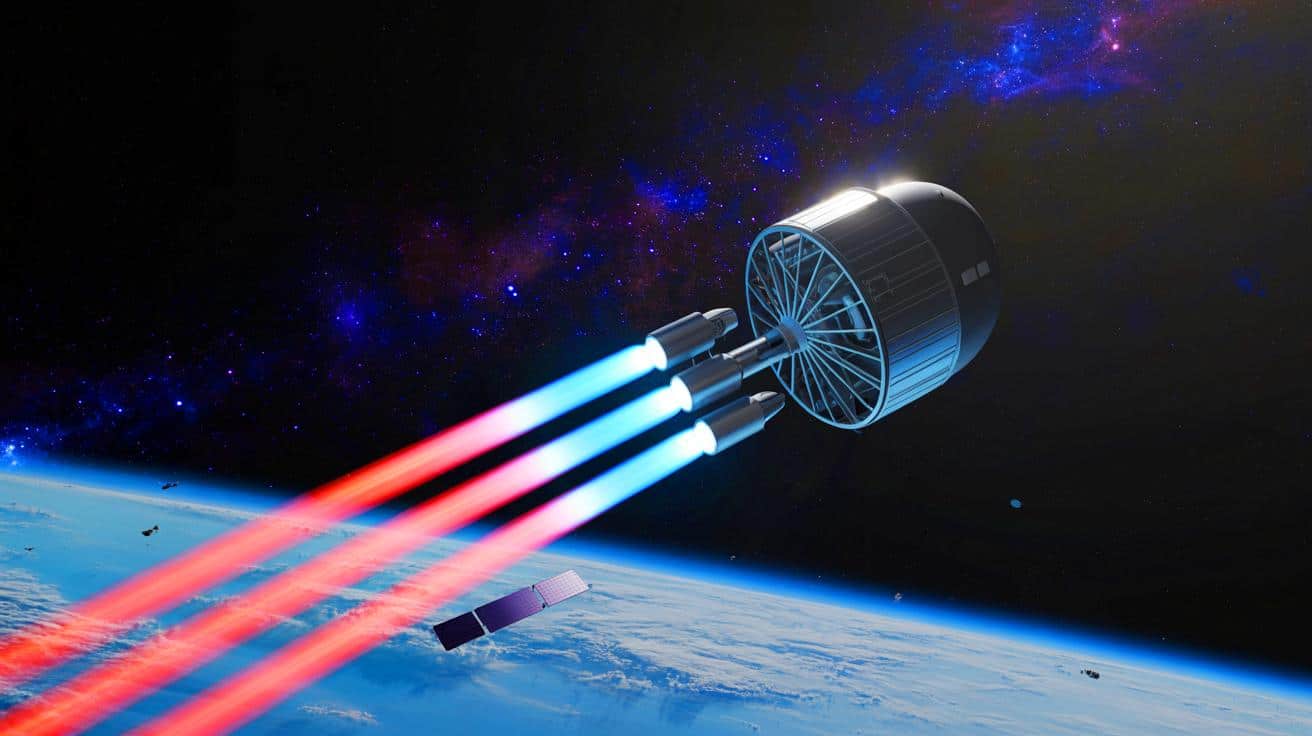
The core of this novel technology lies in its ability to eject two plasma streams simultaneously. Traditional methods of space debris removal often rely on physical contact, using robotic arms, nets, or tethers. These approaches come with significant risks, such as entanglement with the rotating debris. The new system aims to circumvent these challenges by using a satellite equipped with an ion engine to expel plasma. This plasma exhaust serves to nudge the space debris into the atmosphere, where it can burn up safely.
The ingenuity of this system is in its dual plasma streams—one aimed at the debris to decelerate it, and another in the opposite direction to counteract the kickback force. This balanced thrust ensures that the removal satellite remains stable and on target, rather than being pushed away by the plasma’s recoil. Professor Kazunori Takahashi, who spearheaded this project, explains that the propulsion engine applies deceleration force to the target object while maintaining stability with the counteracting plasma stream.
Argon: The Affordable Propellant
One of the standout features of this propulsion system is its use of argon as a propellant. Argon is not only cheaper but also more abundant compared to traditional propellants, making it an economically viable option for large-scale deployment. During tests conducted in a vacuum to mimic space conditions, the team observed that the addition of a “cusp” magnetic field significantly enhanced the system’s performance. This field helps contain and focus the plasma, effectively tripling the deceleration force achieved in earlier experiments.
Professor Takahashi emphasized the technological advancement that this represents, highlighting the system’s potential to efficiently and safely remove space debris. With an estimated 14,000 pieces of junk currently floating in low Earth orbit, the stakes are high. This debris poses a constant threat to both existing satellites and future space missions. By providing a sustainable solution, the bidirectional thruster could play a crucial role in mitigating these risks.
Preventing the Kessler Syndrome
The threat of the Kessler syndrome looms large in discussions about space debris. This scenario describes a chain reaction of collisions between space debris and operational satellites, leading to a cascade of further collisions. If such an event were to occur, it could render large sections of low Earth orbit unusable, posing severe challenges to future space exploration and satellite operations. The bidirectional plasma thruster developed by Tohoku University could help avert this crisis by targeting larger pieces of space junk, which are more likely to trigger such events.
The findings from this research were published in Scientific Reports on August 20, 2025, marking a significant step forward in space debris mitigation efforts. As the global community continues to rely on satellite technology for communication, navigation, and earth observation, addressing the issue of space debris becomes increasingly imperative.
Future Implications for Space Sustainability
The development of this propulsion system opens new avenues for maintaining a sustainable presence in space. As countries and private companies continue to launch satellites at an unprecedented rate, the need for effective debris management solutions becomes ever more urgent. The bidirectional plasma ejection system offers a promising alternative to current methods, with the potential to be integrated into future satellite missions as a standard feature.
Moreover, this technology exemplifies the innovative spirit of space research, demonstrating how challenges in orbit can be addressed through cutting-edge science and engineering. As the system undergoes further testing and potential deployment, it could set a precedent for international cooperation in space debris management. With space becoming an increasingly crowded and competitive arena, how will global stakeholders coordinate efforts to ensure the long-term sustainability of our shared orbital environment?
This plasma gun sounds like something out of a sci-fi movie! Can’t wait to see it in action. 🚀
Wow, une arme à plasma pour les débris spatiaux ? On est dans un film de science-fiction ! 😄
Est-ce que cette technologie est déjà opérationnelle ou encore en phase de test ?
Does this mean we’re one step closer to a cleaner and safer orbit for our satellites?
Je me demande combien de temps il faudra pour nettoyer tout ce bazar là-haut. 🤔
I hope they thought about the potential risks of using plasma in space. Sounds like a delicate operation.
C’est génial de voir des solutions innovantes pour un problème si urgent. Bravo, Tohoku University !
Great job, Japan! Tackling space junk is a massive leap for all of us. 😊
J’espère que cette technologie ne va pas créer plus de déchets qu’elle n’en élimine.
Argon comme propulseur ? Intéressant, ça doit vraiment réduire les coûts !
Will this technology be shared globally, or is it just for Japan’s use?
Est-ce que d’autres pays travaillent sur des solutions similaires ?
Finally, a solution to all that space junk! About time someone took action.
Ah ouais, la Kessler syndrome, ça fait peur. Heureusement qu’ils y pensent ! 😅
This sounds amazing, but what happens if the plasma gun accidentally hits a functioning satellite?
Je suis curieux de savoir comment ça fonctionne exactement, mais ça a l’air compliqué.
Merci pour cet article, j’ai appris quelque chose de nouveau aujourd’hui !
Est-ce que cette technologie pourrait être utilisée pour autre chose que les débris spatiaux ?
J’espère qu’ils ont pensé à la sécurité des satellites existants pendant le nettoyage.
Pourquoi personne n’a pensé à ça plus tôt ? C’est brillant !
Combien de temps avant que cette technologie soit en action ? 😊
Je suis sceptique sur l’efficacité à long terme, mais bon, on verra bien.
Est-ce que ce système pourrait être utilisé pour protéger les stations spatiales ?
Les chercheurs japonais sont toujours à la pointe de la technologie, impressionnant !
Espérons que cela ne perturbe pas les satellites en orbite actuellement.
Est-ce que d’autres matériaux que l’argon pourraient être utilisés comme propulseur ?
Je suis juste heureux que quelqu’un fasse quelque chose à ce sujet. Merci ! 😃
Est-ce que cela pourrait aussi fonctionner sur d’autres orbites que la basse Terre ?
Combien ça coûte de lancer cette technologie dans l’espace ?
La science avance à grands pas, c’est fascinant !
Est-ce que cette technologie pourrait être militarisée ?
J’espère qu’on pourra voir ça en action bientôt, ça a l’air incroyable !
Combien de temps pour qu’on nettoie tout l’espace ? Des décennies ?
Est-ce que ce plasma pourrait endommager les satellites à proximité ?
Je trouve ça incroyable, mais est-ce vraiment réaliste ? 🤨
Je ne comprends pas tout, mais ça a l’air super intéressant !
Est-ce que ces systèmes vont être intégrés dans les futurs satellites ?
Enfin une solution pour éviter une catastrophe spatiale !
Je suis curieux de savoir comment ils ont testé ça sur Terre. 🤔
Peut-être que cela ouvrira la voie à d’autres innovations spatiales.
Est-ce que d’autres universités travaillent sur des projets similaires ?
J’espère que cette technologie sera partagée internationalement.
On verra si ça marche aussi bien que ça en a l’air. 😉