




| IN A NUTSHELL |
|
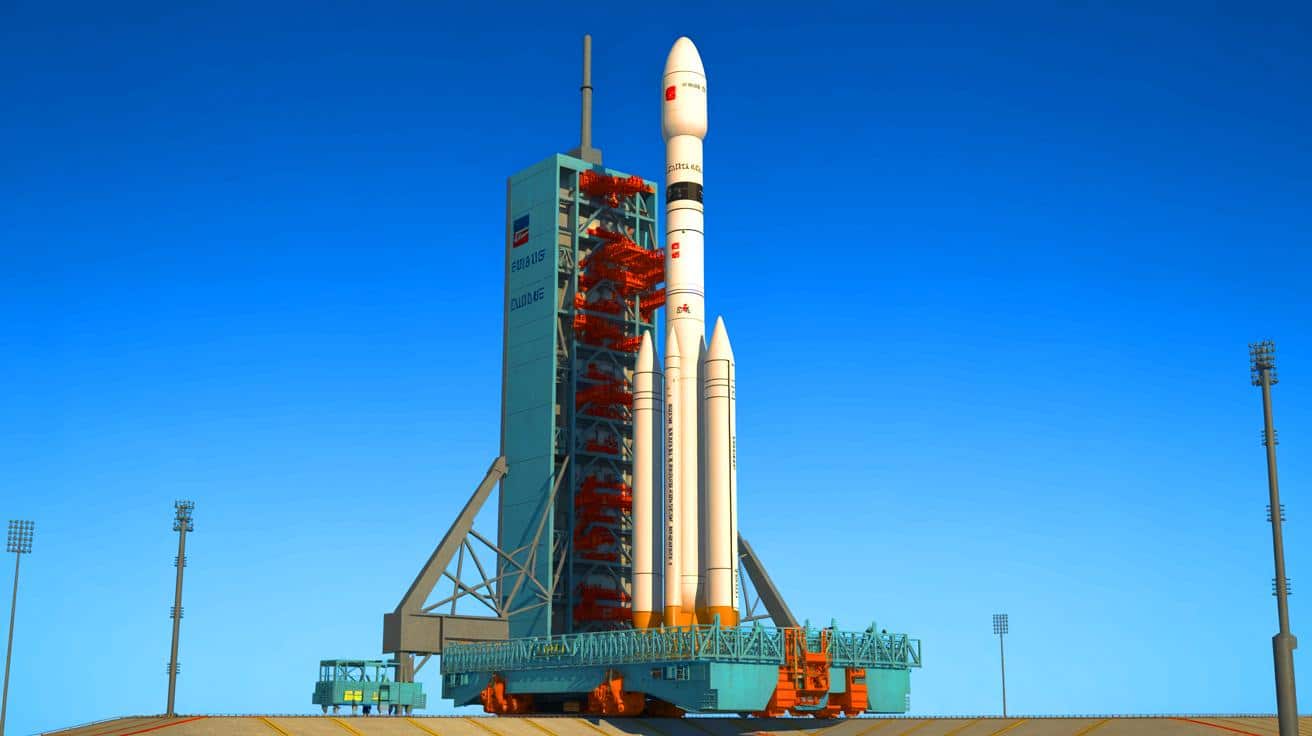
The space race is evolving, with China taking significant strides toward advancing its reusable rocket technology. Space Pioneer, a Beijing-based start-up, has recently completed a successful full-scale ground test of its Tianlong-3 launch vehicle. This milestone marks a crucial step as the company prepares for the rocket’s debut flight later this year. On Monday, the Tianlong-3 fired its nine Tianhuo-12 engines for 35 seconds, achieving a thrust of nearly 1,102 tons. This test is a testament to China’s growing ambitions in space exploration and its desire to compete with established players like SpaceX, which has set benchmarks in the industry with its Falcon 9 rocket.
Aiming to Match SpaceX Falcon 9
The Tianlong-3 stands at an impressive 236 feet and is designed as a partially reusable, medium-lift rocket. It is engineered to carry between 17 and 18 tons to low Earth orbit, aligning closely with the capabilities of SpaceX’s Falcon 9. This comparison underscores Space Pioneer’s ambitious goal to challenge the global standard for reusable rockets. Since its development began in 2022, Tianlong-3 has been positioned as a key player in launching internet satellites. The rocket is expected to support the deployment of two substantial Chinese broadband constellations, Guowang and Qianfan, which aim to launch over 13,000 satellites each.
Despite the ambitious plans, both projects are currently behind schedule due to rocket shortages. Space Pioneer aims to conduct over 30 missions annually, offering a low-cost and high-frequency launch solution once Tianlong-3 becomes operational. This ambitious schedule is indicative of China’s broader strategy to carve out a significant share in the competitive space industry.
A Competitive Field in China
China’s space ambitions extend beyond Space Pioneer. The country’s landscape is dotted with several contenders vying for a piece of the orbital launch market. LandSpace, a private company, is also in the race with its Zhuque-3 reusable vehicle, which completed a trial in June. LandSpace CEO Zhang Changwu has hinted at a potential launch window between September and November. Meanwhile, China’s national aerospace program is developing the Long March-12A, with its first orbital launch targeted for late 2025.
All these vehicles share a common design approach: two-stage, medium-lift rockets with reusable first stages. This design philosophy echoes the model pioneered by SpaceX, which showed that reusability could significantly reduce launch costs and increase frequency. However, the path to reusability has not been smooth for China. Last year, a test mishap saw the Tianlong-3 lift off unexpectedly, resulting in a crash. Similarly, LandSpace’s Zhuque-2E faced a setback with a failed flight, although it was reportedly unrelated to the Zhuque-3’s design.
What Does It Mean for the U.S. and the Rest?
SpaceX’s Falcon 9 has set a high bar, achieving an unmatched launch cadence, largely driven by the deployment of its Starlink constellation. However, China’s rapid progress in developing reusable rocket technology signals a narrowing gap in capabilities. If Tianlong-3 or Zhuque-3 can achieve orbit and demonstrate reliable reusability, China could bolster its satellite deployment ambitions significantly. The increasing importance of reusable rockets extends beyond commercial considerations; they are also becoming strategic assets on the global stage.
For the United States, the critical concern is not whether China can replicate the achievements of Falcon 9, but rather how swiftly it can scale these innovations to meet its national objectives. As China continues to enhance its space capabilities, the global landscape of space exploration and utilization is poised for substantial shifts.
As China’s reusable rocket technology advances, it prompts questions about the future of global competition in space. Will China’s progress spur further innovations and collaborations, or will it intensify the space race among nations? The coming years will undoubtedly reveal how these developments reshape the dynamics of space exploration and international cooperation. How will other nations respond to China’s emerging capabilities in the realm of reusable rockets?

Wow, 26,000 satellites! Is that even possible? 🤔
Wow, ça devient intense cette course à l’espace ! 🚀
This sounds like a plot straight out of a sci-fi movie. 🚀
Est-ce que la technologie de SpaceX est vraiment si facile à copier ? 🤔
Are we sure China really stole the technology? Seems like a bold claim!
Impressionnant de voir la Chine rattraper SpaceX si rapidement !
Interesting read, but how reliable is this source?
China is really stepping up its game in the space race. Impressive! 😊
Encore un exemple de la rapidité avec laquelle la Chine avance technologiquement.
Can the Tianlong-3 really compete with SpaceX’s Falcon 9?
La compétition est bonne pour l’innovation. Qui sait ce qui en sortira ? 😊
I’m curious about the environmental impact of so many satellites.
Why would SpaceX let their technology be stolen? Sounds fishy!
Maybe this competition will lead to even more innovations in space travel.
Do we really need more satellites? Space is getting crowded.
Thanks for the article! It’s fascinating to see the global space race evolving.
Are there any other countries trying to catch up with SpaceX?
Didn’t SpaceX face similar accusations in the past? 🤔
I’m not sure how I feel about this. More satellites, more problems?
Haha, China’s secret rocket test sounds like a James Bond plot. 😄
Is this just a case of technological espionage, or is it exaggerated?
I wonder how the U.S. will respond to China’s advancements in space tech.
The space race is getting intense! Who will come out on top?
How will this affect global satellite communications?
Isn’t it about time other companies caught up with SpaceX?
Could this mean more internet access worldwide? Fingers crossed! 🤞
Space Pioneer’s ambitions are huge! Can they really pull it off?
Are the Tianlong-3 and Falcon 9 really that similar?
How do they plan to launch 26,000 satellites without collisions?
Will this lead to more collaborations or just more competition?
It’s always exciting to hear about advancements in space technology!
Does this mean cheaper internet for everyone? I hope so! 😊
I can’t believe they might have copied SpaceX. What happened to innovation?
Does anyone know if there are any legal actions being taken?
Is this article a bit biased, or am I imagining things?
Would love to see a follow-up on how the U.S. responds to this.
Hopefully, this will push the boundaries of what’s possible in space exploration.
How will this impact other space agencies around the world?
So many satellites! Are we prepared for potential space debris issues?
Thanks for the info! It’s crazy to think about the future of space travel. 🤯
Are the Chinese rockets as reliable as SpaceX’s? Only time will tell!
Space exploration is truly entering a new era. Exciting times ahead!