




| IN A NUTSHELL |
|
In recent years, the development of autonomous vehicles has captured the public’s imagination and sparked significant debate. A recent demonstration in Austin, Texas, however, has brought to light the potential dangers these vehicles pose to public safety. Sponsored by the Dawn Project, a watchdog group founded by Dan O’Dowd, the demonstration depicted Tesla’s autonomous taxis failing to stop for a child-sized mannequin crossing the street. This event has raised critical questions about the readiness and safety of autonomous technology, especially when navigating common scenarios like encountering a stopped school bus.
The Demonstration’s Alarming Findings
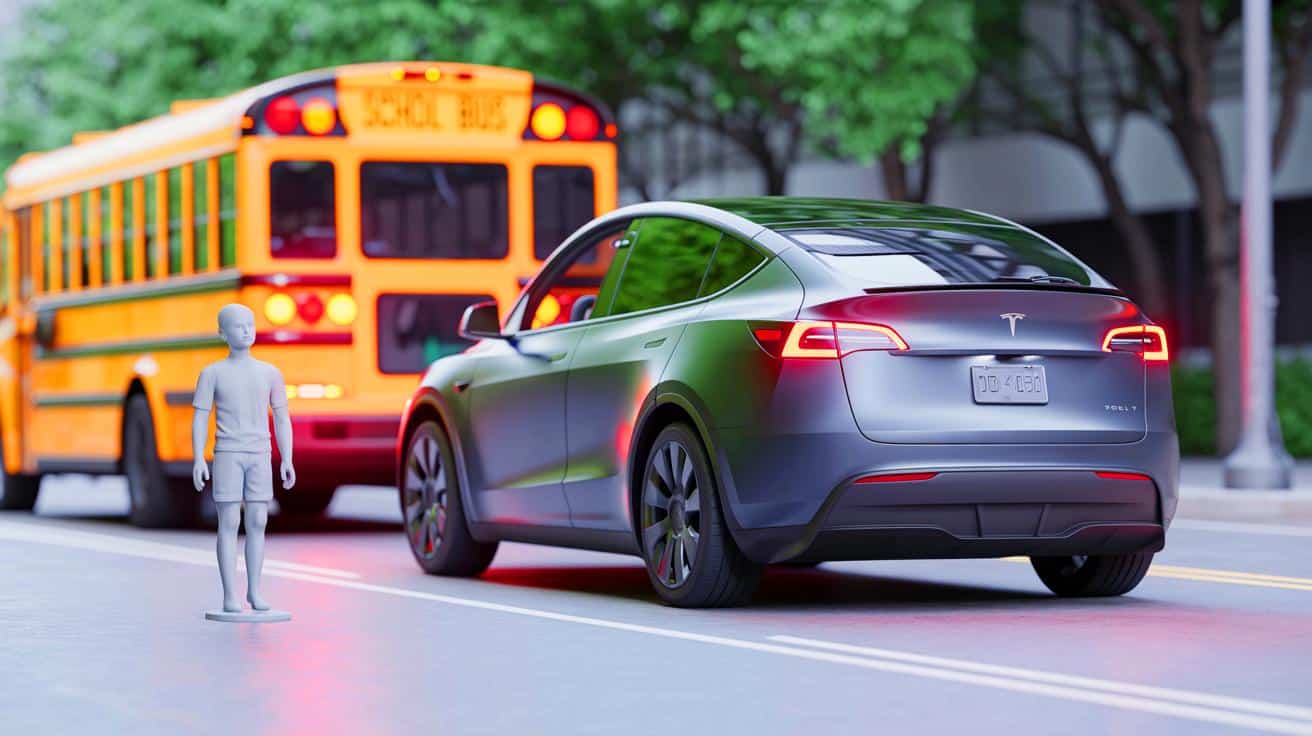
During the demonstration, a Tesla Model Y equipped with the latest autonomous driving software was put to the test on public roads. The vehicle approached a stopped school bus, which had its lights flashing, indicating that children might be crossing. Instead of slowing down, the Tesla continued at full speed, striking a child-sized mannequin that was placed to simulate a pedestrian crossing the street. It took the vehicle an entire car length to come to a complete stop.
The implications of such a failure are significant, indicating a severe limitation in the vehicle’s ability to detect and respond to common traffic signals and pedestrian safety measures. Dan O’Dowd, the founder of the Dawn Project, highlighted the gravity of the situation by stating, “This shows that a fully autonomous Tesla won’t stop for a bus, and if a child emerges, it will strike them.” O’Dowd has been vocal about the need for legislative action to address these issues, yet progress has been frustratingly slow.
Calls for Action and Accountability
Despite the alarming demonstration, efforts to prompt action from Tesla and government regulators have been largely ineffective. O’Dowd noted, “Despite a two-year campaign by the Dawn Project to highlight the school bus problem, lawmakers and Tesla itself have done nothing to resolve the issue.” This statement underscores the ongoing tension between technological advancement and regulatory oversight.
Tesla has yet to address the software bug that caused the autonomous vehicle to fail the demonstration. Additionally, there has been no government-mandated recall to address the potential safety hazards. This lack of response raises questions about the accountability of tech companies and their obligation to ensure public safety as they develop and deploy new technologies.
Tesla’s Struggles in a Changing Market
Tesla’s autonomous taxis represent a crucial component of Elon Musk’s strategy to revitalize the company amidst a backdrop of declining sales and political controversy. The company’s Cybertruck sales have been on a downward trend, contributing to Tesla’s financial struggles. Furthermore, Musk’s political decisions have alienated some customers, leading to lawsuits from owners who feel their vehicles represent political views they do not support.
Amidst these challenges, the success of Tesla’s autonomous taxi project is seen as a potential lifeline. However, the recent demonstration has cast doubt on the viability of relying on this technology to restore the company’s fortunes. As Tesla navigates these turbulent times, the effectiveness and safety of its autonomous vehicles will play a pivotal role in shaping its future.
Future of Autonomous Vehicles
The demonstration in Austin has reignited the debate over the safety and readiness of autonomous vehicles. Proponents argue that these technologies have the potential to reduce traffic accidents and improve transportation efficiency. However, instances like the one demonstrated by Tesla expose the current limitations and potential risks associated with these vehicles.
“What has happened since? Tesla hasn’t fixed the bug. And the government still hasn’t forced a recall,” lamented O’Dowd.
This highlights the ongoing challenge of balancing innovation with safety and regulatory oversight. The future of autonomous vehicles will depend on the industry’s ability to address these safety concerns and build public trust in the technology.
The recent demonstration of Tesla’s autonomous taxis in Austin has highlighted significant safety concerns and sparked renewed debate over the readiness of self-driving technology. As the industry continues to evolve, the need for robust regulatory frameworks and accountability measures becomes increasingly apparent. How will Tesla and other autonomous vehicle manufacturers respond to these challenges, and what steps will be taken to ensure the safety of the public in the face of rapid technological advancement?

Oh non, c’est terrifiant! Comment Tesla va-t-elle régler ça? 😱
Les voitures autonomes sont censées être plus sûres, alors pourquoi ça ne marche pas? 🤔
Merci pour cet article qui met en lumière les problèmes de Tesla. 👏
Je pense que ce n’est qu’une question de temps avant que la technologie s’améliore.
Est-ce que quelqu’un a informé les régulateurs de la sécurité routière?