





| IN A NUTSHELL |
|
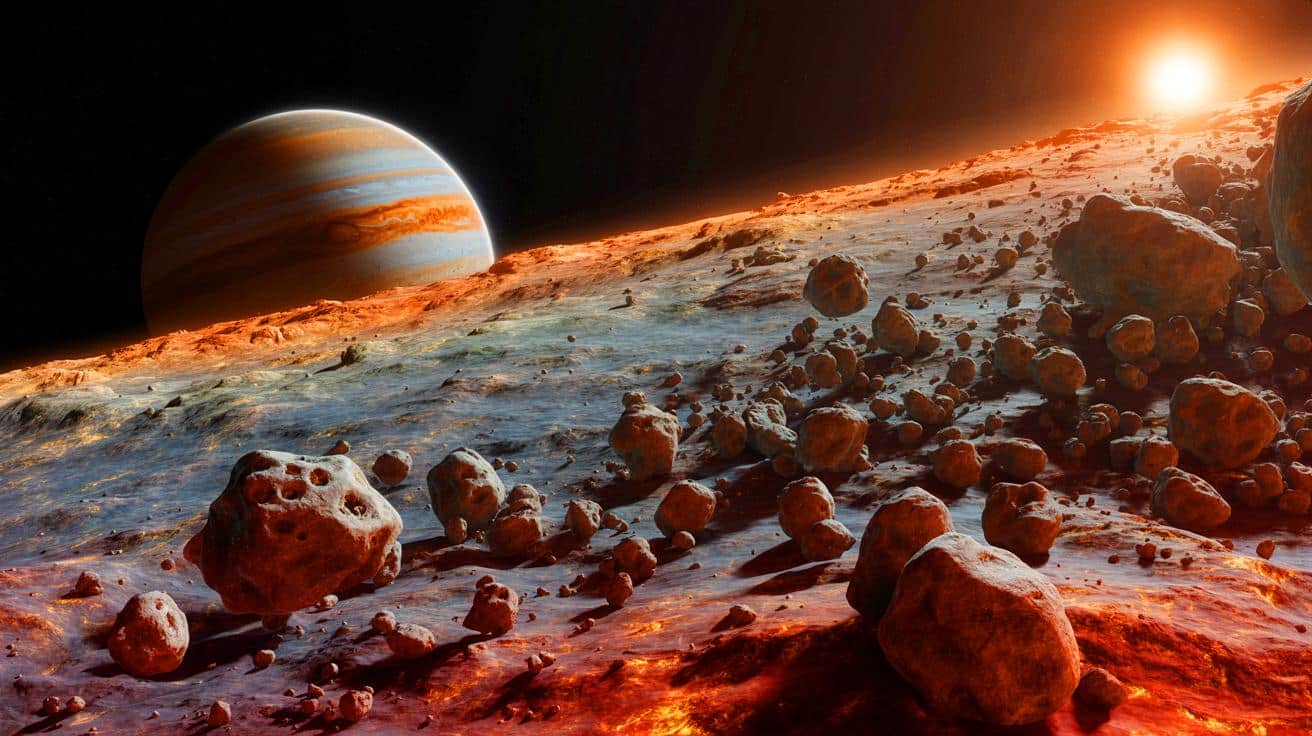
Orbiting between Mars and Jupiter lies a vast region populated by millions of asteroids, known as the asteroid belt. This expansive ring of space rocks has been present since the formation of the solar system, serving as a boundary between the inner rocky planets and the outer gas giants. Despite its long-standing existence, recent studies reveal that the asteroid belt is gradually losing its mass, potentially leading to its eventual disappearance. These findings highlight the dynamic nature of our solar system and raise important questions about the future of these celestial bodies.
The Asteroid Belt’s Slow Demise
Recent research has shed light on the gradual erosion of the asteroid belt, revealing that it is losing approximately 0.0088% of its mass every million years. This study, led by planetary scientist Julio Fernández from the Universidad de la República in Uruguay, was published on the preprint server arXiv. The focus of the research was on the collisionally active portion of the asteroid belt, where frequent collisions and gravitational interactions occur.
According to Fernández and his team, the asteroid belt has already lost about a third of its original mass over the last 3.5 billion years. A significant portion of this mass loss is attributed to asteroids being ejected into the inner and outer solar system or being pulverized into cosmic dust. This dust eventually contributes to the zodiacal cloud, a thick dust cloud that orbits the Sun within the inner solar system. The continuous collisions and fragmentation of asteroids are key drivers of the belt’s mass depletion.
Planetary Defense Implications
While the asteroid belt is losing mass, it will ultimately meet its end with the death of the Sun, approximately 5 billion years from now. Despite this distant timeline, the findings from the study are crucial for understanding planetary defense. As asteroids leave the belt, they could potentially head toward Earth, posing a threat that necessitates preparation.
One notable endeavor in planetary defense was NASA’s DART mission, which successfully altered the trajectory of an asteroid moonlet named Dimorphos in 2022. This mission demonstrated humanity's capability to change the course of asteroids on a collision path with Earth. Understanding the rate at which asteroids are ejected from the belt enhances our ability to anticipate and mitigate potential impacts. The study also deepens our understanding of the role asteroids have played throughout the history of our solar system.
Jupiter’s Gravitational Influence
The gravitational pull of Jupiter, the largest planet in our solar system, plays a significant role in the dynamics of the asteroid belt. Jupiter’s immense gravity occasionally pulls large asteroids out of the belt and can also cause collisions among the space rocks within the belt. These interactions contribute significantly to the fragmentation and mass loss of the belt over time.
Jupiter's influence extends beyond simply removing asteroids. The planet's gravitational forces create a dynamic environment in which asteroids frequently collide and break into smaller pieces. This ongoing process of pulverization has a profound impact on the structure and longevity of the asteroid belt. As the mass of the belt diminishes, the frequency of collisions decreases, further slowing the rate of mass loss.
The Ancient Origins of the Asteroid Belt
The asteroid belt is as ancient as the solar system itself, formed from the material present during the early stages of planetary formation. This historical context provides valuable insights into the processes that shaped our solar system. Scientists hypothesize that asteroids have played a crucial role in delivering water and even the building blocks of life to Earth.
By studying the asteroid belt, researchers can gain a deeper understanding of the conditions prevalent during the early solar system.
The data from recent studies allow scientists to explore the ancient history of our universe, shedding light on the intricate interplay between celestial bodies.
This ongoing research not only enriches our knowledge of the past but also informs our understanding of future planetary dynamics.
As the asteroid belt continues to lose mass, it prompts us to consider the broader implications for our solar system. How will these changes affect the future of planetary exploration and defense? What further insights might we gain from studying the remnants of this ancient celestial structure? These questions invite further exploration and underscore the importance of ongoing research in understanding the evolution of our cosmic neighborhood.

Wow, I had no idea the asteroid belt was disappearing! Should we be worried? 🌌
This is crazy! 😲 Is there a chance the whole asteroid belt could disappear within our lifetime?
This is fascinating! Thanks for breaking down such a complex topic. 🙏
Great article, but can we really be sure about the rate of mass loss? Science is often full of surprises.
Is there any chance that Jupiter’s gravitational pull could affect Earth in a similar way?
So, if the asteroid belt disappears, does that mean more asteroids will head towards Earth? 🤔
So Jupiter is basically a giant vacuum cleaner for the asteroid belt? 😂 #SpaceHousekeeping
Great article! But I wonder, how do they measure the mass loss of the asteroid belt so precisely?
Does this mean we’ll have fewer meteor showers in the future? I love watching them! 🌠
If only we could harness the energy from these collisions! 🚀
This sounds like the plot of a sci-fi movie! Are we sure this is real? 😅
Thank you for the insightful read. The implications for planetary defense are quite alarming.
Does this mean we’ll have fewer meteor showers to enjoy in the future? 🌠