




| IN A NUTSHELL |
|
In an intriguing development, scientists have successfully recreated the process that forms enigmatic gullies on Mars, shedding light on extraterrestrial geological activities. By simulating Martian conditions in a specialized laboratory, researchers have uncovered the role of CO2 ice in shaping the red planet’s landscape. Two scientists from Utrecht University ventured to the United Kingdom’s “Mars Chamber” to investigate these phenomena, which bear a resemblance to scenes from science fiction. Their studies not only offer insights into Martian geology but also hold potential implications for understanding Earth’s own geological processes. This breakthrough invites a closer examination of how space research informs our knowledge of terrestrial science.
Using the ‘Mars Chamber’
Scientists have long speculated that CO2 ice blocks are integral to the formation of Martian gullies. Recent experiments conducted by Dr. Lonneke Roelofs and her team have now confirmed this hypothesis. At the Milton Keynes Open University’s “Mars Chamber,” they meticulously recreated Martian conditions to observe these processes. The chamber, designed to mimic Mars’s atmospheric pressure, provided the perfect setting.
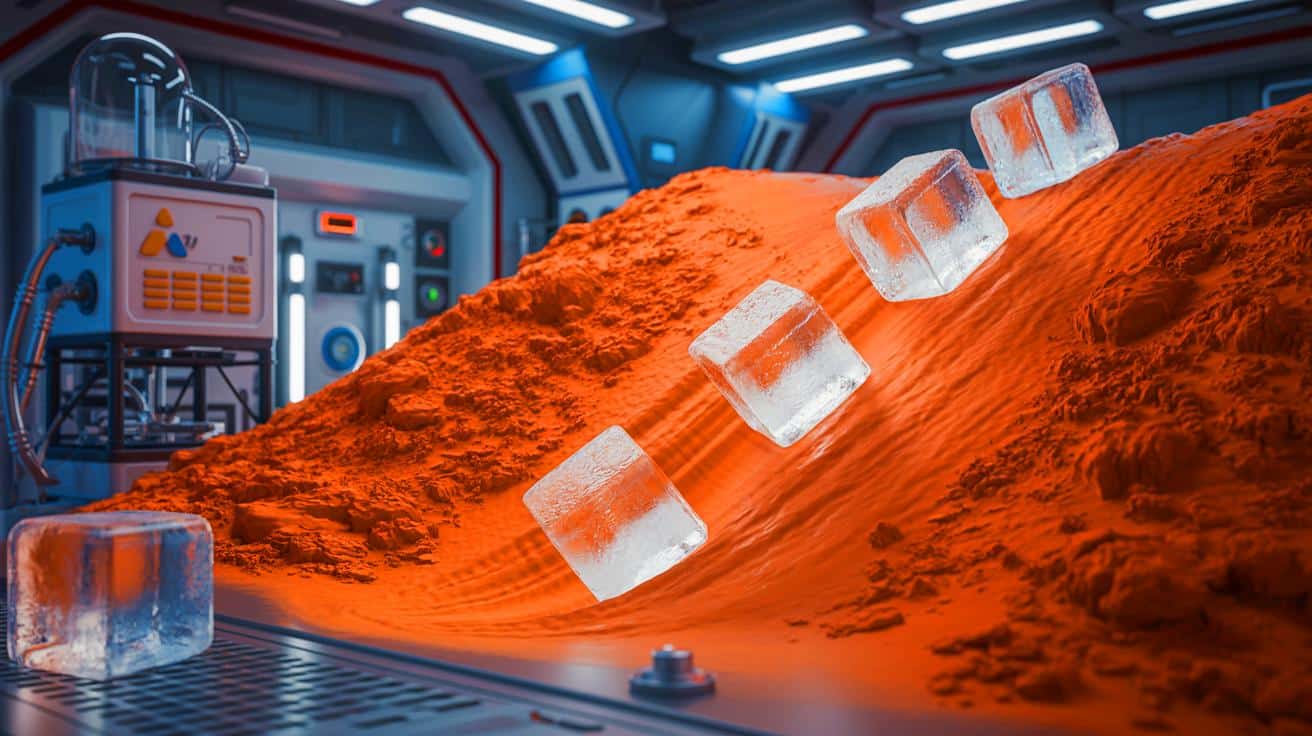
Dr. Roelofs, alongside master’s student Simone Visschers, used a ramp with sand to replicate Martian dunes. CO2 ice blocks were released from the ramp’s top, simulating natural Martian conditions. “We experimented with different slope angles to find the right conditions,” Roelofs explained. Upon reaching the correct configuration, the ice blocks began to carve into the sand, mimicking the burrowing action seen with sandworms in fiction. This groundbreaking experiment marks the first time such a process has been recreated on Earth.
Investigating Mars to Understand Our Planet Better
Mars experiences extreme cold during its winters, with temperatures plummeting to -184 °F. As the planet warms, CO2 ice forms on Martian dunes and subsequently breaks off. The temperature differential causes the ice’s underside to sublimate, transforming directly from solid to gas. This rapid change generates force, propelling the ice into the sand and creating gullies.
This sublimation process continues as the block moves down the slope, leaving a distinct trail. Roelofs suggests that such extraterrestrial studies can enhance our understanding of Earth’s geological processes. “Researching other planets’ landscapes allows us to rethink Earth’s structures,” she stated. This broader perspective can yield new insights, potentially revolutionizing our understanding of planetary science.
Scientific Implications and Future Research
The success of this experiment opens new avenues for research into planetary geology. Understanding Martian gullies could provide clues to similar processes on Earth, particularly in extreme environments. This knowledge might be applicable to studying climate change and its impact on terrestrial landscapes.
Future research could explore the variations in gully formation under different Martian conditions, such as varying CO2 levels or atmospheric pressures. Additionally, these findings could aid in the development of technologies for future Mars missions, particularly in navigation and terrain analysis. The experiment underscores the symbiotic relationship between planetary exploration and Earth sciences, paving the way for interdisciplinary discoveries.
Challenges and Technological Innovations
Recreating Martian conditions on Earth presents numerous challenges. The “Mars Chamber” is a testament to technological innovation, allowing scientists to simulate specific extraterrestrial environments. Developing such facilities requires precision engineering and substantial investment, highlighting the importance of cross-disciplinary collaboration in scientific endeavors.
These technological advances not only facilitate research but also encourage the development of new scientific methods. As we continue to explore space, the ability to simulate otherworldly conditions will be crucial. This experiment exemplifies how technological progress can drive scientific discovery, offering a model for future space-related research.
The exploration of Martian gullies through controlled experimentation represents a significant leap in planetary science. By simulating Mars-like conditions, researchers have not only advanced our understanding of the red planet but also enriched our perspective on Earth’s natural processes. As we continue to investigate the mysteries of Mars, what other secrets of our universe might we uncover, and how could these findings reshape our understanding of our own world?

Can’t wait to see what they’ll find under the surface! 🚀
Wow, this is incredible! Can’t wait to see what they find beneath Mars’ surface! 🚀
Why are we so obsessed with Mars? Shouldn’t we focus on our own planet first? 🤔
How deep will the rover be able to drill? And what kind of samples are they expecting to find?
I hope they find little green men. That would make my day! 👽
Is this European rover part of the ExoMars mission?
Finally! I hope they find some Martian cheese down there! 🧀
It’s amazing how far technology has come. Go Europe! 🇪🇺
Do we really need to drill into Mars? What if we disturb something we shouldn’t?
It’s amazing how much we’re investing in Mars exploration. But shouldn’t we focus on Earth more?
This is fantastic news for space enthusiasts everywhere. Thanks for the update!
What are the chances that the rover might actually find signs of life? 🤔
Will the data from this mission be shared with the public?
Finally, we might get answers about life beyond Earth. Fingers crossed! 🤞
Thank you for such a detailed article. It’s fascinating to see how tech is advancing space exploration!
How deep will this rover be able to drill? I hope they find something groundbreaking.