




| IN A NUTSHELL |
|
In an extraordinary scientific breakthrough, a team of researchers from Brown University has uncovered new insights into the early formation of the moon by examining samples collected during NASA’s Apollo 17 mission. These samples, which had been sealed since their collection in 1972, have recently been analyzed using cutting-edge techniques, revealing surprising isotopic compositions. This discovery not only challenges long-held assumptions about the moon’s formation but also opens new avenues for understanding our celestial neighbor’s history.
Analyzing Apollo 17 Moon Samples
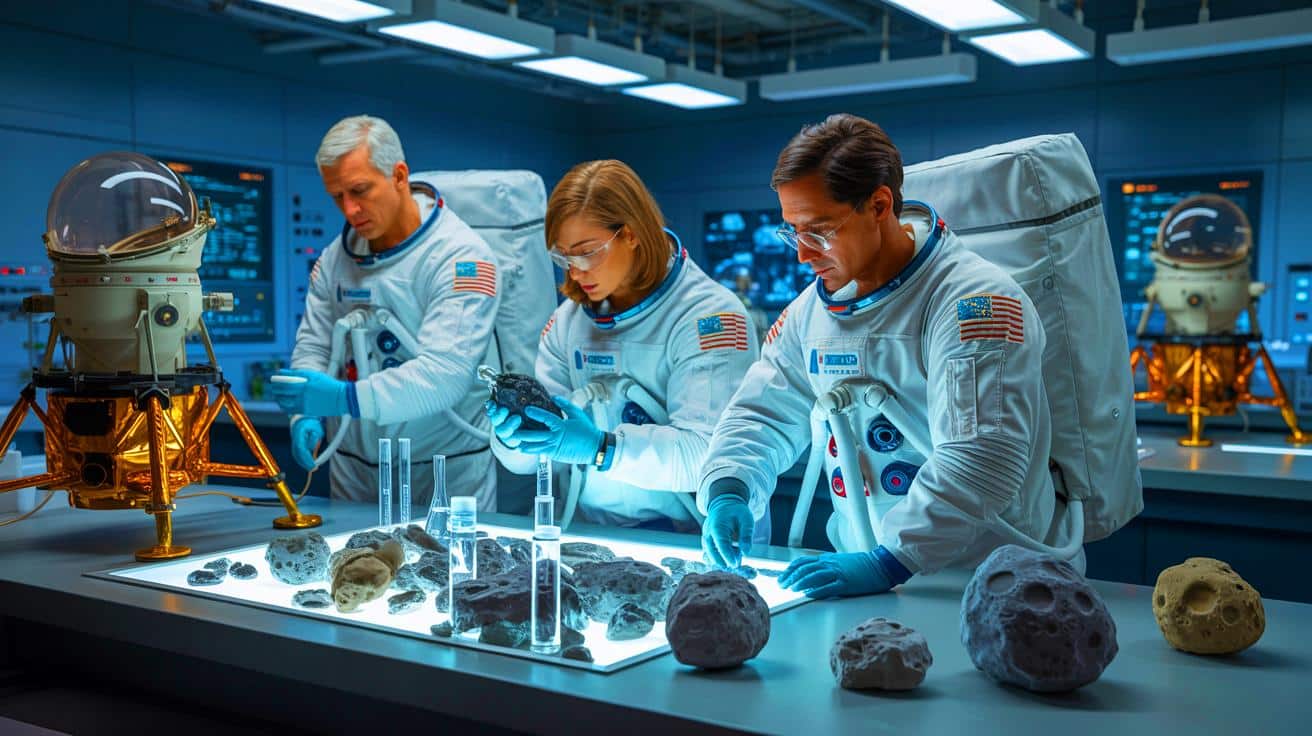
The Apollo 17 mission, conducted in 1972, marked the last time humans set foot on the lunar surface. Upon their return, the astronauts brought back a variety of lunar samples. Not all of these samples were immediately analyzed. Instead, some were sealed and preserved under the Apollo Next Generation Sample Analysis (ANGSA) program. The idea was to save them for future scientists equipped with more advanced technology.
Decades later, that foresight has paid off. Researchers at Brown University have utilized state-of-the-art techniques to analyze samples from the Taurus Littrow region of the moon. Their study, published in the journal JGR: Planets, highlights a new type of sulfur present in the samples, specifically in volcanic material. These sulfur compounds are highly depleted in the isotope sulfur-33, a finding that is unprecedented compared to terrestrial samples.
Surprising Isotope Ratio Findings
Isotopes act as elemental “fingerprints,” helping scientists trace the origins and processes involved in the formation of celestial bodies. Historically, oxygen isotopes on the moon were found to be similar to those on Earth, leading researchers to assume a similar pattern for sulfur isotopes. However, the recent findings challenge this assumption.
James Dottin, the lead researcher, expressed his initial disbelief at the results. “Before this, it was thought that the lunar mantle had the same sulfur isotope composition as Earth,” he stated. Upon further verification, the team confirmed the unusual sulfur isotope ratios, which differ significantly from Earth’s known isotopic compositions. This unexpected discovery has prompted a re-evaluation of the moon’s formative processes.
Uncovering the Moon’s Ancient Mysteries
The pristine condition of the samples, maintained in a helium-sealed environment, allowed for precise analysis using secondary ion mass spectrometry, a technology unavailable in 1972. Dottin and his team speculate that the peculiar sulfur isotope ratios could be remnants of chemical processes from the moon’s earliest history.
One compelling hypothesis is that these isotopic anomalies are traces left by a Mars-sized celestial body, Theia, which is believed to have collided with Earth, leading to the moon’s formation. If true, the findings suggest that the lunar surface still bears the chemical footprint of Theia, offering a unique glimpse into the moon’s tumultuous origins.
Implications for Lunar and Earth Sciences
The implications of this discovery extend beyond lunar science. Understanding the distinct isotopic compositions of the moon provides critical insights into the broader processes that shaped our solar system. These findings may also refine models of Earth’s early history, as the Earth-moon system is deeply interconnected.
This research underscores the value of preserving scientific samples for future study, as advancements in technology can yield insights previously thought impossible. As scientists continue to explore the moon’s surface, these new findings will undoubtedly inform future missions and studies, potentially reshaping our understanding of both the moon and our planet’s past.
The newly uncovered isotopic evidence from the Apollo 17 samples raises profound questions about the moon’s formation and its relationship with Earth. As researchers delve deeper into these mysteries, what other secrets might the moon hold about the early solar system, and how will these discoveries influence our understanding of planetary science?

Wow! I never imagined moon rocks could change our understanding of Earth. 🌕
Wow! I can’t believe they waited 50 years to open those samples. What were they hoping to find? 🤔
What is a sulfur isotope, and why is it important?
Incredible discovery! How will this change our understanding of the moon’s history?
50 years is a long wait! Was it worth it, though?
Why did it take so long to analyze these samples? Seems like they were sitting on a goldmine!
This is mind-blowing! Can’t wait to see what else they discover. 😃
So fascinating! I wonder if we’ll ever find evidence of Theia on Earth too. 🌍
How does a sulfur isotope differ from those on Earth?
This could change everything about our solar system’s history. Mind-blowing stuff!
Could this new discovery affect future moon missions?
Is there a possibility that Earth has similar undiscovered isotopes? 🤷♂️
Seems like every time we think we know something, science surprises us!