





| IN A NUTSHELL |
|
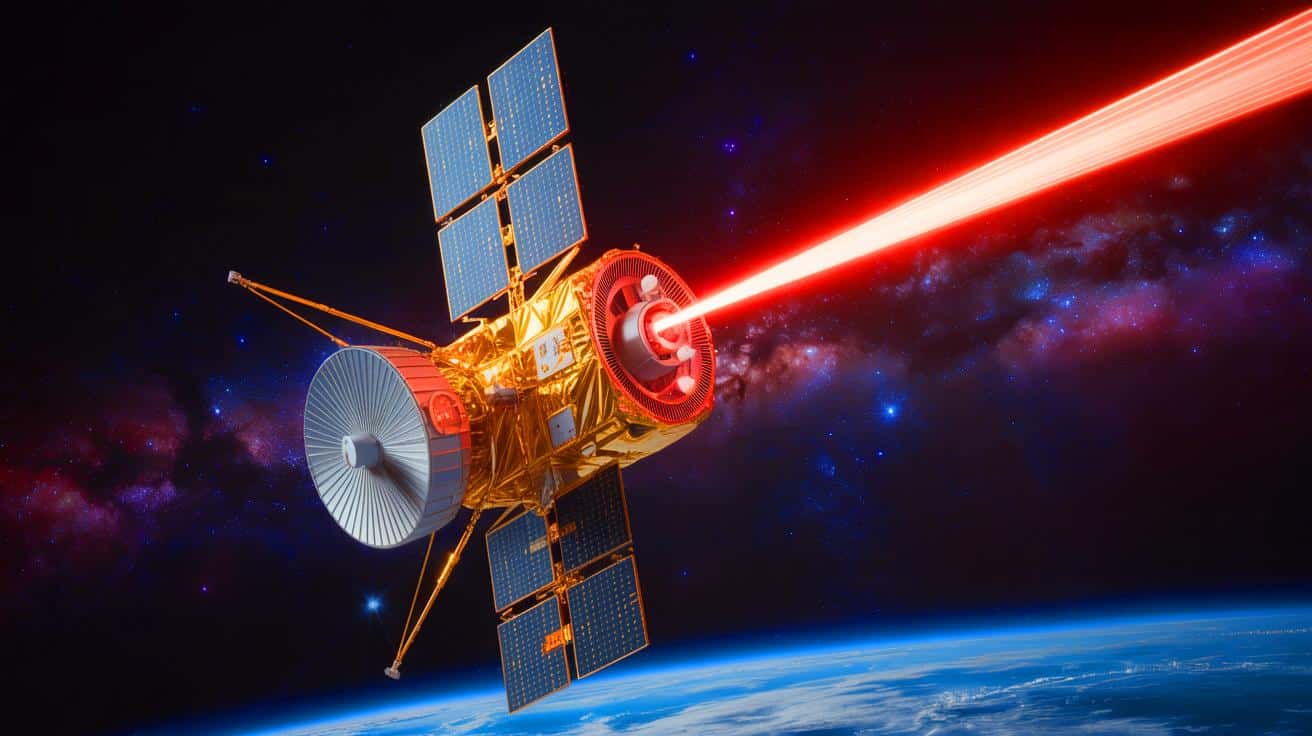
NASA has achieved a monumental breakthrough in space communication, setting new standards with its latest technological advancements. In December 2024, the Psyche spacecraft successfully transmitted an infrared laser message back to Earth from a staggering distance of 307 million miles. This distance is over twice that between Earth and Mars and significantly farther than the Moon. This milestone marks the 65th and final laser downlink signal from Psyche, received from 218 million miles away. With this achievement, NASA has not only demonstrated the potential of its Deep Space Optical Communications (DSOC) technology but has also paved the way for future space exploration missions that demand faster and more efficient data transmission.
Revolutionizing Space Communication
The successful transmission of data from the Psyche spacecraft represents a significant leap forward in space communication technology. Traditional radio communications, while reliable, have limitations in terms of speed and capacity. The DSOC technology tested by NASA offers a promising alternative by using lasers to transmit data. Lasers provide a narrower and more precise beam compared to radio waves, enabling the potential for higher data rates. However, this precision also poses challenges, as the laser beams must be perfectly aligned to reach their target receivers. Despite these challenges, NASA has demonstrated the feasibility of laser communication through successful data transfers over vast distances.
This technological advancement is particularly important as NASA sets its sights on Mars and beyond. The ability to stream high-definition video and transmit large volumes of data quickly is crucial for future missions. As acting NASA Administrator Sean Duffy noted, “advancing laser communications technologies brings us one step closer to streaming high-definition video and delivering valuable data from the Martian surface faster than ever before.” The DSOC has already transmitted 13.6 terabytes of data to Earth, with data rates comparable to household broadband internet.
Challenges and Innovations
While the potential of laser communication is significant, several challenges need to be addressed. One of the main issues is the attenuation and degradation of light signals as they travel through space. The farther the transmission distance, the weaker the signal becomes, requiring highly sensitive receivers to capture the few photons that reach Earth. Additionally, the Earth's atmosphere and weather conditions can interfere with laser signals, necessitating the development of space relays to assist in data reception and storage.
Despite these challenges, the DSOC technology has proven its robustness and effectiveness. When the Psyche spacecraft was 225 million kilometers (approximately 140 million miles) from Earth, it successfully transmitted data at 25 megabits per second. This achievement underscores the potential of laser communication to revolutionize how data is transmitted across space, enhancing our ability to explore and understand the cosmos.
Implications for Future Missions
The success of the DSOC technology test has significant implications for future space missions. As NASA continues to explore the possibility of human missions to Mars, efficient communication will be a critical component. The ability to transmit data quickly and reliably can make the difference between mission success and failure. Laser communication technology, as demonstrated by the Psyche spacecraft, offers a viable solution to the communication challenges posed by deep space exploration.
NASA's commitment to testing and proving new technologies in the harsh environment of space is essential for advancing our capabilities. As Clayton Turner, associate administrator of NASA's Space Technology Mission Directorate, stated, "Over two years, this technology surpassed our expectations, demonstrating data rates comparable to those of household broadband internet and sending engineering and test data to Earth from record-breaking distances."
The Path Ahead for Psyche
With the completion of its laser communication tests, the Psyche spacecraft now focuses on its primary mission: exploring the asteroid belt. The spacecraft is on a trajectory that will take it to a rendezvous with its namesake asteroid in 2029. As it continues its journey deeper into the Solar System, Psyche will rely on more conventional radio communications to transmit data back to Earth. However, the successful demonstration of DSOC technology will undoubtedly play a role in shaping future missions and the development of advanced communication systems for space exploration.
As we look to the future, the question remains: How will advances in communication technology continue to shape our exploration of space and our understanding of the universe? The achievements of the Psyche mission and NASA's ongoing innovation in laser communication technology provide a glimpse of the possibilities that lie ahead.

This is mind-blowing! How long did it take for the laser message to reach Earth? 🚀
Absolutely amazing! How long did it take for the laser message to travel that distance? 🚀
Why haven’t we used laser communications sooner? Seems like a game-changer!
Wow, 307 million miles! That’s like sending a text to the other side of the universe. 😂
Isn’t it risky to rely on lasers when the atmosphere can interfere with signals? 🤔
Does this mean we’ll finally get HD Mars selfies? 📸
Does this mean our internet on Mars will be faster than on Earth? 🤔
I’m skeptical. How do they ensure the laser beam is perfectly aligned over such vast distances?
Thank you, NASA, for pushing the boundaries of space communication!
Incredible achievement by NASA, but I’m curious—how do they ensure the laser stays aligned over such a distance?
How does this compare to traditional radio waves in terms of speed?
Incredible achievement! Looking forward to faster and more reliable data from Mars. 🌌
Great job, NASA! This is a giant leap for mankind’s communication with the cosmos. 🌌
How do they deal with signal attenuation over such long distances?
So, lasers are the new radio waves? Can’t wait for the next mission updates! 😄
Doesn’t this technology require a ton of power? How do they manage that in space?
What challenges do they face with Earth’s atmosphere interfering with laser signals?
Bravo, NASA! 🏆 This is a tremendous leap for space communication.
How revolutionary is this technology for future deep space missions?
The future of space communication is here! Can’t wait for more discoveries. 🌠
Is this technology capable of transmitting large volumes of data efficiently?
Yay, now we can binge-watch Martian landscapes in HD! 📺
How will this impact future missions to Mars and beyond?
Wait, how do they ensure the laser is always aligned with the receiver on Earth? 🤨
Can this technology be used for real-time communication with astronauts on Mars?
Wow, 307 million miles! That’s like sending a text from here to the far reaches of the solar system. 😂
Does this mean fewer delays in receiving data from space missions?
How does the DSOC tech work in bad weather conditions? 🌧️
Thank you, NASA, for continuing to amaze us with groundbreaking technology! 🙏
How soon can we expect this technology to be standard for all space missions?
The article mentions potential challenges with laser communication. How are they addressing these?
How soon can we expect to receive HD video from Mars? Exciting times ahead! 📹
How does NASA test such technologies before deployment in space?
Is it possible for this technology to be used on Earth for faster internet? 🌍
Are there any plans to use this tech for communication within our solar system?
Can’t wait to see what other innovations NASA has in store for us! 🚀