





| IN A NUTSHELL |
|
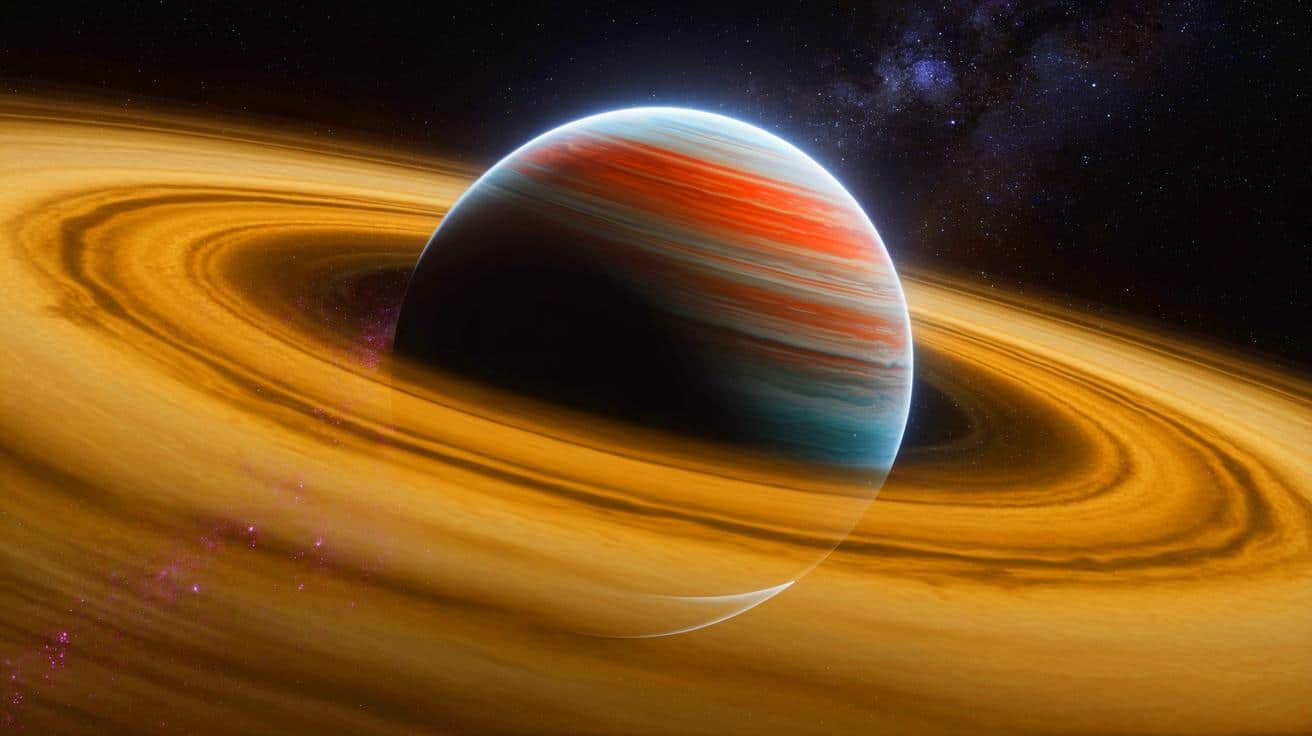
The discovery of a rogue planet consuming material at an unprecedented rate has stunned astronomers and challenged our understanding of planetary formation. Cha 1107-7626, a rogue planet devoid of a star, is devouring gas and dust at a speed of six billion tonnes per second. This astonishing rate of growth, observed by the European Southern Observatory’s Very Large Telescope, has ignited discussions about how planets form and evolve, especially those that drift alone in the cosmos. The findings suggest that some of these lonely worlds may form in ways similar to stars, blurring the lines between celestial categories.
The Remarkable Growth of a Rogue Planet
Rogue planets, unlike their star-orbiting counterparts, wander through space without a tether. Cha 1107-7626, located roughly 620 light-years away in the constellation Chamaeleon, exemplifies the intriguing nature of these celestial bodies. This planet, with a mass between five and ten times that of Jupiter, is currently in a phase of rapid growth. Surrounded by a disc of gas and dust, it is undergoing a process known as accretion, where it draws in material from its surroundings.
Recent observations have revealed that this accretion is not a slow, steady process but rather a series of dramatic bursts. By August 2025, the accretion rate had escalated significantly, reaching a staggering six billion tonnes per second. Such a rapid rate of growth is unprecedented for any planet, offering new insights into the mechanisms behind rogue planetary formation. This discovery, facilitated by advanced spectrographic technology, showcases the dynamic and sometimes volatile life of planets that do not orbit stars.
Insights from the Chamaeleon Constellation
Cha 1107-7626’s presence in the Chamaeleon constellation has provided astronomers with a unique opportunity to study the characteristics of rogue planets. This particular rogue planet’s mass and its isolation make it a fascinating subject for understanding planetary evolution. The planet’s rapid accretion of gas and dust suggests that its formation may share similarities with that of stars, which also undergo bursts of accretion during their early stages.
The research team, led by Víctor Almendros-Abad, utilized data from multiple sources, including the James Webb Space Telescope and ESO’s VLT, to analyze the changes occurring within the accretion disc. The increase in accretion rate and the subsequent chemical changes observed during this period reflect complex interactions that are more often associated with stellar formation. This could indicate that rogue planets like Cha 1107-7626 might form through processes traditionally thought to apply only to stars.
Blurring Boundaries Between Stars and Planets
The discovery of rapid accretion in Cha 1107-7626 raises questions about the fundamental differences between stars and planets. Traditionally, stars and planets have been categorized by their formation processes and physical characteristics. However, the behavior of this rogue planet challenges these distinctions. The presence of strong magnetic fields funneling material toward the planet is a phenomenon previously observed only in stars.
As co-author Aleks Scholz notes, the findings suggest that rogue planets may form through mechanisms akin to those of stars. This notion blurs the once-clear line separating stars from planets. The study also found that the chemical composition of the accretion disc changed during the burst, with water vapor appearing during the event. Such chemical shifts have previously been documented in stellar environments, further supporting the idea that planetary and stellar formation processes may overlap.
The Future of Rogue Planet Research
As technology advances, the study of rogue planets like Cha 1107-7626 is set to enter a new era. The European Southern Observatory’s upcoming Extremely Large Telescope (ELT) promises to enhance our ability to detect and analyze these elusive celestial bodies. With its powerful instruments, the ELT will allow astronomers to explore the characteristics of rogue planets in greater detail, potentially uncovering more about their formation and evolution.
As astronomer Amelia Bayo highlights, the prospect of studying planetary objects that display star-like behavior is both exciting and challenging. Understanding the early stages of rogue planets could provide valuable insights into the diversity of planetary systems and the processes that govern their formation. The knowledge gained from these studies may reshape our understanding of the cosmos and the various ways in which celestial bodies come into existence.
The discovery of Cha 1107-7626’s rapid growth offers a glimpse into the complex and fascinating world of rogue planets. These findings invite further exploration into their formation and the potential overlap with stellar processes. As we continue to uncover the mysteries of these cosmic wanderers, what new insights about planetary and stellar evolution might we discover?

Wow, six billion tonnes a second? That’s a lot of cosmic fast food! 🍔
Wow, six billion tonnes per second? That’s a buffet fit for a cosmic king! 🪐
Pensez-vous que ce phénomène pourrait être observé dans notre système solaire un jour ?
Is it possible that this rogue planet is actually a new kind of celestial body?
Les astronomes vont-ils renommer Cha 1107-7626 en “Planète Vorace” ? 😂
Thank you for sharing such fascinating insights into the universe! 🌌
Incroyable découverte ! Merci pour cet article captivant !
How does this affect the current theories of planet formation?
Does this mean we need to rewrite our textbooks on planetary formation?
J’ai du mal à croire que quelque chose puisse consommer à ce rythme. Est-ce vraiment possible ?
I’m curious, how do scientists measure such massive accretion rates?
Maybe it’s secretly a star in disguise! 🌟
This sounds like something straight out of a sci-fi movie! 🚀
Pourquoi est-ce qu’on n’a pas découvert ça plus tôt ? Quelqu’un dormait au télescope ?