





| IN A NUTSHELL |
|
In the rapidly evolving landscape of electric vehicles, Tesla’s Cybertruck was hailed as a revolutionary advancement in automotive design and functionality. Launched amidst great expectation and fervor, it promised to reshape the pickup truck market with its futuristic aesthetics and cutting-edge technology. However, as the dust settles from its initial debut, the Cybertruck is facing unexpected challenges. Price adjustments and market competition are reshaping the narrative, prompting questions about its place in the electric vehicle sector. Despite its ambitious launch, the Cybertruck’s journey highlights the dynamic nature of consumer expectations and market competition in the electric vehicle industry.
From $39,900 to $100,000—and Back Down Again
When Elon Musk first introduced the Cybertruck in 2019, it was with the promise of affordability and innovation. The initial price of $39,900 was intended to make the Cybertruck an accessible option for a wide range of consumers. However, by the time it reached production in 2023, the introductory price had escalated to $60,990. This increase, nearly 50%, was a significant departure from the original vision.
The pricing strategy became even more complex with premium models reaching over $100,000. This high cost exceeded many potential buyers’ expectations and budgets. Despite a staggering 1.9 million reservations, the conversion to actual sales was less than 5%. The stark contrast between reservations and sales highlighted a critical issue: the competition in the electric truck market was more formidable than anticipated. The Cybertruck faced stiff competition from the Ford F-150 Lightning and the GMC Hummer EV, both of which offered compelling features at more attractive price points.
A Tough Market and an Even Tougher Production Process
As the Cybertruck made its entrance into the market, Tesla faced unanticipated competition from established automakers. The Ford F-150 Lightning and GMC Hummer EV offered compelling alternatives with traditional designs and competitive pricing. These alternatives appealed to consumers who were hesitant to embrace Tesla’s radical design.
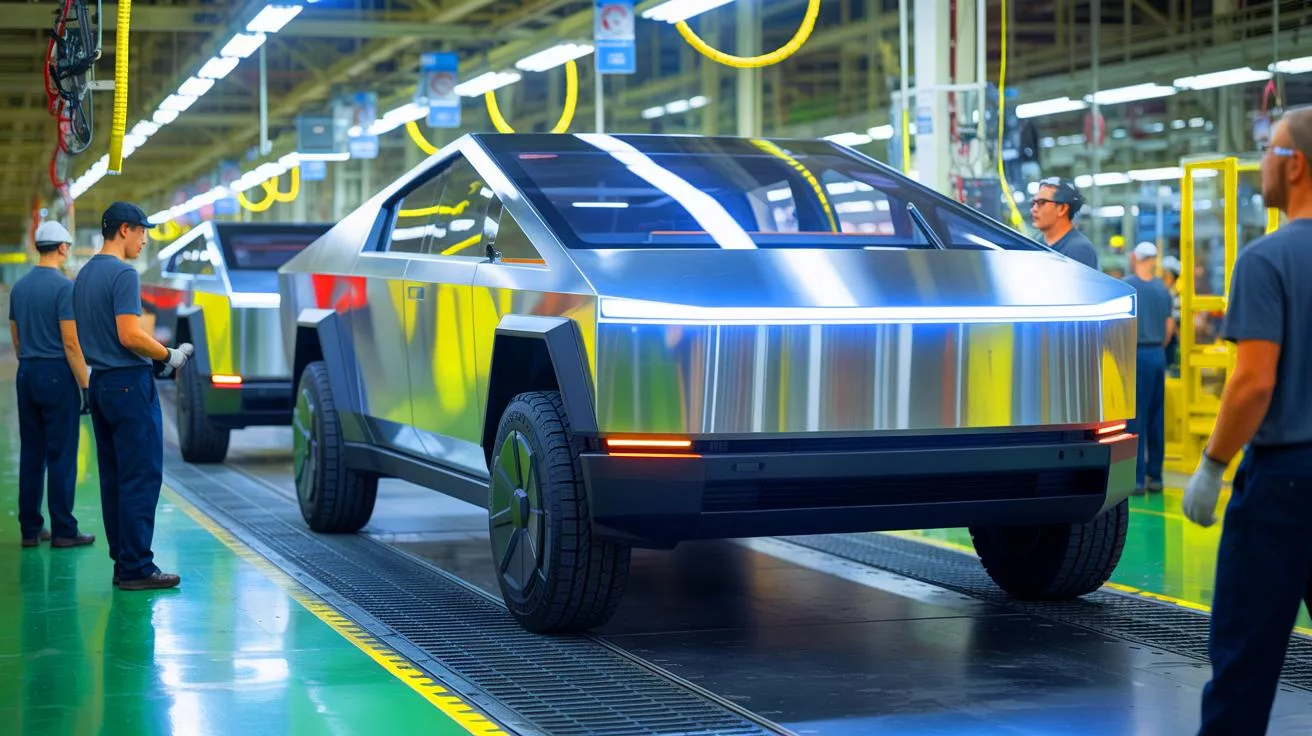
The Cybertruck’s stainless steel exoskeleton, while a visual marvel, presented significant manufacturing challenges. Its sharp-edged, unpainted design introduced technical hurdles that slowed down production and increased costs. The complexity of the manufacturing process impacted Tesla’s ability to meet demand while maintaining high prices. These challenges forced Tesla to reevaluate its strategy, balancing the innovative design with practical production considerations.
Tesla’s Pivot: Price Cuts and Damage Control
In response to slow initial sales, Tesla implemented strategic changes to boost the Cybertruck’s marketability. The company restructured its pricing model, repositioning what were initially top-tier models as standard offerings. This shift effectively reduced costs for consumers and aimed to attract a broader customer base.
Beyond pricing adjustments, Tesla is focused on reducing production costs to improve profitability. However, the stainless steel construction remains expensive and challenging to scale. To remain competitive, Tesla must enhance manufacturing efficiencies, ensuring that cost reductions do not compromise quality or profitability. This delicate balance is crucial for Tesla’s efforts to make the Cybertruck a viable and profitable product in the electric vehicle market.
Can the Cybertruck Still Be a Hit?
The critical question for Tesla is whether the Cybertruck can achieve commercial success amid its pricing and production challenges. While price reductions have stabilized interest, profitability remains a concern. The Cybertruck’s unique design and high manufacturing costs present a distinct challenge compared to previous Tesla models.
The excitement surrounding the Cybertruck endures, but Tesla must demonstrate that its innovative pickup can succeed in the practical world, beyond initial hype and pre-orders. The battle for dominance in the electric truck market is ongoing, and Tesla’s future actions will be pivotal in determining whether the Cybertruck becomes an industry icon or a lesson in the complexities of electric vehicle production and market competition.
As Tesla navigates these challenges, the broader implications for the electric vehicle industry are significant. Will the Cybertruck’s evolution influence future design and production strategies across the sector? How will consumer expectations and competitive dynamics continue to shape the electric vehicle landscape?

Wow, that’s quite a jump in price! What’s Tesla’s explanation for this? 🤔
Wow, 1.9 million reservations but only 5% sales? That’s a huge drop-off! 😲
Maybe Tesla should have stuck to the original price promise. $100,000 is a bit much for most of us!
Je ne suis pas surpris. Tesla a toujours eu des problèmes avec les coûts de production.
Is the Cybertruck still worth buying with all these pricing issues?
Does anyone actually believe the Cybertruck will ever meet its promised price? 😅
Elon promised $39,900 and now it’s $100,000? That’s not cool. 😡
Sounds like the stainless steel design is causing more problems than it’s worth!
How does Tesla plan to compete with cheaper alternatives like the Ford F-150 Lightning?
At least they’re trying to cut prices now. Better late than never, I guess.
C’est fou! Comment passer de 39 900 $ à plus de 100 000 $? 😮
Why do they keep changing the price? It’s so confusing!
I was so hyped for the Cybertruck, but now I’m not so sure. 🤔
Honestly, I feel like the Cybertruck is just a status symbol now.
Less than 5% sales conversion? Ouch, that’s gotta hurt!
Thanks for the article! I was wondering why the Cybertruck was so expensive now.
Tesla should have foreseen the competition from Ford and GMC!