




| IN A NUTSHELL |
|
For over two decades, NASA’s Chandra X-ray Observatory has trained its lens on the Cassiopeia A (Cas A) supernova remnant, a vibrant tapestry of cosmic debris. Recent findings from Chandra have unveiled a dramatic rearrangement within the progenitor star of Cas A that occurred just before its explosive end. This discovery sheds new light on the complex processes that precede a supernova explosion. The research, spearheaded by Toshiki Sato from Meiji University, combines advanced computer models with Chandra’s invaluable data, revealing extraordinary details about the star’s final moments.
The Enigmatic Nature of Cassiopeia A
Cassiopeia A, a supernova remnant approximately 11,300 years old, has captivated astronomers for generations. The light from its dramatic explosion reached Earth in the 1660s, yet no historical records confirm its visual observation. The progenitor star, estimated to have been between 15 to 30 times the mass of our Sun, likely existed as a red supergiant or possibly a Wolf-Rayet star. Despite the ambiguity surrounding its nature, Cas A has become one of the most scrutinized remnants in the astronomical community.
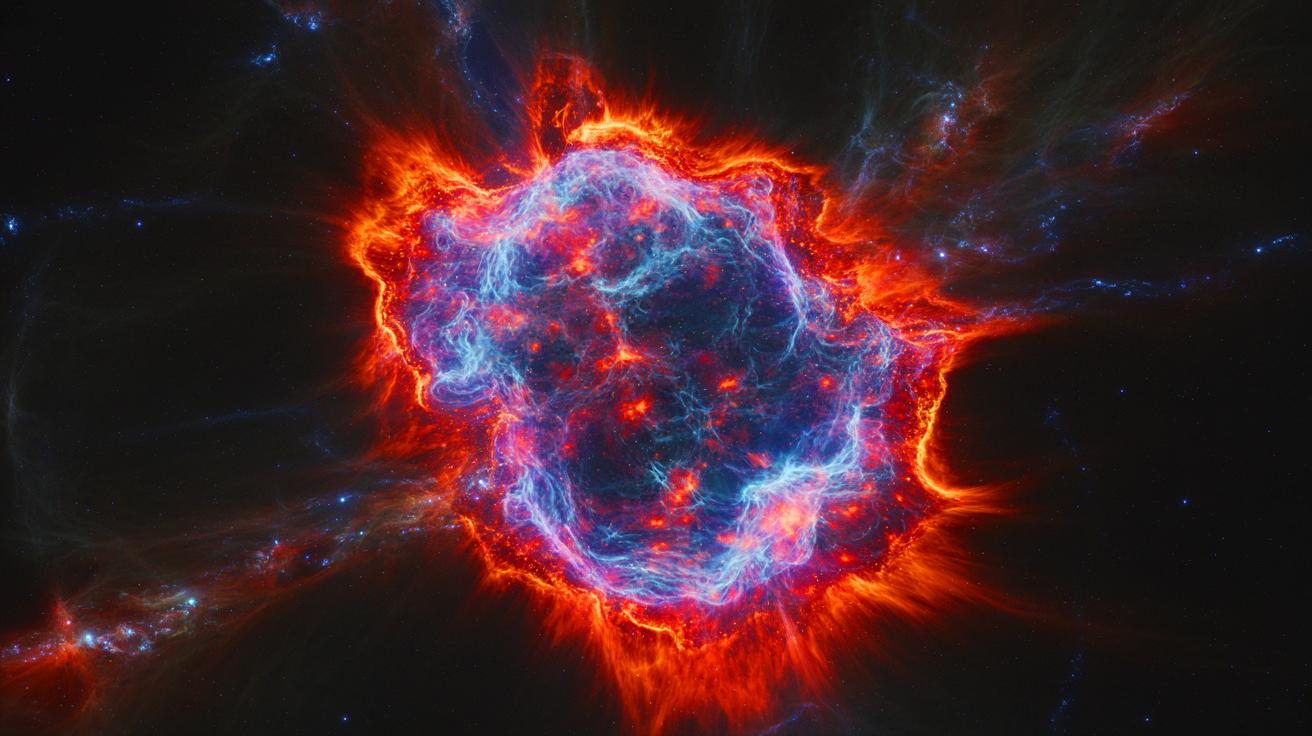
Modern observations across various wavelengths have provided a detailed picture of Cas A’s remnants. The Chandra X-ray telescope, along with the Hubble and Spitzer Space Telescopes, has contributed to an intricate composite image of the supernova’s aftermath. This composite showcases a vibrant interplay of silicon-rich and neon-rich materials, each color-coded to highlight their unique compositions. Such insights have propelled Cas A into the spotlight of supernova research.
The Final Hours: A Violent Stellar Reorganization
In the hours leading up to the Cas A supernova, the progenitor star underwent a violent internal reconfiguration. This process, termed “inhomogeneous stellar mixing,” involved the movement of silicon and neon materials within the star’s interior. Chandra’s observations have shown that silicon-rich materials surged outward, breaching a layer rich in neon. This unexpected mixing of elements challenges previous assumptions about the symmetry of supernova explosions.
The buildup of heavy elements, such as iron, within the star’s core was critical to the eventual explosion. Iron, unlike lighter elements, absorbs rather than releases energy during fusion, leading to a loss of outward pressure and a subsequent core collapse. The resulting gravitational implosion set the stage for the star’s dramatic demise. This process, now illuminated by Chandra’s findings, offers a novel perspective on the turbulent final moments of massive stars.
Astrophysical Implications of Asymmetrical Explosions
The revelation of asymmetrical supernova explosions marks a significant shift in our understanding of stellar deaths. Traditionally, supernovae were thought to be symmetrical, with material ejected uniformly in all directions. However, the new findings suggest a more chaotic reality, characterized by multiscale compositional inhomogeneities and asymmetric velocity fields.
This asymmetry has profound implications for the behavior of neutron stars, the dense remnants left behind by supernovae. The uneven distribution of ejected material could impart additional momentum to these remnants, explaining the high velocities observed in some neutron stars. Furthermore, the internal turbulence preceding the explosion might itself have triggered the star’s final detonation, adding another layer of complexity to the narrative of stellar death.
The Future of Supernova Research
Chandra’s insights into Cas A represent a significant leap forward in astrophysics, offering a rare glimpse into the inner workings of a star on the brink of collapse. The research highlights the potential for advanced observational techniques to unravel the mysteries of stellar evolution and death. By understanding the intricate processes that lead to supernovae, scientists can refine models of stellar behavior and improve predictions about the life cycles of massive stars.
The study of Cas A also underscores the importance of interdisciplinary collaboration in astronomy. Combining observational data with sophisticated computer simulations allows researchers to explore scenarios that were previously inaccessible. As technological advancements continue to enhance our observational capabilities, the secrets of the cosmos are gradually being unveiled, providing invaluable insights into the universe’s most violent phenomena.
Through these groundbreaking observations, we are reminded of the dynamic and often unpredictable nature of the universe. As we continue to uncover the intricacies of stellar explosions, a question emerges: how might these findings influence our broader understanding of cosmic evolution and the role of massive stars within it?

Wow, so supernova explosions are not symmetrical?! That’s mind-blowing! 🤯
Wow, it’s amazing how much we can learn from a star’s last moments! Thanks for sharing this incredible insight. 🌟
Could this discovery help us predict when the next supernova might happen?
Pourquoi n’avons-nous pas vu l’explosion de Cassiopeia A à l’époque si elle était si dramatique ? 🤔
Sounds like these stars have a wild party before going out with a bang. 🎉
Je trouve fascinant que les explosions de supernovae puissent être asymétriques. Cela change tout ce qu’on pensait savoir !
Isn’t it crazy that we can learn so much from something that happened 11,300 years ago?
Great article! It’s fascinating how much we’re still learning about the universe. 😊
Est-ce que d’autres étoiles proches de nous pourraient exploser de manière similaire à Cassiopeia A ?
Can we see these asymmetrical explosions from Earth with the naked eye?
Merci pour cet article ! J’adore apprendre sur l’univers et ses mystères. 😊
Chandra Observatory is truly a game changer in astrophysics!