



| IN A NUTSHELL |
|
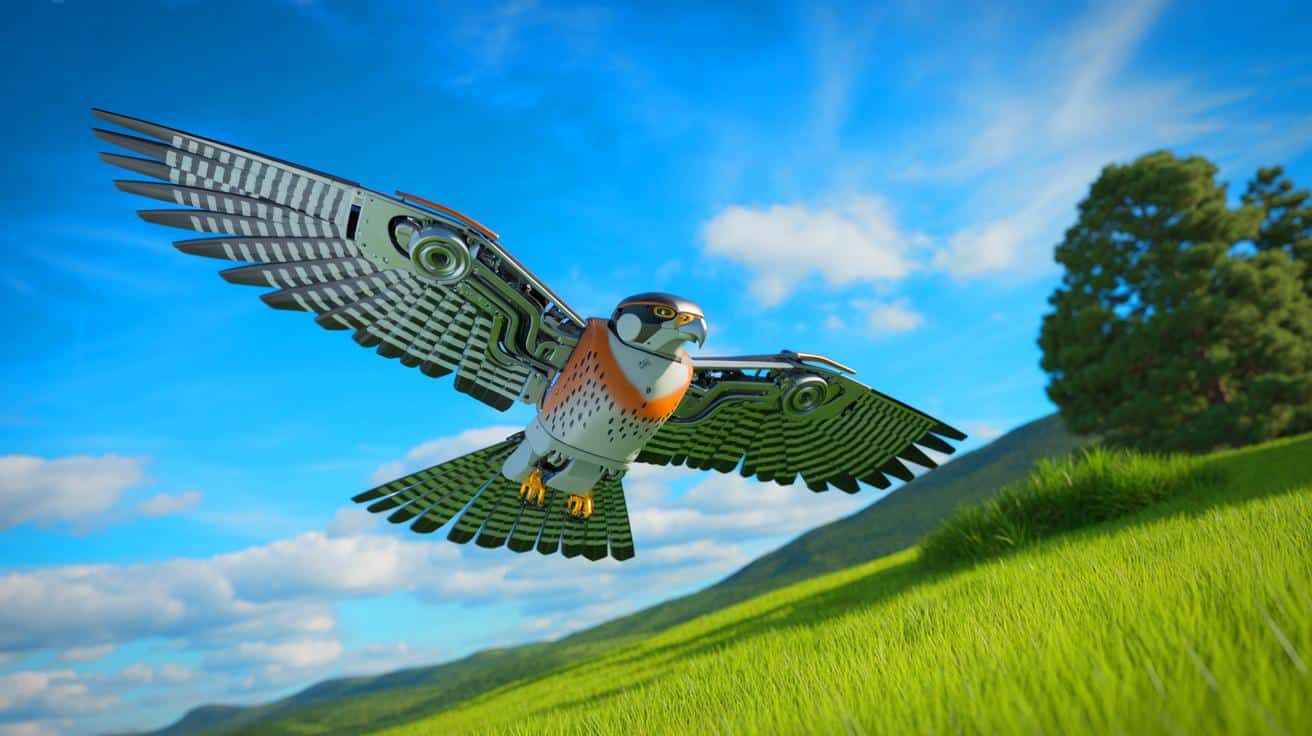
In a groundbreaking development, scientists in China have unveiled RoboFalcon2.0, a robot that mimics the flight mechanics of falcons. This innovative robot employs a unique flap-sweep-fold motion to achieve self-powered takeoff, marking a significant advance in bio-inspired flight technology. Unlike traditional robotic flyers that rely on fixed-wing propellers or hovering rotors, RoboFalcon2.0’s novel approach offers fresh insights into the mechanics of avian flight. By replicating the complex movements of bird wings, this prototype promises to revolutionize bio-inspired aviation and could have far-reaching applications in various fields, including surveillance and environmental monitoring.
Bird-Inspired Mechanics in Action
RoboFalcon2.0’s development represents a significant leap forward in understanding and replicating avian flight mechanics. The robot’s distinctive flap-sweep-fold (FSF) wing motion is a departure from conventional robotic flyers. This motion not only generates lift but also provides pitch control, an essential component for successful takeoff. The innovation lies in the robot’s ability to mimic bird-like movements, which traditional fixed-wing or rotor-based systems cannot achieve.
Wind tunnel experiments have demonstrated that sweeping the wings forward at larger angles enhances lift and aids in pitching the robot upward. This capability, confirmed through simulations, is crucial for the takeoff phase. By amplifying a vortex at the wing’s leading edge, RoboFalcon2.0 boosts aerodynamic forces and shifts the pressure center forward, resulting in improved pitch stability. The successful real-world tests underscore the potential of FSF motion to transform robotic flight.
Wings That Think
The reconfigurable wing system of RoboFalcon2.0 is a remarkable engineering feat. This system, which includes mechanical decouplers and a lightweight frame, enables the robot to flap, sweep, and fold its wings in a coordinated manner. This rhythmic motion mimics the flight patterns of various birds, such as geese and kingfishers, during slow flight. With a weight of just 1.8 pounds and a wingspan of 3.9 feet, RoboFalcon2.0 effectively captures the dynamics of small birds while maintaining robustness for controlled experiments.
Despite its relatively low weight, the robot consumes significant power during takeoff, paralleling the high metabolic cost observed in living birds. Wind-tunnel measurements reveal that the FSF motion delivers superior lift coefficients and head-up pitching moments compared to simple flapping. The adjustable sweep amplitude, reaching up to 25 degrees, allows the robot to fine-tune its aerodynamic center, enhancing control during liftoff.
Exploring the Flight Frontier
Field tests of RoboFalcon2.0 reveal both the potential and challenges of this innovative system. While the robot excels at smooth takeoff and low-speed flight, it encounters difficulties with pitch stability as speed increases. The absence of a tail elevator limits control authority during faster flight, an issue that researchers aim to address in future iterations.
Despite these challenges, RoboFalcon2.0’s achievements are noteworthy. It is one of the first flapping-wing robots to achieve self-powered, bird-scale takeoff, reflecting the biomechanics of real vertebrates. The implications of this technology are vast, with potential applications in surveillance, environmental monitoring, and defense. The ability to blend efficiency with stealth and navigate turbulent conditions naturally positions bird-like machines as valuable assets in various fields.
Potential Applications and Future Directions
RoboFalcon2.0’s successful demonstration of bird-like flight mechanics opens the door to numerous applications. In fields where vertical lift, silent operation, and agility at low speeds are crucial, such as surveillance and environmental monitoring, this technology could prove transformative. Unlike rotorcraft drones, bird-inspired robots can operate more efficiently and stealthily, making them ideal for navigating complex environments.
As an experimental platform, RoboFalcon2.0 paves the way for future advancements in bio-inspired aviation. By faithfully replicating the subtle motions of avian wings, researchers are closer to developing flying machines that not only fly but do so in harmony with nature’s design. The study’s findings, published in the journal Science Advances, highlight the potential for these innovations to revolutionize the field.
As researchers continue to refine the design and capabilities of RoboFalcon2.0, the potential for bio-inspired robots to impact various industries becomes increasingly apparent. How might advances in this technology influence the future of aviation and beyond?
Wow, RoboFalcon2.0 sounds like a game changer! How soon can we expect to see these in use? 🤔
Wow, un robot qui vole comme un oiseau ! C’est impressionnant. 🦅
Is this a step towards creating real-life Transformers? 😄
Est-ce que ce RoboFalcon pourrait être utilisé pour la livraison de colis à l’avenir ?
I’m amazed by the ingenuity of the flap-sweep-fold wings. Truly cutting-edge!
J’ai hâte de voir ça en action. Peut-être qu’il fera des figures aériennes comme les vrais faucons !
What are the implications of such technology for the defense industry?
Could these RoboFalcons replace traditional drones in surveillance missions?
Ca a l’air super, mais combien ça coûte de construire un tel robot ? 🤔
The idea seems fantastic, but how environmentally friendly is this technology?
I’m a bit skeptical about the “terrorizing defense experts” part. Really?
Je suis sceptique. Les oiseaux ont mis des millions d’années à évoluer, et les robots peuvent vraiment faire pareil ?
Can RoboFalcon2.0 actually differentiate between different types of birds in flight?
Merci aux scientifiques pour cette avancée technologique incroyable !
How does the power consumption of RoboFalcon2.0 compare to conventional drones?