





| IN A NUTSHELL |
|
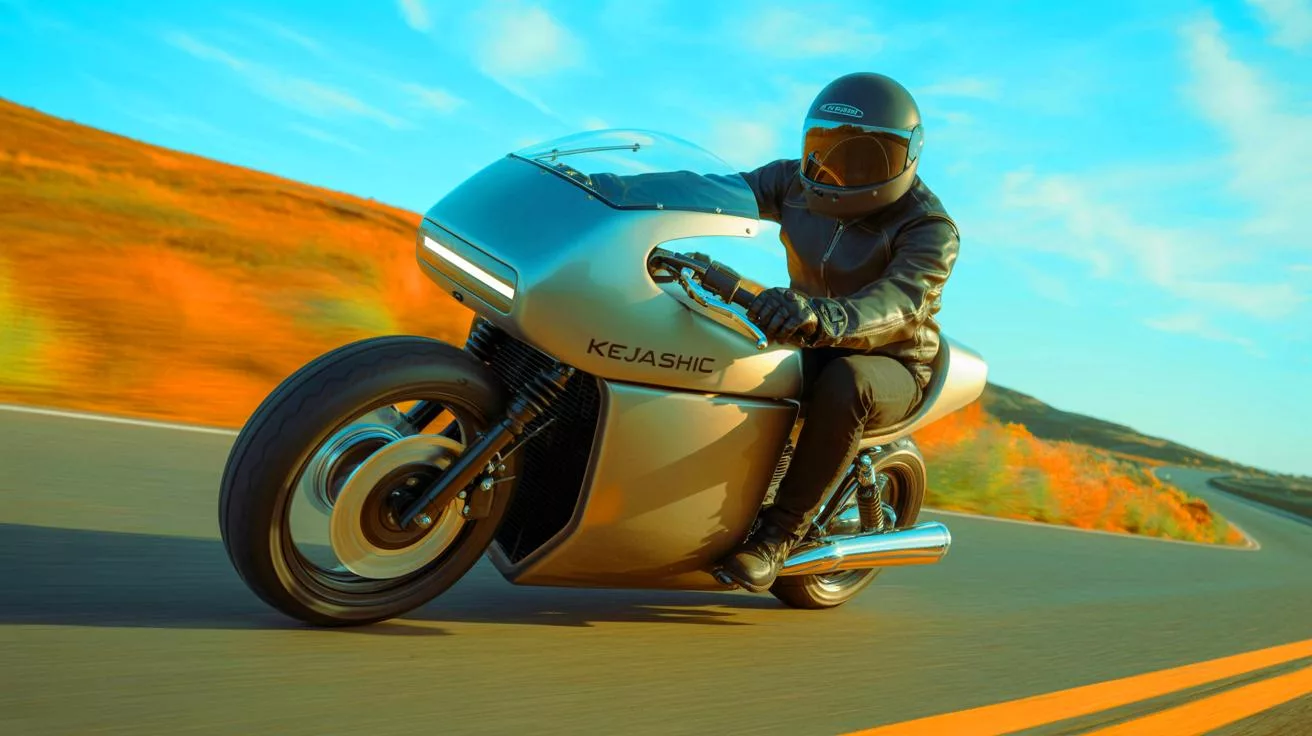
The world of motorcycle design is often punctuated by incremental changes, but occasionally, a truly revolutionary concept emerges. The Kejashi tilt-wing motorcycle, conceived by South Australian mechanic Kent Shillitoe, is one such innovation. This motorcycle not only challenges conventional design but also endeavors to solve a problem long associated with high-speed cornering. By introducing a tilt-wing mechanism, Shillitoe aims to exploit the aerodynamic benefits typically reserved for Formula One cars, thereby enhancing the motorcycle’s stability and downforce without compromising its agility.
The Genesis of a Radical Idea
Shillitoe’s journey toward creating the Kejashi tilt-wing motorcycle began with a simple observation: Formula One cars achieve extraordinary speeds around corners due to their superior downforce. This downforce is a result of their aerodynamic designs, which push the car onto the track. In contrast, MotoGP bikes, despite their speed, suffer from a lack of similar aerodynamic downforce. Shillitoe pondered whether a motorcycle could harness downforce akin to that of an F1 car, thus giving birth to the idea of a tilt-wing motorcycle.
Observing the limitations of existing MotoGP winglets, which often create adverse effects when leaned into a corner, Shillitoe envisioned a wing that could remain level during cornering. This would allow the motorcycle to maintain downforce without pushing it outward. The Kejashi motorcycle’s design incorporates a large wing at the front, strategically placed to provide the necessary grip and stability.
“If you could keep the wing level, you’d get all the downforce and nothing pushing you towards the gravel trap.”
https://www.rudebaguette.com/en/2025/09/coding-will-be-dead-in-18-months-tech-billionaire-chamath-palihapitiya-predicts-ai-will-eliminate-traditional-programming-jobs-as-engineers-become-supervisors/
Innovative Steering System
The Kejashi motorcycle’s steering system is as innovative as its tilt-wing design. Departing from traditional motorcycle steering, Shillitoe developed an offset, trailing steering system. The handlebars and forks are disconnected from the typical steering head and mounted on a trailing arm. This arm extends from a point well in front of the motorcycle’s fairing.
When initiating a turn, the entire steering column and wheel move laterally, offsetting the bike’s weight towards the inside of the turn. This unique configuration reduces the lean angle required for cornering, making the motorcycle more stable and easier to handle. Shillitoe likens the experience to riding a Can-Am Spyder, where the offset wheel mimics the effect of a secondary suspension system.
“Offsetting the weight toward the inside of the turn, that’s what the GP guys are trying to do with their bodies.”
https://www.rudebaguette.com/en/2025/08/executives-tease-bizarre-delivery-dominos-tests-submarine-drops-and-robot-dogs-as-workers-protest-costly-experiments-and-safety-risks/
The Challenges of a Tilt-Wing
Incorporating a tilt-wing into a motorcycle presents several challenges, not the least of which is the added weight. However, Shillitoe managed to keep the bike’s weight close to its original by removing unnecessary components. Despite being built from steel, the prototype weighs only slightly more than the standard model.
One of the most notable features of the tilt-wing design is its visual obstruction. The wing, positioned in front of the rider, can obscure vision when riding straight. However, Shillitoe compares this to the HALO device on a Formula One car, which drivers quickly adapt to. The aerodynamic drag, while present at high speeds, is offset by the significant downforce generated, improving stability and control.
“According to my calculations, at 93 mph, there should be about 132 lb of downforce.”
https://www.rudebaguette.com/en/2025/08/the-spotify-empire-sparks-fury-as-leaders-announce-costly-subscription-increases-and-face-accusations-of-exploiting-loyal-music-fans/
The Future of the Kejashi Motorcycle
While the Kejashi tilt-wing motorcycle is a prototype, its potential applications are intriguing. Shillitoe envisions its use in time attack events or hill climbs, where its unique design can be fully exploited. He hopes that with further development, the motorcycle could incorporate advanced materials like carbon fiber to improve its performance.
Shillitoe’s ambition is to see the Kejashi system adopted by manufacturers with greater resources, enabling the production of a super-rigid, lightweight frame. The offset wheel could act as a secondary suspension system, potentially revolutionizing motorcycle design. As he awaits the opportunity to test the motorcycle on a track, Shillitoe remains optimistic about its capabilities.
“I’ve got dreams that it’ll go somewhere, but I don’t know! I can’t hype it up too much ’til I’ve actually proven it properly.”
The Kejashi tilt-wing motorcycle represents a bold leap forward in motorcycle design, challenging the norms and pushing the boundaries of what is possible. As Shillitoe prepares to test his creation on the racetrack, the question remains: Will this innovative design set a new standard for motorcycle performance, or is it destined to remain a fascinating prototype? The world of motorcycle enthusiasts eagerly awaits the answer.


Wow, j’adore l’idée d’un système de direction décalé! Ça doit être incroyable à conduire! 😍
Wow, c’est incroyable ! Comment as-tu pensé à un concept aussi innovant ? 🤔
Est-ce que ce type de moto pourrait être légale sur route ouverte, ou est-ce juste pour les circuits?
Je suis sceptique… Est-ce que cette moto est vraiment stable à haute vitesse ?
132 pounds of downforce? Ça me semble un peu exagéré, non?
J’adore l’idée ! Enfin quelque chose de vraiment nouveau dans le monde de la moto ! 😊
Bravo à Kent Shillitoe pour repousser les limites du design moto! C’est inspirant. 💪
Je suis sceptique quant à la visibilité avec cette grande aile devant. Est-ce que ça ne gêne pas le pilote?
Combien coûterait une moto comme celle-ci si elle était mise sur le marché ?
Comment cette moto se compare-t-elle aux modèles MotoGP traditionnels en termes de performances?
132 livres de pression d’air ? Ça a l’air un peu dangereux, non ?
C’est fascinant de voir des idées de F1 appliquées à des motos. J’espère que ça marchera!
La moto a l’air cool, mais je doute que les constructeurs adoptent un design aussi radical.
Merci pour cet article fascinant. J’ai appris beaucoup sur l’aérodynamique !
Je suis vraiment curieux de savoir comment elle se comporte dans les virages serrés.
C’est un projet ambitieux mais est-ce que ça ne coûte pas trop cher à produire?
Est-ce que quelqu’un sait où on peut voir cette moto en action?
Ça ressemble à une moto de science-fiction! J’adore l’innovation. 🚀
Est-ce que l’aérodynamisme compense vraiment le poids supplémentaire de l’aile?
Le design de cette moto semble aller à l’encontre de tout ce que je connais sur les motos.
Le concept est intéressant, mais je suis inquiet pour la sécurité en cas de chute.
Est-ce que d’autres ingénieurs travaillent avec lui sur ce projet?
J’espère qu’il y aura une vidéo de cette moto sur le circuit. Ça doit être génial à voir!
Impressionnant! Mais je me demande combien de temps il faut pour s’habituer à conduire ça.
Est-ce que la moto restera stable à des vitesses inférieures à 93 mph?
Je suis très curieux de voir si elle sera adoptée par les grandes marques.
Je ne suis pas sûr que ça fonctionne en pratique, mais je suis prêt à être surpris. 🤔
Les innovations comme celle-ci sont ce qui rend le monde de la moto si excitant!
Est-ce que cette moto pourrait révolutionner les courses de motos comme la F1 l’a fait pour les voitures?
Le système de direction décalé semble être un concept intéressant. Quelle est la sensation de conduite?
Je me demande combien de personnes seront prêtes à essayer ce type de moto.
Est-ce que Shillitoe a prévu d’autres prototypes avec des matériaux différents comme la fibre de carbone?
La moto a l’air d’une oeuvre d’art technologique. Bravo à l’équipe! 🎨
J’espère que cette moto passera à la production. Il est temps d’avoir du nouveau sur le marché!
Je suis curieux de savoir si le système peut être adapté à d’autres types de véhicules.
Wow, il faut vraiment du courage pour innover à ce niveau. Chapeau bas à l’inventeur! 🎩
J’aimerais bien voir comment ça fonctionne en direct. Est-ce qu’il y aura un événement public?
Ce concept pourrait vraiment changer la donne pour les amateurs de vitesse. 🏁