




| IN A NUTSHELL |
|
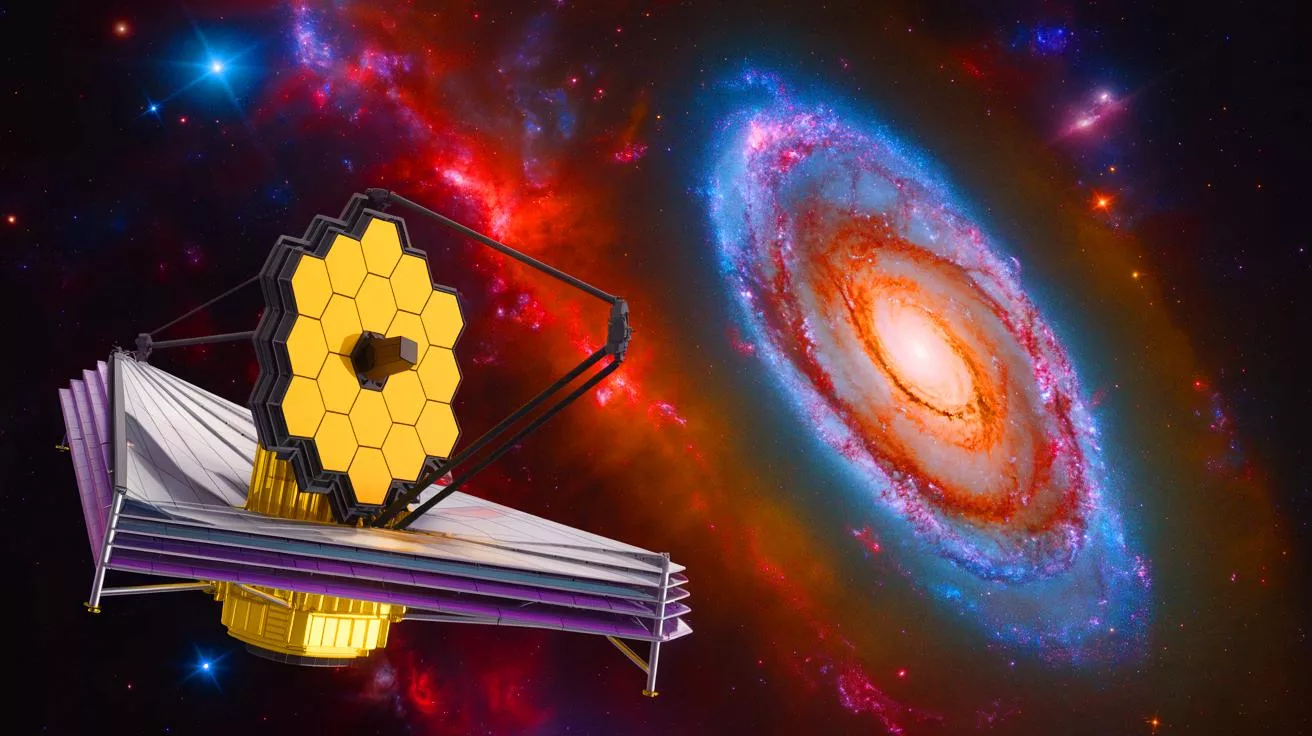
The cosmos has always been a source of fascination, and recent discoveries have only deepened our wonder. Utilizing the James Webb Space Telescope (JWST), researchers have uncovered a potentially transformative insight into the universe’s structure. A study revealing that a majority of ancient galaxies rotate in the same direction has sparked a debate among scientists. This has led to the bold hypothesis that our universe might be situated within a massive black hole. Such a proposition challenges existing cosmological theories and raises profound questions about the universe’s origins and structure. As research continues, the implications of these findings could dramatically alter our understanding of the cosmos.
Galactic Rotations: Unlocking Cosmic Mysteries
In a groundbreaking study, researchers have analyzed the rotational patterns of galaxies, uncovering a surprising degree of uniformity. The James Webb Space Telescope has provided images of 263 ancient galaxies, some dating back to just 300 million years after the Big Bang. These observations revealed that approximately 60% of these galaxies rotate clockwise. Such a discovery challenges the long-held belief that galactic rotations occur randomly across the universe.
The implications of this finding are profound and suggest a previously unrecognized cosmic order. If galaxies exhibit a consistent directional alignment, it raises questions about the forces that influence cosmic dynamics. The possibility of a shared origin or external influence on these rotations could lead to a fundamental reevaluation of our understanding of the universe’s formation and evolution. This pattern suggests that the universe might be more structured than previously thought, prompting scientists to develop new theories about its underlying mechanics.
The Black Hole Hypothesis: A New Cosmic Perspective
Among the most intriguing theories emerging from this study is the notion that our universe might exist within a black hole. This hypothesis suggests that the observed rotational patterns could be a result of the universe’s location within a black hole’s gravitational field. If this theory holds true, it would challenge conventional cosmological models and introduce the possibility of a universe governed by the unique physical laws of a black hole.
Such a realization would necessitate a reevaluation of our understanding of the universe’s boundaries and the nature of space-time. It suggests that fundamental cosmic principles, such as matter distribution and time flow, might operate differently within this cosmic environment. Although this hypothesis requires further exploration, it opens new avenues for understanding the universe’s true nature and its potential fate.
Alternative Explanations: The Role of Observational Bias
While the black hole hypothesis presents a captivating perspective, researchers are also considering alternative explanations for the observed galactic rotations. One possibility is the influence of observational bias, particularly the Doppler effect, which can affect the perceived motion of celestial objects. This effect might lead to an inaccurate interpretation of galactic rotations, highlighting the need for careful examination of observational methods.
If this alternative explanation proves valid, it would suggest that the perceived rotational alignment of galaxies does not reflect an inherent cosmic order. Instead, it would underscore the complexities and challenges involved in making precise astronomical observations. Addressing these biases is critical for ensuring the accuracy of future studies and validating the groundbreaking claims made by current research.
Implications for Cosmology: The Future of Cosmic Exploration
The potential discovery that our universe might reside within a black hole carries significant implications for cosmology. It challenges existing theories about the universe’s origins, structure, and eventual destiny. Should this hypothesis be confirmed, it would necessitate the development of new models to describe the universe’s behavior within this unique context.
This discovery highlights the importance of continued cosmic exploration and observation. As we refine our tools and techniques, we stand on the brink of potentially revolutionary insights into the universe’s mysteries. The quest to understand the universe’s true nature propels the scientific community to push the boundaries of knowledge and question the very fabric of reality.
The insights gained from the James Webb Space Telescope offer a glimpse into the universe’s hidden secrets, challenging us to reconsider our place in the cosmos. As we delve deeper into these cosmic mysteries, one must ask: What other profound revelations await our discovery in the vast expanse of the universe?