





| IN A NUTSHELL |
|
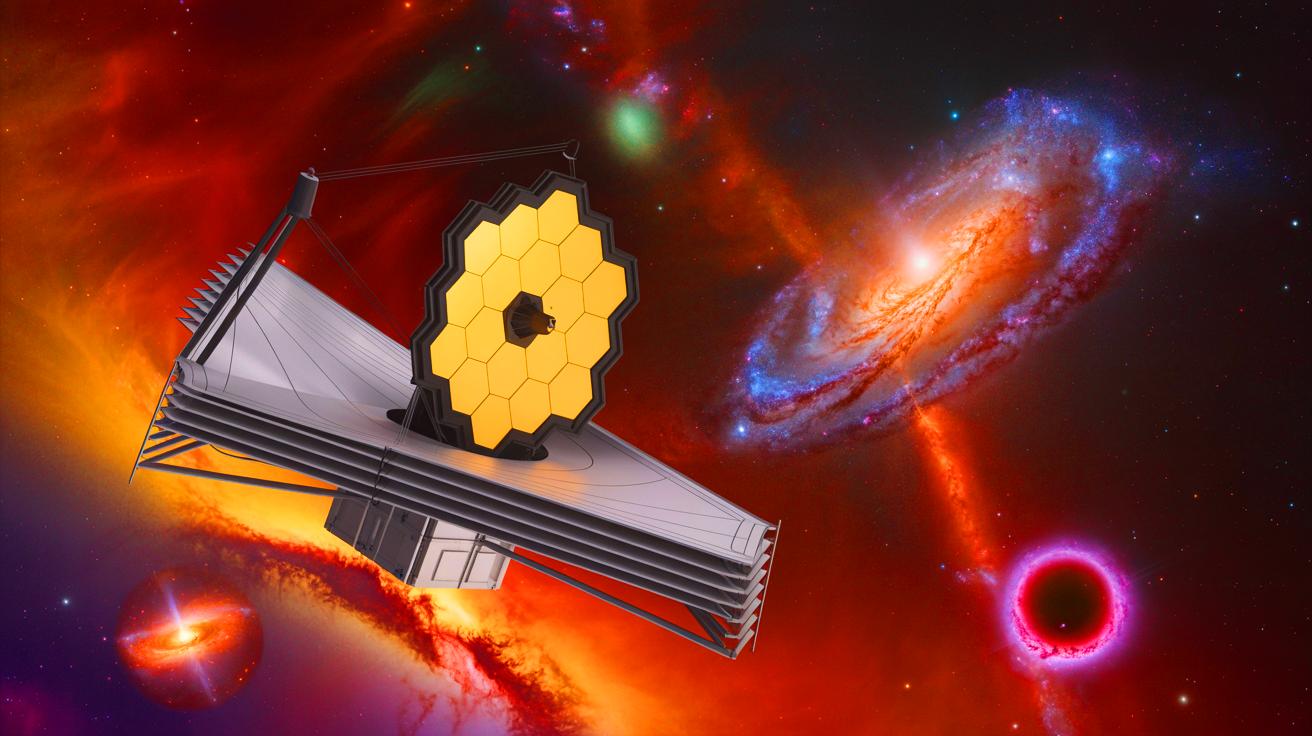
The universe, vast and enigmatic, often presents us with phenomena that challenge our understanding of cosmic principles. Recently, researchers using the James Webb Space Telescope (JWST) have made a startling discovery: a pattern in the rotational direction of galaxies. This finding has led to a bold hypothesis suggesting that our universe might be encapsulated within a massive black hole. Such a proposition has profound implications, potentially redefining our understanding of cosmology and the fundamental laws governing our universe. As we delve into this discovery, the scientific community is prompted to explore alternative theories and the potential for observational biases that might influence these groundbreaking observations.
Galactic Rotations: Unlocking Cosmic Mysteries
In a groundbreaking study, researchers have unveiled a pattern in the rotational directions of galaxies, challenging long-held beliefs about cosmic randomness. Utilizing the advanced capabilities of the James Webb Space Telescope, scientists have observed 263 ancient galaxies, revealing that a significant 60% of these celestial bodies rotate clockwise. This uniformity in rotation suggests a previously unrecognized cosmic order, compelling scientists to rethink the dynamics that govern the universe.
The implications of such a discovery are vast. If galaxies across the universe exhibit similar rotational alignments, it could indicate a shared origin or an unseen influence guiding their movement. This revelation prompts a deeper investigation into the cosmic forces at play, potentially redefining our understanding of galactic formation and evolution. The newfound pattern challenges the notion of randomness in galactic behavior, suggesting a more structured universe than previously imagined.
The Black Hole Hypothesis: A New Cosmic Perspective
Among the theories emerging from this study is the intriguing hypothesis that our universe might reside within a massive black hole. This concept, if validated, would mean that the observed clockwise rotation of galaxies is influenced by the gravitational pull of a black hole. Such a scenario challenges established cosmological models, proposing that the universe’s behavior is dictated by the unique environment of a black hole.
This hypothesis necessitates a reevaluation of how we perceive the boundaries and structure of the universe. It suggests that fundamental principles, such as time and matter distribution, operate differently within this context. Although the theory requires further investigation, it opens new avenues for understanding the universe’s nature and its ultimate fate. The idea of a universe governed by black hole dynamics is both revolutionary and provocative, urging scientists to explore beyond traditional cosmological boundaries.
Alternative Explanations: The Role of Observational Bias
While the black hole hypothesis captivates the imagination, researchers must also consider alternative explanations for the observed galactic rotations. One possibility is the impact of observational bias, particularly the Doppler effect, which can alter the perceived motion of galaxies. This effect might lead to misinterpretations of galactic behavior, underscoring the need for careful examination of observational data.
If observational bias is influencing these findings, it highlights the complexities of precise astronomical measurements. Addressing these biases is crucial for ensuring the accuracy of future research and validating the current study’s claims. The potential for such biases serves as a reminder of the challenges faced in the pursuit of cosmic knowledge and the importance of refining our observational techniques.
Implications for Cosmology: The Future of Cosmic Exploration
The possibility that our universe is trapped within a black hole has profound implications for cosmology. It challenges existing theories about the universe’s origins, structure, and destiny. If true, it would require the development of new models to describe cosmic behavior within this unique framework.
This discovery underscores the necessity of ongoing exploration and observation of the cosmos. As we enhance the capabilities of telescopes like the JWST, we stand on the brink of potentially transformative insights into the universe’s mysteries. The quest to understand the universe’s true nature drives the scientific community to push the boundaries of knowledge and question the very fabric of reality. The findings from the James Webb Space Telescope open a realm of possibilities, urging us to reconsider our place in the cosmos.
The mysteries unveiled by the James Webb Space Telescope ignite a sense of wonder and curiosity about the universe. As we continue to probe these cosmic enigmas, we are left with a compelling question: What other secrets lie hidden in the vast expanse of space, waiting for us to discover?


Wow, mind blown! 🤯 Are we really living inside a black hole?
This is fascinating! Could this mean time works differently in our universe?
I’ve always thought the universe was random. Guess I was wrong! 😅
How reliable are these observations? Could it just be a coincidence?
Thank you for this insightful article. It’s intriguing to think about these new theories!
Could the JWST findings impact our understanding of dark matter too?
Is this like a cosmic dance choreographed by a giant black hole? 💃🕺
Is there a possibility of observational errors influencing these findings?