





| IN A NUTSHELL |
|
The recent discovery of an unusual black hole in the Infinity Galaxy by the James Webb Space Telescope (JWST) has stirred curiosity and excitement among astronomers and space enthusiasts alike. This groundbreaking observation challenges existing theories about the formation of supermassive black holes and offers a tantalizing glimpse into the universe’s early days. The Infinity Galaxy, with its distinct infinity shape, has become the focal point of this intriguing find, and scientists are eager to unravel the mysteries it holds. As we delve deeper into the details of this discovery, we uncover a story of cosmic collisions, direct collapse black holes, and the relentless pursuit of understanding the cosmos.
The Enigmatic Infinity Galaxy
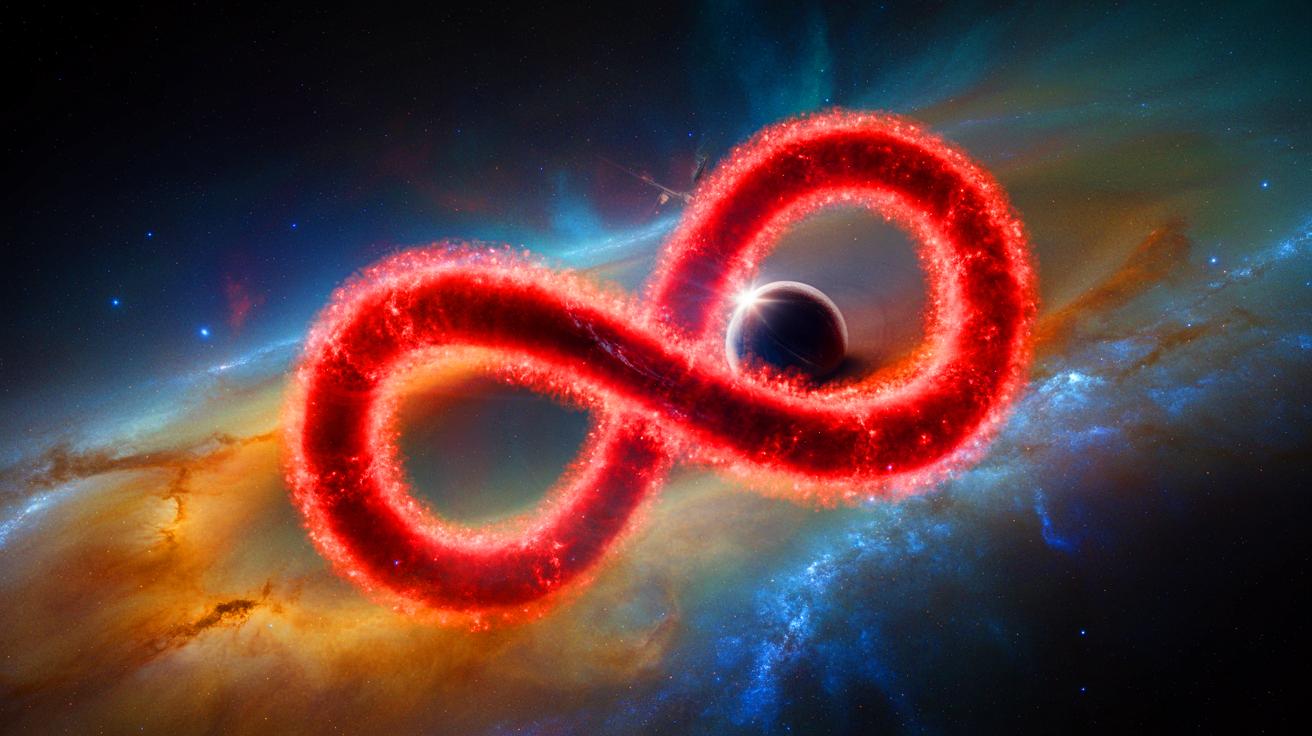
At the heart of this cosmic drama lies the Infinity Galaxy, a celestial body unlike any other. Resembling an infinity symbol, this galaxy is a product of two disk galaxies that collided head-on, creating a unique shape with two red lobes or “nuclei.” This collision, while not uncommon in the universe, has resulted in an exceptional formation. Within this galactic structure, astronomers have identified a black hole that defies conventional understanding. Positioned between the two colliding galaxies, this black hole is surrounded by a vast cloud of gas, feeding voraciously on its surroundings. Researchers believe that this very cloud may have been the birthplace of the black hole, offering the first observational evidence of a direct collapse black hole.
The discovery was made during the JWST’s extensive 255-hour COSMOS-Web survey, which aimed to explore the early universe. The findings have not only revealed the existence of the black hole but also highlighted the presence of supermassive black holes within each nucleus of the colliding galaxies. The peculiar location of the black hole, coupled with its rapid growth, poses intriguing questions about its origin and the processes that govern such phenomena in the universe.
Challenging Conventional Black Hole Formation
The traditional understanding of black hole formation involves the collapse of massive stars into stellar-mass black holes, which then merge and grow over time. This process, however, takes billions of years, making it difficult to explain the presence of supermassive black holes in the early universe. The JWST’s observations have challenged this notion, suggesting that black holes could form rapidly through a direct collapse mechanism, bypassing the stellar phase entirely. This theory, known as the “heavy seed” hypothesis, posits that a massive gas cloud could collapse directly into a black hole, providing a quicker route to supermassive status.
While this idea offers a solution to the conundrum of early supermassive black holes, it also raises new questions about the conditions required for such a collapse. Gas clouds typically fragment into stars rather than collapsing into a single massive object, so understanding the factors that prevent fragmentation is crucial. The Infinity Galaxy, with its evidence of a direct collapse black hole, provides a rare opportunity to study this process and refine our theories about black hole formation.
Unraveling the Mystery of Heavy Seeds
The heavy seed theory, while compelling, requires further evidence to support its validity. In the case of the Infinity Galaxy, the collision between the two disk galaxies may have played a pivotal role in the formation of the direct collapse black hole. The violent collision likely resulted in the compression of gas, creating a dense knot that could collapse into a black hole. The presence of ionized gas and X-ray emissions from the black hole supports this hypothesis, suggesting active growth and energy release.
To solidify this theory, researchers are focused on measuring the velocity of the gas and the black hole. If their velocities align, it would strongly indicate that the black hole formed from the gas cloud. This alignment would rule out alternative explanations, such as a runaway black hole or a black hole from an unseen third galaxy. The ongoing analysis of the Infinity Galaxy data offers the potential to confirm the direct collapse pathway and reshape our understanding of cosmic evolution.
The Implications of a New Discovery
The discovery of a direct collapse black hole in the Infinity Galaxy has far-reaching implications for astronomy and cosmology. It challenges existing models of black hole formation and opens new avenues for research into the early universe. Understanding how such massive objects can form so quickly could provide insights into the conditions of the universe shortly after the Big Bang, shedding light on the processes that shaped the cosmos we observe today.
As researchers continue to analyze the data from the JWST, the Infinity Galaxy serves as a reminder of the vast and complex nature of the universe. It underscores the importance of advanced telescopes and collaborative efforts in pushing the boundaries of our knowledge. With each new discovery, we are reminded of the mysteries that await us in the cosmos, prompting us to ask: What other secrets does the universe hold, and how will they reshape our understanding of the world around us?

Wow, the Infinity Galaxy sounds like something out of science fiction! 🌌
Can someone explain how a black hole can form directly from a gas cloud? 🤔
I’m not surprised physicists are tearing each other apart over this. It’s monumental!
Is it possible that the James Webb telescope has made a mistake in its observations?
Thank you for sharing such an exciting discovery with us!
Ça remet en question tout ce qu’on pensait savoir sur les trous noirs !
How does this change our understanding of the universe’s early days?
Les physiciens ne s’entendront jamais, c’est sûr ! 😂
C’est incroyable que le télescope Webb puisse voir si loin dans l’espace !
I’ve always wondered what the Infinity Galaxy looks like. Is there an image available?