





| IN A NUTSHELL |
|
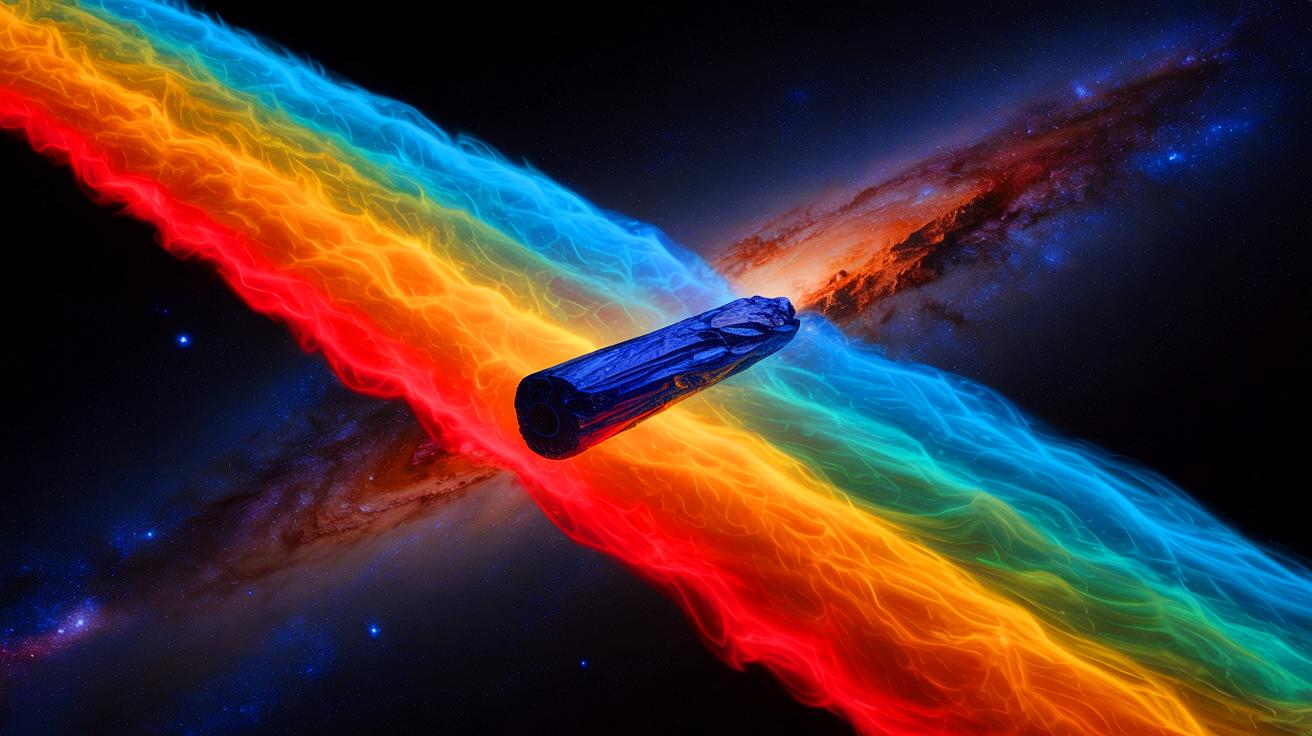
The cosmos never ceases to amaze, and the recent discovery of 3I/ATLAS, an interstellar object traversing our solar system, is a testament to the mysteries that lie beyond. This celestial visitor, currently millions of miles away, has ignited a fervor in the scientific community as experts rush to uncover its secrets before it vanishes forever. With advanced telescopes like the James Webb Space Telescope (JWST) and Hubble focused on this enigmatic object, the race is on to answer key questions about its origin, composition, and trajectory.
The Origins of 3I/ATLAS
The origin of 3I/ATLAS is one of the most intriguing puzzles facing astronomers today. Tracing its path back to its original star system is an almost impossible task, yet researchers are determined to pinpoint its region of origin. Speculation suggests that this object may hail from the thick disk of our galaxy, a region populated by older stars. If this hypothesis holds, 3I/ATLAS could be an extremely ancient relic, possibly over eight billion years old, and potentially even older than the stars currently shining in our skies. Its age and journey could offer invaluable insights into the history and evolution of the galaxy itself.
The possibility that 3I/ATLAS originated from a now-extinct star adds an extra layer of mystery. Given its potential age, understanding its path may help astronomers learn about the life cycles of stars and the dynamic processes that govern our galaxy. As scientists continue to study this cosmic traveler, they remain hopeful that its story will shed light on the ancient mechanisms of the universe.
Estimating Its Size
Amidst the mysteries surrounding 3I/ATLAS, determining its size has been a challenging task. Initially, estimates suggested a diameter of about 12 miles. However, more recent observations have revised this estimate to a more modest 0.6 to 1.2 miles, aligning it more closely with its interstellar predecessors, 1I/ʻOumuamua and 2I/Borisov. If the earlier, larger size were confirmed, it would challenge existing models regarding the prevalence of large interstellar objects.
The accurate measurement of 3I/ATLAS’s size is crucial for understanding the population of similar objects in our galaxy. Its current size estimation suggests that smaller interstellar travelers are more common than previously thought. This information is vital for developing models that predict the frequency and distribution of such objects, offering a clearer picture of the cosmic environment that surrounds us.
Unraveling Its Composition
If 3I/ATLAS is indeed an ancient cometary remnant, it might harbor ices that have never been heated. As it approaches the Sun, it could become active and release gases, revealing its chemical composition. The JWST and Hubble are poised to identify the molecules emitted, despite observational challenges in October when it is closest to the Sun. Observatories like Lowell and the Mars MAVEN orbiter will also play a role in this investigative process.
Scientists hope to detect water, carbon monoxide, carbon dioxide, and ammonia, which could confirm its “pristine” state and ancient origins. Understanding its composition will provide insights into the materials present in other star systems and how they compare to those in our own solar neighborhood. This knowledge could further our understanding of planetary formation processes across the cosmos.
Survival of Its Solar Encounter
The survival of 3I/ATLAS as it passes near the Sun is a topic of considerable interest. While ʻOumuamua withstood its journey, the comet Borisov fragmented, and the same fate might await 3I/ATLAS. Astronomers are closely monitoring this visitor, as solar winds pose a significant threat by potentially stripping away its cometary tail.
Furthermore, the path of 3I/ATLAS offers a unique opportunity to study solar wind interactions in the outer solar system. Observing how the object reacts will enhance our understanding of these interactions and the forces at play. This information could be pivotal for future missions that aim to explore and understand the nature of interstellar objects and their interactions with the solar environment.
The discovery of 3I/ATLAS is not just an astronomical event; it represents a unique opportunity to glimpse the processes of planetary and stellar formation beyond our own system. Each observation and data point gathered contributes to a larger cosmic puzzle. As 3I/ATLAS prepares to leave our view, the quest for answers to these seven critical questions continues, fueling human curiosity and pushing the boundaries of our understanding of the universe. What other cosmic secrets will the new generation of telescopes unveil in the coming years?


Wow, another interstellar object! Does this mean we might find more of them in the future? 🚀
Merci pour cet article fascinant. Ces découvertes nous rappellent à quel point l’univers est vaste et mystérieux.
Could 3I/ATLAS contain any alien technology, or is it purely natural?
Is it possible that this object is a fragment of an ancient alien civilization? 😲
Quelqu’un sait si cette sonde est visible à l’œil nu ou si on a besoin d’un télescope ?
I’m always amazed at how little we actually know about our own solar system, let alone the universe!
Est-ce que les scientifiques prévoient d’envoyer une sonde pour explorer 3I/ATLAS de plus près ?
It’s incredible how these objects can spark such global debates. Love it!
If it a probe its not from the thick disk, likely gravity slingshot correction using a dark object possibly in the Oort Cloud or beyond. The speed and timing points to Proxima system origin with launch around 25,000 years ago when it was closest. Hopefully this is not the front end of the “moving in freight train”. Think about, if humanity was technologically advanced enough and the solar system has approached another with another habitable planet ! It’s maybe the only opportunity ever to expand … we would have done the same thing.