




| IN A NUTSHELL |
|
In a groundbreaking development in materials science, researchers at the USC Viterbi School of Engineering have made significant strides in creating a new, smarter form of concrete. Utilizing an innovative AI-powered simulation model named Allegro-FM, scientists can now mimic the behavior of billions of atoms simultaneously. This advancement paves the way for the development of concrete that is not only stronger and more fire-resistant but also environmentally friendly by capturing carbon dioxide emissions. Concrete, the most commonly used man-made material globally, has long been associated with high environmental costs. The production of cement, a key component of concrete, accounts for approximately 8 percent of global CO₂ emissions.
Smarter Mixes, Cleaner Planet
The Allegro-FM model represents a substantial shift in how researchers approach concrete composition. By allowing scientists to test various molecular structures virtually, the model accelerates the discovery of carbon-trapping and self-reinforcing concrete formulas. This process eliminates the need for costly and time-consuming trial-and-error methods typically conducted in laboratories.
Professor Aiichiro Nakano, one of the developers of Allegro-FM, explained that the simulations have demonstrated the potential to trap CO₂ released during cement production within the concrete itself, effectively making it carbon-neutral. According to Nakano, “You can just put the CO₂ inside the concrete, and that makes a carbon-neutral concrete.”
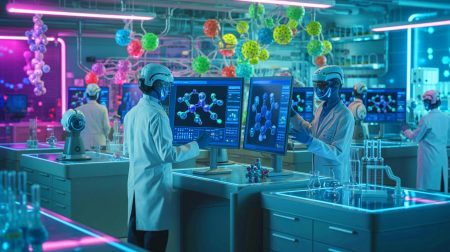
With the support of the Aurora supercomputer at Argonne National Laboratory, the AI system has simulated over 4 billion atoms with an impressive 97.5 percent efficiency. This scale is nearly 1,000 times larger than conventional models, enabling researchers to delve deeper into understanding the atomic interactions that affect concrete’s performance, including its resistance to wildfires and prolonged structural decay.
Atomic Clarity Meets Concrete
The potential benefits of Allegro-FM extend beyond just environmental gains. The simulations suggest the possibility of creating concrete that is much more durable than its modern counterpart. While contemporary concrete typically degrades over a century, the incorporation of CO₂ might form a robust carbonate layer, potentially enhancing its longevity to rival that of ancient Roman concrete, which has endured for millennia.
The transformative aspect of Allegro-FM lies in its ability to predict atomic interactions without relying on element-specific equations. Traditionally, quantum mechanics required distinct formulas for each material. However, the AI-driven models utilized by Allegro-FM, trained on extensive datasets, can simulate these behaviors with exceptional accuracy and efficiency.
Professor Ken-Ichi Nomura emphasized the system’s versatility, highlighting its capability to model 89 different chemical elements. While the immediate focus remains on revolutionizing construction materials, the potential applications of Allegro-FM span a wide range of fields, including carbon storage materials, battery chemistries, new pharmaceuticals, and biomedical devices.
Implications for Construction Industry
The introduction of Allegro-FM into the field of construction materials could have far-reaching implications. The ability to create stronger, more sustainable concrete may revolutionize the industry, reducing its carbon footprint while enhancing the longevity and safety of structures. The AI-driven approach provides a unique opportunity to rethink and redesign the materials that form the backbone of global infrastructure.
As researchers continue to explore the capabilities of Allegro-FM, they are focusing on developing more complex concrete geometries and surfaces. These advancements could lead to the creation of customized construction materials tailored to specific environmental and structural requirements, further expanding the possibilities for sustainable building practices.
The findings of this research have been published in The Journal of Physical Chemistry Letters, marking a significant contribution to the ongoing dialogue surrounding sustainable development and climate change mitigation.
Challenges and Future Prospects
Despite the promising advancements made possible by Allegro-FM, challenges remain in the widespread adoption of this technology. Scaling up the production of carbon-neutral concrete and integrating it into existing construction practices will require collaboration between researchers, industry stakeholders, and policymakers.
Moreover, the economic feasibility of implementing these new materials on a large scale will play a crucial role in determining their success. Addressing these challenges will be essential to realizing the full potential of Allegro-FM and its contributions to a more sustainable future.
As the world grapples with the impacts of climate change, innovations like Allegro-FM offer a glimpse into the possibilities of harnessing technology to mitigate environmental damage. How will the construction industry adapt to these advancements, and what role will policy play in shaping the future of sustainable materials?


Wow, simulating 4 billion atoms sounds like sci-fi! How accurate are these simulations? 🤔
Isn’t it incredible how AI can help create carbon-neutral concrete? Hats off to the scientists! 🎩
From carbon-neutral concrete to ancient Roman durability, this sounds like a game-changer!
Can this technology really reduce the carbon footprint of construction on a global scale? 🌍
I’m skeptical. How long before we see this in real-world applications?
What do the oil giants have to say about this development?
Finally, a way to fight climate change with concrete! Let’s hope it gains traction fast. 😊
Does Allegro-FM work for other materials besides concrete?
Can Allegro-FM really mimic the behavior of billions of atoms simultaneously?
Great step towards a sustainable future! What are the challenges in scaling up this tech?