





| IN A NUTSHELL |
|
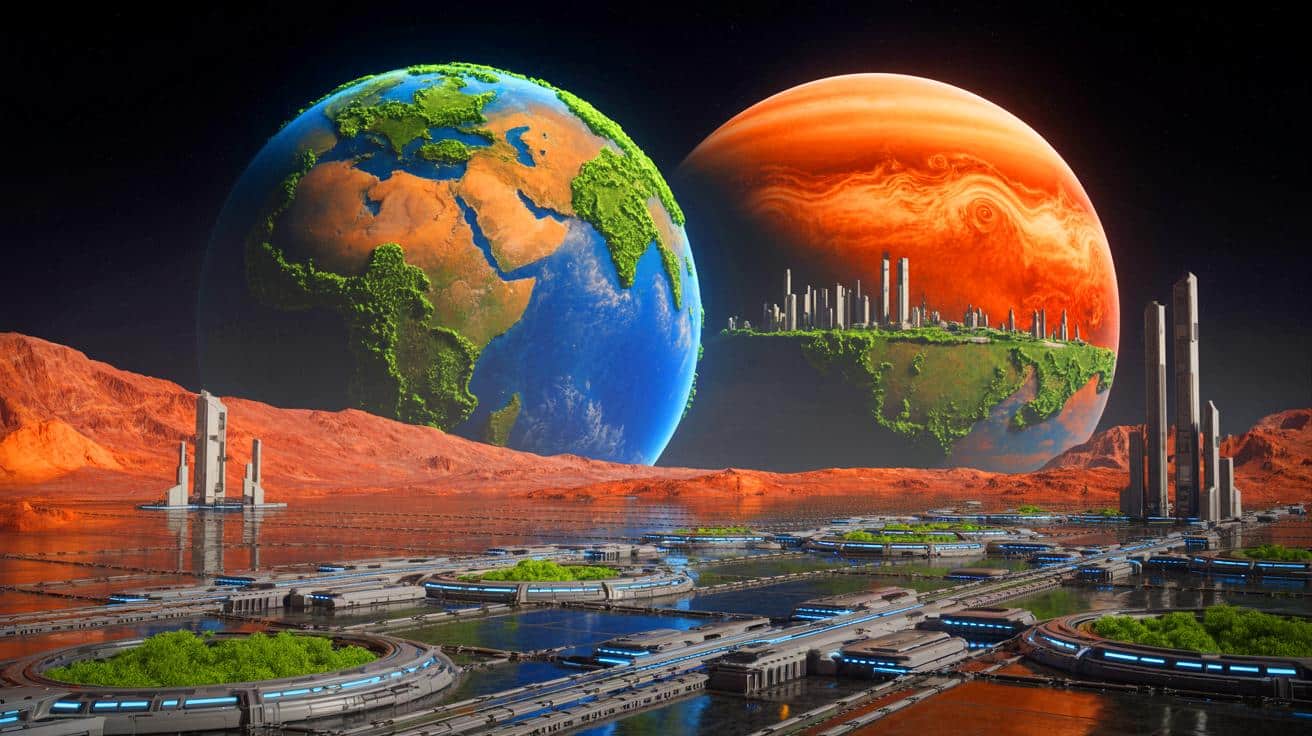
The pursuit of building communities on other planets is no longer a distant fantasy. Researchers from the University of Central Florida (UCF) and other institutions are actively exploring how humans might one day inhabit planets like Mars and Venus. These ambitious projects aim not only to extend human life beyond Earth but also to push the boundaries of scientific knowledge. By investigating the potential for creating breathable atmospheres, sustainable energy, and agricultural systems on these planets, scientists hope to ensure the survival of humanity and foster a deeper understanding of our universe.
Redesigning Mars Into a Habitable World
UCF Planetary Scientist and Astrobiologist Ramses Ramirez is at the forefront of research to make Mars habitable. His work focuses on terraforming, the process of altering a planet’s environment to resemble Earth’s. Key to his approach is using Martian nanoparticles to warm the planet’s surface, potentially supporting liquid water and plant life. Ramirez’s vision extends beyond scientific curiosity. “Ultimately, I’m interested in finding life on other planets,” he says. “And if it’s not there, then we should become that life on that planet.”
Mars was once more Earth-like, with evidence of valleys and rivers. These signs suggest that Mars had an atmosphere dense enough to support liquid water. The challenge now lies in determining whether any of these resources still exist or how to create alternatives if they do not. Ramirez questions, “Does Mars still have enough of those resources that it once did?” His research aims to fill the gaps necessary to restore Mars to a habitable state.
Terraforming Mars
Mars presents significant challenges, particularly its extreme cold, with an average surface temperature of minus 80 degrees Fahrenheit. To address this, Ramirez proposes using Martian dirt to grow microscopic nanorods. These nanorods, when released into the atmosphere, could trap solar energy and create a greenhouse effect. This method could increase temperatures to around 30 degrees Fahrenheit, sufficient for melting ice and supporting simple plant life.
The nanorods are remarkably efficient, being 5,000 times more effective than earlier methods. This approach offers a cost-effective, locally available solution that does not require importing large quantities of material from Earth. Furthermore, Ramirez believes that this technique could be adapted for other planets, utilizing materials like water vapor or carbon dioxide, based on the atmospheric composition. “It can sustain at least Earth-like life, or at least warm enough conditions with high enough pressures and low enough toxicity to survive,” he explains.
Finding Food in Martian Soil
Beyond warming the planet, sustaining a colony requires a reliable food source. Researchers have long experimented with growing food in Martian soil simulants. Space Resource Technologies, an offshoot of UCF’s Exolith Lab, has developed realistic Mars soil simulants to study plant growth. The discovery of organic molecules by the Viking, Curiosity, and Perseverance missions suggests that Mars once supported life. “Those conditions could have led to life on early Mars,” Ramirez notes. While no fossils have been found, the presence of these organic compounds indicates that Mars had the potential to support life.
Efforts to cultivate food in Martian soil are crucial for ensuring the survival of any future colonies. If successful, these techniques could significantly reduce the need for transporting food from Earth, making long-term habitation more feasible.
Powering Life Beyond Earth
Consistent power is essential for sustaining life on Mars or any other planet. While solar power has been effective for rovers, it is unreliable due to dust storms and long nights. NASA is exploring nuclear fission devices capable of providing 40 kilowatts of continuous power for up to a decade. These reactors could power habitats through the darkest nights.
Mars has a day similar to Earth’s, making solar energy a viable option. However, other planets like Venus pose more significant challenges due to their slow rotation and dense atmospheres. Scientists have proposed innovative solutions, such as solar planes floating in Venus’s upper atmosphere. These planes would collect sunlight, store energy in batteries, and transfer it to surface landers via laser power. While ambitious, these proposals could one day sustain long-term missions in hostile environments.
Floating Above the Clouds of Venus
Venus might seem an unlikely candidate for colonization due to its extreme surface conditions. However, approximately 31 miles above the surface, the atmosphere is surprisingly Earth-like, making the idea of floating cities or research stations plausible. Venus is closer to Earth than Mars, making trips shorter and more cost-effective. Its thick atmosphere also offers protection from cosmic radiation.
While mining the Venusian surface is nearly impossible, the carbon dioxide in its atmosphere could be converted into oxygen to support life. Ramirez emphasizes the necessity of adapting to the corrosive acid in the atmosphere to ensure safety for any future missions. “That way, if things go wrong, astronauts there would be safe,” he states.
Practical Uses of the Research
The research into terraforming and sustaining life beyond Earth has far-reaching implications. Techniques like nanoparticle-based warming and in-situ resource utilization can lower the costs associated with space colonization. These advances could also influence climate engineering on Earth, from carbon capture to optimizing renewable energy.
Planetary science not only advances our understanding of habitability but also drives technological and agricultural innovation. These developments could benefit both space settlers and life on Earth, providing valuable insights into sustainable living and resource management.
The exploration of Mars and Venus presents a remarkable opportunity to expand human presence beyond Earth. With ongoing research and technological advancements, the dream of living on another planet inches closer to reality. As we continue to explore these possibilities, one question remains: How will these pioneering efforts transform our understanding of life and our place in the universe?
Wow, floating cities on Venus? That’s straight out of a sci-fi movie! 😮
C’est fascinant, mais est-ce vraiment réalisable dans notre vie ? 🤔
Je suis tellement excité par l’idée de vivre sur Mars un jour ! 🚀
How long before we can actually move to Mars? Can’t wait! 😄
Les chercheurs ont-ils envisagé l’impact psychologique de vivre si loin de la Terre ?
Je me demande comment ils vont gérer l’acidité dans l’atmosphère de Vénus. 😅
C’est incroyable! Mais comment vont-ils gérer les tempêtes de poussière sur Mars ?
Merci pour cet article inspirant, ça ouvre vraiment l’esprit sur ce qui est possible.
Terraforming Mars sounds amazing, but is it really feasible in our lifetime?
Et si on terraformait la Terre d’abord pour résoudre nos problèmes climatiques actuels ?
Les nanorods sur Mars, c’est de la science-fiction ou de la science réelle ? 🤔
Thank you for such an insightful article. The future looks exciting! 😊
Je trouve ça fou qu’on puisse même envisager des villes flottantes sur Vénus !
Mars and Venus, here we come! But what about the cost? 🤔
Les voyages interplanétaires sont-ils vraiment la solution à la surpopulation terrestre ?
Bravo aux chercheurs pour repousser les limites de ce qu’on pensait possible. 👏