





| IN A NUTSHELL |
|
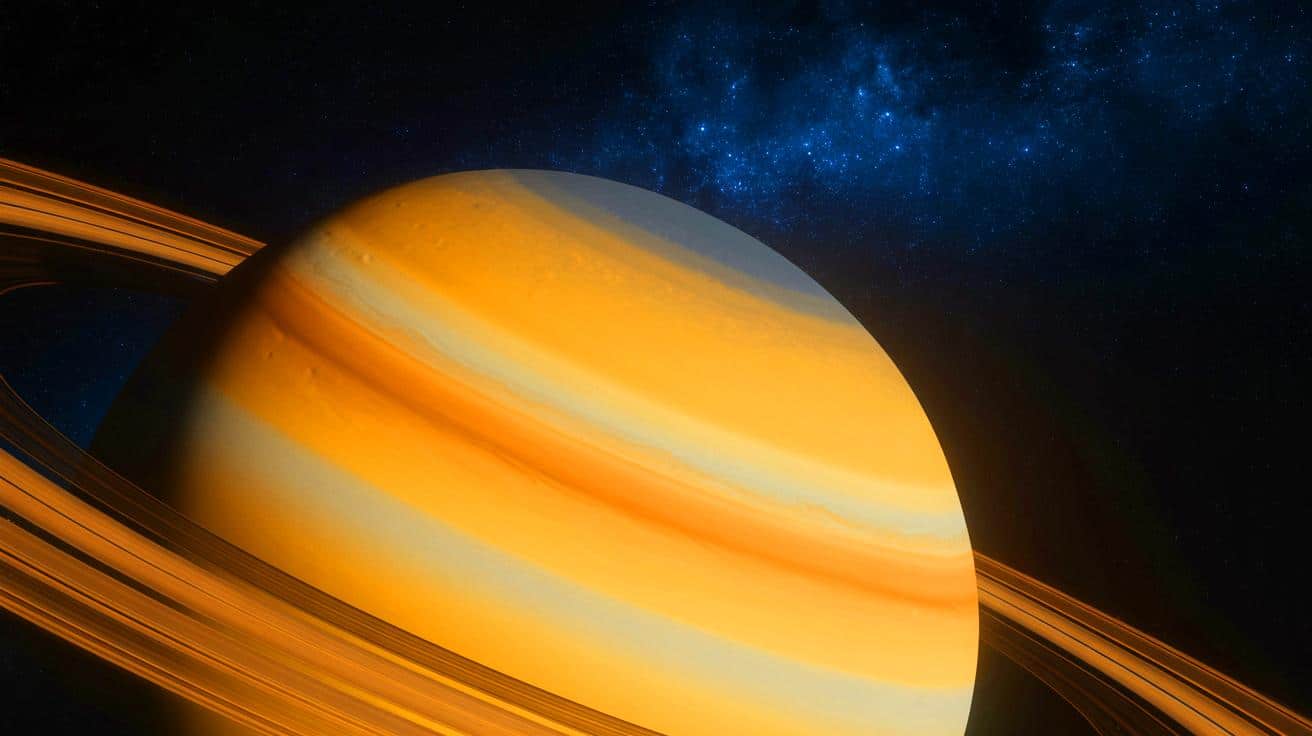
Saturn’s largest moon, Titan, continues to captivate scientists with its dense, hazy atmosphere that behaves in unexpected ways. Recent research conducted by the University of Bristol, utilizing data from the Cassini-Huygens mission, has unveiled unprecedented insights into Titan’s atmospheric dynamics. The findings reveal that Titan’s atmosphere does not rotate in unison with its surface, instead oscillating like a gyroscope and changing its tilt with the seasons. This discovery holds significant implications for future space missions, particularly NASA’s upcoming Dragonfly mission, and offers fresh perspectives on atmospheric physics both within and beyond our Solar System.
Titan’s Unique Atmospheric Behavior
Titan is unique among the moons in our Solar System due to its substantial atmosphere, which stands out as a subject of intrigue for planetary scientists. Unlike other moons, Titan’s atmosphere is dense and shrouded in a golden haze. This atmosphere does not rotate synchronously with Titan’s surface; rather, it exhibits a peculiar gyroscopic wobble. Researchers at the University of Bristol have determined that this wobble results from an oscillation in the atmosphere, possibly triggered by an event in Titan’s past that knocked it off its spin axis.
Lucy Wright, the lead author of the study, described the behavior of Titan’s atmospheric tilt as “very strange.” The research team found that the size of this tilt changes with Titan’s seasons, adding another layer of complexity to the moon’s atmospheric dynamics. The study provides a new lens through which scientists can examine the atmospheric physics of celestial bodies, offering insights that extend beyond Titan itself.
Seasonal Shifts and Atmospheric Drift
The research team uncovered that Titan's atmospheric temperature field is not perfectly aligned with the moon's pole, as previously assumed. Instead, the center of this field drifts gradually, influenced by Titan's extended seasonal cycle, which spans nearly 30 Earth years. This seasonal shift challenges previous assumptions and introduces new mysteries about the forces influencing Titan's atmosphere.
Professor Nick Teanby, a co-author of the study, noted the unusual aspect of the tilt direction remaining fixed in space. This behavior contrasts with expectations that the atmosphere would be influenced by external factors such as the Sun or Saturn. The findings leave scientists with a new enigma to solve, as the anticipated clues to explain the tilt were not found.
Impact on Future Space Missions
The discovery of Titan’s atmospheric wobble is particularly significant for NASA’s Dragonfly mission, which is set to explore Titan in the 2030s. Dragonfly, a drone-like rotorcraft, will rely on a precise understanding of Titan's atmospheric conditions to safely navigate and land on the moon's surface. The mission will be affected by Titan's fast-moving winds, which are about 20 times faster than the moon’s surface rotation.
Understanding the seasonal wobble of Titan’s atmosphere is crucial for calculating Dragonfly's landing trajectory. The research by the University of Bristol team will aid engineers in predicting where Dragonfly will touch down, enhancing the mission's success. This study exemplifies how knowledge gleaned from past missions like Cassini can shape the strategies and technologies of future explorations.
Broader Implications of Titan’s Atmospheric Dynamics
The peculiar behavior of Titan’s atmosphere presents broader implications for the field of atmospheric science. Dr. Conor Nixon, a planetary scientist at NASA Goddard and co-author of the study, emphasized the continued value of Cassini’s data archive. The research not only sheds light on Titan's unique atmospheric characteristics but also contributes to the broader understanding of atmospheric physics.
The notion that Titan's atmosphere acts like a spinning top disconnected from its surface prompts fascinating questions for scientists. It challenges existing models of atmospheric behavior and encourages further exploration into similar phenomena on other planets and moons, including Earth. Titan serves as a reminder that despite its Earth-like appearance, it remains an alien world with its own climate systems and hidden mysteries.
The discovery of Titan's atmospheric wobble opens new avenues for research and exploration in planetary science. As scientists continue to analyze data from the Cassini mission, they uncover more about the enigmatic nature of this distant moon. What other secrets does Titan hold, and how will they influence our understanding of planetary atmospheres across the Solar System?

Wow, Titan’s atmosphere spins like a gyroscope? Mind blown! 🤯
Wow, Titan’s atmosphere spins like a gyroscope? That’s mind-blowing! 🌪️
Can someone explain how this affects the Dragonfly mission in simple terms?
Does this mean that the Dragonfly mission will be delayed? I hope not!
Is this “gyroscopic wobble” similar to anything we see here on Earth?
Great article, but I wish there was more detail about how the Cassini data was analyzed.
Why are the seasons on Titan so long? Love to learn more about that.
So, Titan is basically a giant spinning top in space? That’s wild! 🎡
Thank you for the article! It’s amazing how much we still have to learn about our solar system.
How will these findings change the landing strategies for Dragonfly?
Fascinating! Does this mean we have to rethink our models for all planetary atmospheres?
So does this mean Titan has its own version of a weather forecast? 😂
Why did it take so long to discover this about Titan’s atmosphere?
Loved the article! Keep up the great work on bringing us space news. 🌌
Is Titan’s atmosphere the only one that behaves like this in our solar system?
This is just more proof that space is way cooler than we ever imagined. 🚀
I wonder if this will impact any other planned missions to Saturn’s moons.
Thank you for the article! It’s amazing to see how much we’re still learning from Cassini.
Does this gyroscopic behavior affect Titan’s weather patterns?
How certain are scientists about the “event” that knocked Titan off its axis?
What are the broader implications for our understanding of atmospheric science?
This is a game-changer for planetary exploration! Can’t wait for Dragonfly! 🥳
Did the article mention if Titan’s atmosphere affects its surface in any way?
Is it just me, or does Titan keep getting more mysterious? 🤔
Could this discovery help us understand Earth’s atmosphere better?
Imagine if we could visit Titan and experience that atmosphere firsthand! 🌌
Why is the tilt direction of Titan’s atmosphere fixed in space?
Anyone else think this sounds like something out of a sci-fi movie?
What kind of technology will Dragonfly use to navigate Titan’s fast winds?
Thanks for the info! I had no idea Titan was so complex.
Does Titan’s atmosphere have any impact on its surface conditions?
This is why I love space exploration; you never know what you’ll discover. 🪐
Is there a possibility of finding life in such a dynamic atmosphere?
How do scientists measure the tilt and rotation of Titan’s atmosphere?
More mysteries of the universe! What’s next? 😄
Could this discovery influence how we study other planetary bodies?
I found a typo in the article, but it’s still a great read! 😅
Does this mean Titan is more Earth-like than we thought?
Is there any chance this atmospheric behavior could have been caused by an external object?
Keep the space articles coming! They’re out of this world! 🌠
What else can Cassini’s data tell us about Titan and other moons?
I’m curious how this research will inform future planetary missions.