




| IN A NUTSHELL |
|
The National Aeronautics and Space Administration (NASA) is poised to make history once again as its Space Launch System (SLS) rocket prepares to transport astronauts to the Moon. Following years of setbacks and technological adjustments, this monumental endeavor, known as Artemis II, will mark humanity’s return beyond Earth’s orbit for the first time since 1972. With the SLS now fully operational, the mission is a significant step forward in NASA’s ambitious plan to explore the lunar surface and beyond. This article delves into the intricacies of the SLS development, the upcoming Artemis II mission, and the challenges faced along the way.
The Mission Artemis II Takes Shape
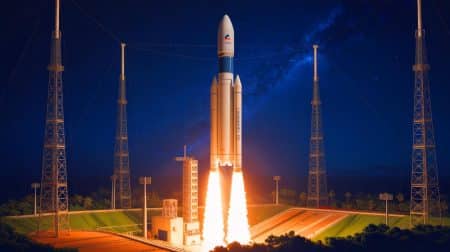
After a five-year delay, NASA’s Space Launch System (SLS) is ready to carry a human crew to the Moon. Standing at over 328 feet, this rocket is the most powerful ever built by the U.S. space agency. Lessons learned from the inaugural Artemis I flight in 2022 have helped refine its configuration. The Artemis II mission will span approximately 10 days and involve a flyby around the Moon without landing. The crew comprises three Americans—Reid Wiseman, Victor Glover, and Christina Koch—and one Canadian, Jeremy Hansen. This mission serves as a dress rehearsal for the planned lunar landing with Artemis III in 2027.
The launch is now scheduled for April 2026, a year later than initially planned for September 2025. This delay is attributed to the need for a thorough analysis of the Orion spacecraft’s heat shield, which unexpectedly shed fragments during the re-entry phase of Artemis I. The mission’s success is crucial for setting the stage for future lunar explorations.
A Rocket Redesigned in Detail
The SLS for Artemis II retains the same basic architecture as its predecessor but includes numerous enhancements. Engineers have repositioned antennas to ensure continuous communication with ground stations and added optical targets on the upper stage to aid astronauts in executing manual maneuvers.
The safety system has been upgraded with a delay in the self-destruct mechanism, allowing the Orion spacecraft to escape in case of an emergency. Booster separation motors have been adjusted by an additional 15 degrees to increase safety distance, with separation occurring four seconds earlier than initially planned.
To address excessive vibrations observed during the first flight, two-meter metal rods have been installed along each booster at the connection points with the main launcher. This modification aims to reduce stress on onboard electronic systems, ensuring a smoother and safer journey.
A Development Fraught With Challenges
Since its inception in 2011, the SLS program has faced delays and budget overruns. Total costs have surged by $6 billion beyond original estimates, with a delay of over six years. These difficulties stem from the complex integration of legacy components from the Space Shuttle program with new technologies.
Concerns linger over quality control at Boeing, the primary contractor for key SLS components. A recent report by NASA's Inspector General highlights deficiencies in staff training and oversight, potentially compromising the reliability of future rocket iterations. Despite these challenges, John Honeycutt, the SLS program manager, remains optimistic. He stated,
"We have wanted to offer the crew a better journey."
The flawless success of Artemis I, which met or exceeded all performance objectives with precision down to a few hundredths of a percent, validates the system's overall design.
The Future of Lunar Exploration
The launch window of April 2026 marks a pivotal moment for the American space program, heralding a new era of lunar exploration that will pave the way for future missions to Mars. The Artemis program is not just about visiting the Moon; it is about establishing a sustained human presence on the lunar surface and using it as a stepping stone for deeper space exploration.
As NASA continues to refine and test its technologies, the lessons learned from Artemis missions will be invaluable. These missions are designed to push the boundaries of human exploration, fostering international collaboration and inspiring the next generation of scientists, engineers, and explorers.
As NASA embarks on this ambitious journey back to the Moon, the success of Artemis II will be crucial in maintaining momentum and public interest in space exploration. With many technical and logistical challenges still ahead, one must wonder: What lessons will humanity learn from returning to the Moon, and how will they shape our future ventures into the cosmos?
Wow, $6 billion over budget! I wonder how many cheeseburgers that could buy? 🍔
Est-ce que quelqu’un sait pourquoi Boeing a autant de problèmes avec ce projet ? 🤔
La NASA devrait vraiment revoir ses contrats avec Boeing. Trop de retards !
Why is NASA still partnering with Boeing if there are so many issues? 🤔
6 milliards de dollars en plus ? C’est de la folie !
Comment la NASA justifie ces dépassements de budget ?
I hope Artemis II goes smoother than Artemis I. Fingers crossed! 🤞
Je suis tout de même excité de voir le retour de l’humanité sur la Lune ! 🌕
Peut-être que SpaceX devrait s’occuper de tout ça à la place de Boeing… 😅
It’s amazing to think we’re going back to the Moon after so long! 🚀
En voyant le coût, je me demande si ça vaut vraiment la peine d’aller sur la Lune.
Merci pour l’article, c’était très instructif !
Can we trust Boeing to get it right this time? Seems like a big gamble.
Pourquoi la NASA ne collabore-t-elle pas davantage avec d’autres agences spatiales ?
La technologie évolue si rapidement, ces retards sont-ils réellement justifiés ?
Est-ce que ce projet va encore être retardé ? J’espère que non !
J’ai toujours rêvé de voir des humains marcher à nouveau sur la Lune. Un jour peut-être ! 🌑
Quel impact ces coûts supplémentaires ont-ils sur le budget global de la NASA ?
Il serait peut-être temps de repenser la stratégie de gestion de projet. 😜
Les défaillances de Boeing vont-elles compromettre d’autres missions spatiales ?
Bravo à la NASA pour ses efforts malgré les difficultés rencontrées.
Est-ce que quelqu’un sait comment les autres missions spatiales sont affectées par ces retards ?
J’espère que les prochaines missions ne connaîtront pas de tels dépassements de budget.
C’est incroyable de voir à quel point l’exploration spatiale est complexe. 🚀
Est-ce que ces défis sont courants dans l’industrie spatiale ?
Quelqu’un peut-il expliquer pourquoi le bouclier thermique a posé problème ?
J’aimerais voir plus de collaborations internationales dans ces missions. 🌍
La NASA devrait-elle se tourner vers de nouveaux partenaires pour éviter ces problèmes ?
Les retards sont frustrants, mais au moins la sécurité est une priorité.
Comment Boeing peut-il se rattraper après ces échecs ?
La prochaine fois, peut-être que la NASA devrait choisir un autre fournisseur. 😏
J’espère que la mission Artemis II sera un succès malgré tout.
Est-ce que l’opinion publique est toujours en faveur de ces missions coûteuses ?
Une autre décennie et nous serons enfin sur Mars ! Patience… 🪐
Y a-t-il des bénéfices concrets pour la Terre grâce à ces missions lunaires ?
Il faut reconnaître que les projets de cette envergure sont toujours risqués.
Courage à toutes les équipes de la NASA qui travaillent sur ce projet !
J’espère que les leçons tirées de ces erreurs aideront pour le futur.
Quelqu’un a-t-il des infos sur les autres membres de l’équipage d’Artemis II ?
Comment expliquer ces dépassements de budget aux contribuables ?
Les retards sont inévitables, mais ça n’enlève rien à l’excitation que je ressens pour cette mission.