




| IN A NUTSHELL |
|
Lightning strikes have long been a formidable natural force, causing significant damage every year. In regions like France and Japan, lightning-induced fires and other damages rack up millions and billions in costs, respectively. This persistent issue has spurred innovation, leading companies like NTT, a Japanese telecommunications giant, to explore unconventional solutions. Their latest venture involves using drones to actively attract and guide lightning strikes away from vulnerable infrastructure. This approach could revolutionize how we protect urban environments from this unpredictable phenomenon.
The Fusion of Two Technologies
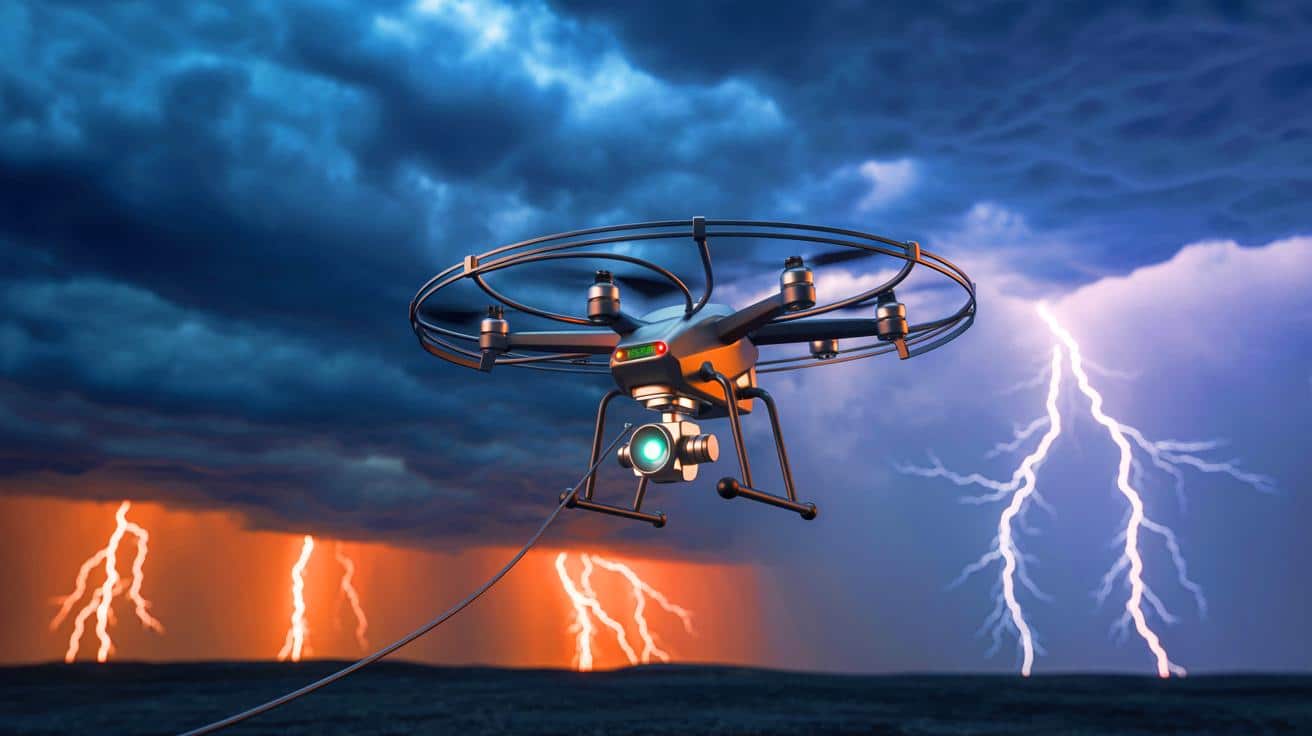
NTT’s innovative approach combines two key technologies aimed at mitigating lightning damage. Firstly, a protective cage surrounding the drone acts as a shield, preventing damage even when the drone is struck by lightning. Made from conductive metal, the cage disperses the lightning’s electrical current radially, neutralizing the intense magnetic fields generated. This design minimizes electromagnetic interference, ensuring the drone’s components remain unaffected by the lightning strike.
The second part of the system involves actively triggering lightning by manipulating the electric field around the drone. This is achieved by connecting the drone to the ground using a conductive wire. By positioning drones strategically beneath storm clouds, NTT can initiate lightning strikes in a controlled manner, guiding them safely away from sensitive areas. This dual-technology approach offers a promising solution to a long-standing natural challenge.
Promising Experimental Outcomes
NTT has conducted extensive testing to assess the effectiveness of their dual-technology system, yielding promising results. The protective cage has withstood artificial lightning strikes with currents up to 150 kiloamperes, which is five times the intensity of an average natural lightning strike. These tests demonstrate the cage’s robustness and reliability in extreme conditions.
For the lightning-triggering system, NTT carried out experiments in Hamada, a mountainous region at an altitude of 2,950 feet. The tests were successful, with a voltage surge of over 2,000 volts occurring between the wire and the ground just before a lightning strike. This rapid increase in the local electric field intensity triggered a controlled lightning discharge towards the drone. NTT utilized a “field mill” device to monitor ground-level electric fields during these experiments, ensuring precise control over the process.
Safeguarding Urban Infrastructure
NTT’s ambitions extend beyond simply protecting individual buildings. The company envisions a future where entire cities and infrastructures are shielded from lightning strikes. By advancing their research, NTT aims to understand the mechanisms of lightning more comprehensively and predict its occurrence with greater accuracy.
In addition to protection, NTT sees potential in harnessing lightning’s energy. They are exploring technologies to capture and store this energy for future use. This innovative approach could transform how we perceive and utilize natural forces, offering sustainable energy solutions. As NTT continues to refine their technology, the implications for urban safety and energy utilization could be profound.
The Broader Implications of Drone Technology
NTT’s use of drones to manage lightning strikes represents a significant technological leap forward. This approach not only enhances safety but also opens new avenues for using drones in weather-related applications. By integrating drones with advanced weather prediction models, we could improve our understanding of storm patterns and develop more effective mitigation strategies.
Furthermore, the successful implementation of this technology could inspire other industries to explore innovative ways to leverage drones for various applications. The potential for drones to become an integral part of urban infrastructure management is immense, paving the way for safer, more resilient cities.
As NTT continues to push the boundaries of technology, they invite feedback and insights from the public. The concept of using drones to redirect lightning offers a glimpse into a future where technology and nature coexist in harmony. How might this innovative approach change our relationship with natural forces, and what other challenges could drones help us overcome in the coming years?


Wow, using drones to attract lightning? That’s electrifying! ⚡
Wow, this is like something out of a sci-fi movie! 🚀
How safe is it to have drones flying during a lightning storm? 🤔
How do they ensure the drones don’t get fried by the lightning? 🤔
Merci pour cet article fascinant ! C’est impressionnant ce que la technologie peut faire aujourd’hui.
Is it possible to harness energy from these redirected lightning strikes? That would be a game-changer! 🌩️
Je suis sceptique… Est-ce que ça pourrait vraiment marcher à grande échelle ?
This sounds like science fiction! Are we sure it’s not an April Fools’ joke? 😂
Can this technology be adapted for other weather phenomena like tornadoes?
I’m curious about the cost of implementing such a system across a city.
Les coûts de développement et de déploiement de ce système doivent être énormes, non ?
Great initiative! Protecting infrastructure from lightning is crucial. Thanks, NTT! 😊
Bravo NTT, c’est une avancée incroyable ! Peut-être la fin des coupures de courant dues aux orages ? ⚡