




| IN A NUTSHELL |
|
Recent discoveries in Egypt have provided a groundbreaking perspective on ancient engineering practices. Around the Pyramid of Djoser, archaeologists have unearthed an advanced water management system, challenging long-held beliefs about the technological capabilities of ancient Egyptian civilization. This sophisticated network of dams, basins, and shafts demonstrates a complex understanding of hydraulic engineering that historians are only beginning to fully appreciate. The implications of these findings are profound, prompting a reevaluation of ancient Egypt’s engineering prowess and raising intriguing questions about other potential technological marvels that remain undiscovered.
Ingenious Stone Dam Capturing Desert Floodwaters
The Gisr el-Mudir structure has fascinated researchers for years, primarily due to its enormous size and previously unclear purpose. Recent studies, however, have redefined this ancient stone enclosure as a sophisticated dam engineered to capture seasonal floodwaters. Spanning approximately 1,180 feet, the structure is believed to have collected water from nearby wadis, transforming the area into a reservoir capable of supporting large-scale construction projects.
By carefully analyzing the natural terrain, researchers identified a watershed capable of channeling substantial volumes of water into the enclosure. The dam’s capacity to hold up to 14 million cubic feet of water underscores its strategic importance, enhancing the site’s utility beyond traditional interpretations. This discovery suggests that the selection of Saqqara as a construction site was not solely for religious purposes but also due to its geological advantages, which provided a reliable water supply for monumental building endeavors. This highlights the advanced planning and understanding of environmental resources by ancient Egyptians.
How Hydraulic Construction of Pyramids Worked
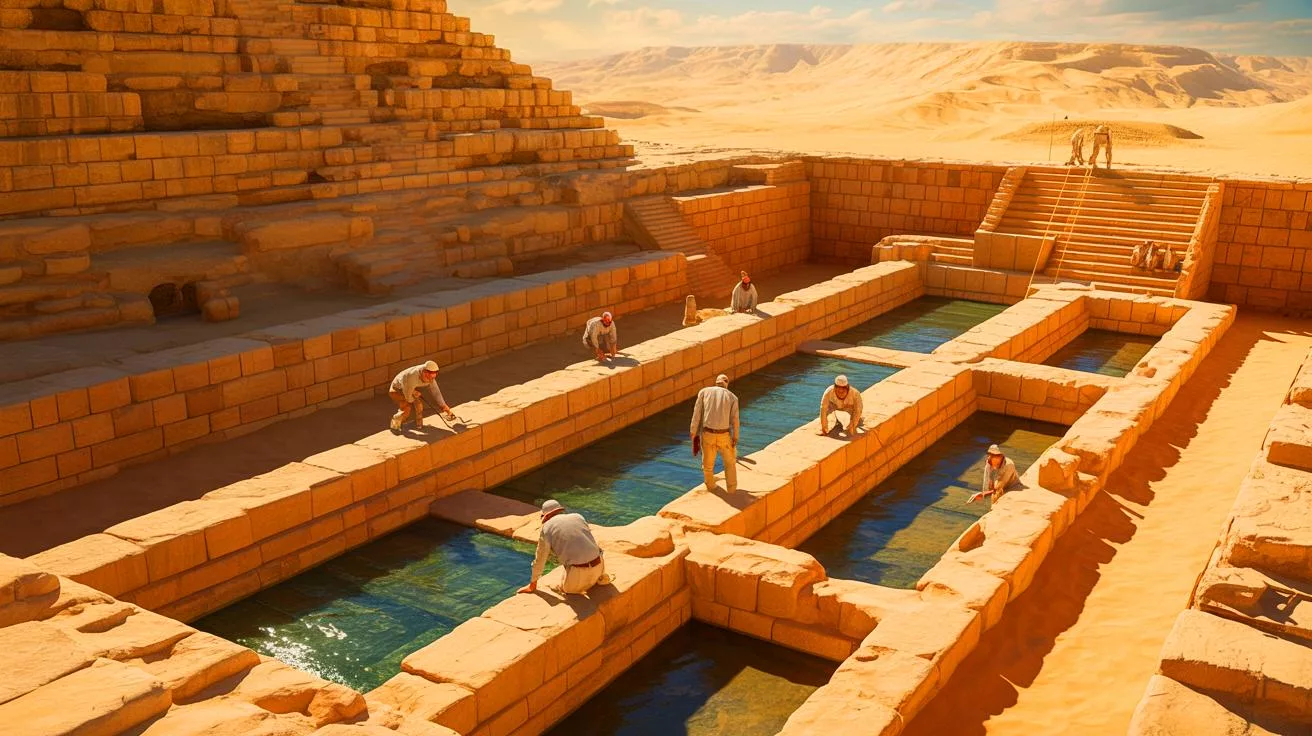
The presence of a substantial water supply was crucial for the construction of ancient pyramids, yet it was the ingenious use of hydraulic systems that truly distinguished these projects. Beneath the Djoser complex lies the “Deep Trench,” an extensive system of basins and compartments initially thought to be symbolic. This network likely served as a water treatment facility, purifying water for use in a vertical lifting mechanism.
Researchers hypothesize that this system functioned similarly to a hydraulic elevator. By utilizing the force of water pressure, stone blocks placed on a floating platform could be elevated efficiently. Once raised, these blocks could be moved onto the pyramid’s upper tiers with minimal mechanical effort. This innovative approach to construction showcases the ancient Egyptians’ ability to harness natural forces to achieve architectural feats that continue to inspire modern engineers.
Sophisticated Technology Matching Pharaohs’ Ambitions
The evidence supporting hydraulic construction techniques at the Pyramid of Djoser challenges existing narratives about ancient Egyptian engineering. The integration of dams, basins, and shafts into a coherent hydraulic system underscores a sophisticated understanding of water management that predates many modern technologies. This revelation invites a reevaluation of other Old Kingdom monuments and suggests that the Pyramid of Djoser represents the height of an advanced engineering tradition.
Ancient Egyptians were not only adept at monumental architecture but also skilled in irrigation and water management. Their ability to construct complex hydraulic systems with limited resources demonstrates a level of innovation and resourcefulness that demands further study. The findings at Saqqara may reshape our understanding of pyramid construction, highlighting a blend of ingenuity and adaptation that enabled the creation of these enduring structures. Their technological achievements continue to offer valuable insights into ancient engineering practices.
How Saqqara’s Hydraulic Remains Alter Our Historical Perspective
The discovery of Saqqara’s hydraulic system opens new avenues for archaeological exploration and shifts the focus from purely symbolic interpretations of pyramids to their technical and environmental contexts. The builders of these ancient structures were not simply executing religious projects but were also constructing sustainable ecosystems that leveraged available resources effectively.
This multidisciplinary approach, combining archaeology, hydrology, and engineering, enriches our understanding of ancient Egypt’s past. It reveals a society capable of sophisticated work organization and material management, challenging the simplistic view of pyramids as mere products of labor mobilization. As researchers continue to uncover new evidence of forgotten hydraulic systems, we are encouraged to reassess other monumental sites and consider the technical genius that may lie beneath the surface.
With every archaeological breakthrough, we are reminded of the potential for future discoveries to reshape our understanding of ancient civilizations. What other hidden technological marvels await beneath the sands of time, poised to rewrite history once more?