





| IN A NUTSHELL |
|
In the rapidly evolving landscape of global defense, technological advancements continue to play a critical role in maintaining military superiority. Lockheed Martin, a leader in defense innovation, has recently unveiled the Joint Air-to-Ground Missile (JAGM) along with the JAGM Quad Launcher (JQL) to significantly boost the capabilities of the U.S. Navy. These new systems promise to enhance operational flexibility and effectiveness, ensuring the Navy remains a dominant force on the high seas. As global threats become more complex, these advancements are vital for maintaining strategic advantage and safeguarding national security.
Transforming Naval Defense With the JAGM Quad Launcher
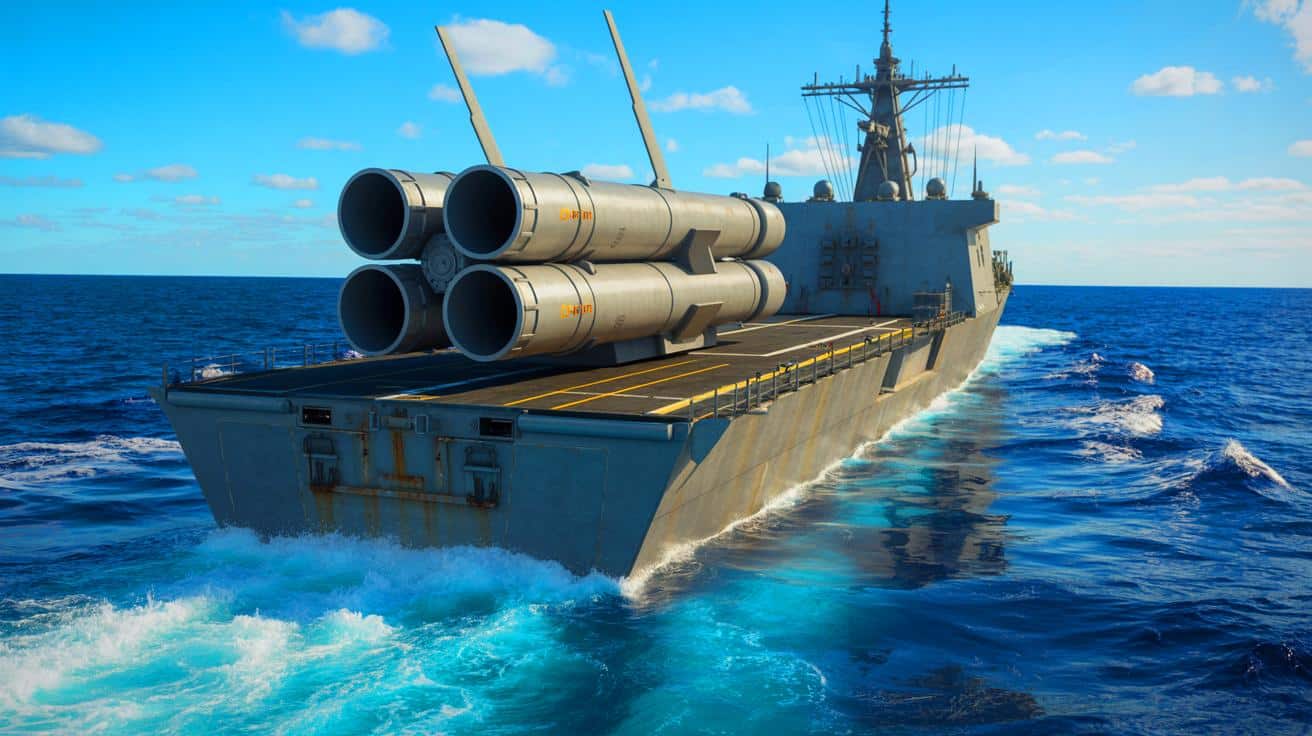
The introduction of the JAGM Quad Launcher (JQL) marks a significant transformation in naval defense capabilities. Designed to enable rapid reloading, the JQL is essential for naval forces operating in dynamic threat environments. Joey Drake, the program director for Multi-Domain Missile Systems at Lockheed Martin, emphasizes that the JAGM serves as a natural successor to the LONGBOW HELLFIRE missile. This transition is not merely about technological innovation; it also ensures continuity in logistical support as LONGBOW production winds down.
By integrating an operator-selectable dual-mode seeker, the JAGM offers greater tactical flexibility. This feature allows for seamless integration with various naval platforms, enhancing the Navy’s response capabilities. The shift from LONGBOW to JAGM is poised to fortify the Navy’s ability to conduct both defensive and offensive operations with increased efficiency. As the U.S. Navy adapts to evolving global threats, the JQL ensures that its rapid response capabilities remain robust and reliable.
Expanding Tactical Options With the JAGM
The JAGM is distinguished by its multi-mode seeker, which significantly enhances its capability to engage air, maritime, and land threats. This feature is particularly valuable in adverse weather conditions and scenarios where countermeasures are deployed. With over 1,000 units already delivered for deployment from the USMC’s AH-1Z attack helicopters, the extension of JAGM to surface ship defense represents a logical evolution in its application.
Chris Abt, director of advanced concepts at Lockheed Martin, notes that deploying the JAGM on surface ships will broaden the Navy’s strategic options and streamline logistical support across the fleet. The missile’s adoption is expected to reduce operational costs while diversifying the capabilities of naval forces. By integrating this advanced system, the Navy enhances its maritime superiority and strengthens its ability to respond effectively to a wide range of threats.
Proven Performance Against Evolving Threats
Lockheed Martin has successfully demonstrated the JAGM’s effectiveness against maritime threats, including unmanned surface vessels. This validation is crucial as the Navy faces increasingly complex challenges, such as unmanned systems. Ongoing software updates are set to further enhance the missile’s capabilities, particularly against unmanned aerial systems (UAS) that pose a threat to naval forces.
The adaptability of the JAGM is evident in its deployment options, whether from the current surface-to-surface missile module or the new modular JQL. Lockheed Martin’s commitment to delivering innovative defense solutions ensures that the JAGM remains a cornerstone of modern naval operations. This adaptability not only addresses emerging threats but also maintains strategic dominance in the maritime domain.
Mako Missile Stuns Military as “Blazing Spear Pierces Sky and Sea” in Potential US Navy Deployment
Continuous Innovation Through Software Enhancements
Software upgrades are a critical component of the JAGM’s ongoing effectiveness against unmanned aerial systems. These enhancements keep the missile at the forefront of missile technology, ensuring it remains relevant in addressing new challenges. Lockheed Martin’s dedication to technological excellence positions it as a leader in the defense industry, ready to meet the demands of a rapidly changing battlefield.
The JAGM’s software-driven advancements ensure it can adapt to current threats and prepare for future challenges. As these enhancements continue, they will shape the future of global maritime defense. Lockheed Martin’s focus on innovation underscores its role in redefining defense capabilities, ensuring the U.S. Navy retains its competitive edge.
As Lockheed Martin pushes the boundaries of missile technology, the global defense landscape is set for significant changes. The integration of advanced systems like the JAGM and JQL promises to redefine naval capabilities, offering unmatched operational flexibility and effectiveness. Looking ahead, how will these technological advancements continue to influence the dynamics of maritime defense on a global scale?



C’est impressionnant de voir jusqu’où la technologie militaire peut aller, mais à quel prix pour la paix mondiale ? 🤔
Les Russes paniquent, mais peut-être qu’ils exagèrent un peu, non ?
Merci pour cet article détaillé ! Ça donne matière à réfléchir sur la course à l’armement.
Est-ce que ces innovations signifient que d’autres pays vont aussi augmenter leur arsenal ?
J’aimerais en savoir plus sur les implications écologiques de ces nouvelles armes.
Qui aurait cru que Lockheed Martin deviendrait presque un nom de ménage. 😄
Est-ce que ces systèmes pourraient vraiment changer la donne dans un conflit naval ?
Un grand merci à l’auteur pour cet aperçu fascinant des nouvelles avancées militaires.
Quel est le coût de développement de ces missiles et est-ce justifié ?
Les Russes sont toujours en mode “drama”, mais peut-être ont-ils raison cette fois-ci ?