





| IN A NUTSHELL |
|
The advent of 3D printing technology has significantly revolutionized various industries, with aerospace being one of the latest to embrace this innovation. In a groundbreaking development, scientists at the Korea Institute of Industrial Technology (KITECH) have successfully 3D printed a titanium space fuel tank that has passed a crucial durability test. This accomplishment marks a significant milestone in the manufacturing of space components, potentially transforming the way such parts are produced. The use of 3D printing for space applications could drastically cut down production times and costs, offering more customizable and robust solutions.
Innovative Use of 3D Printing in Aerospace
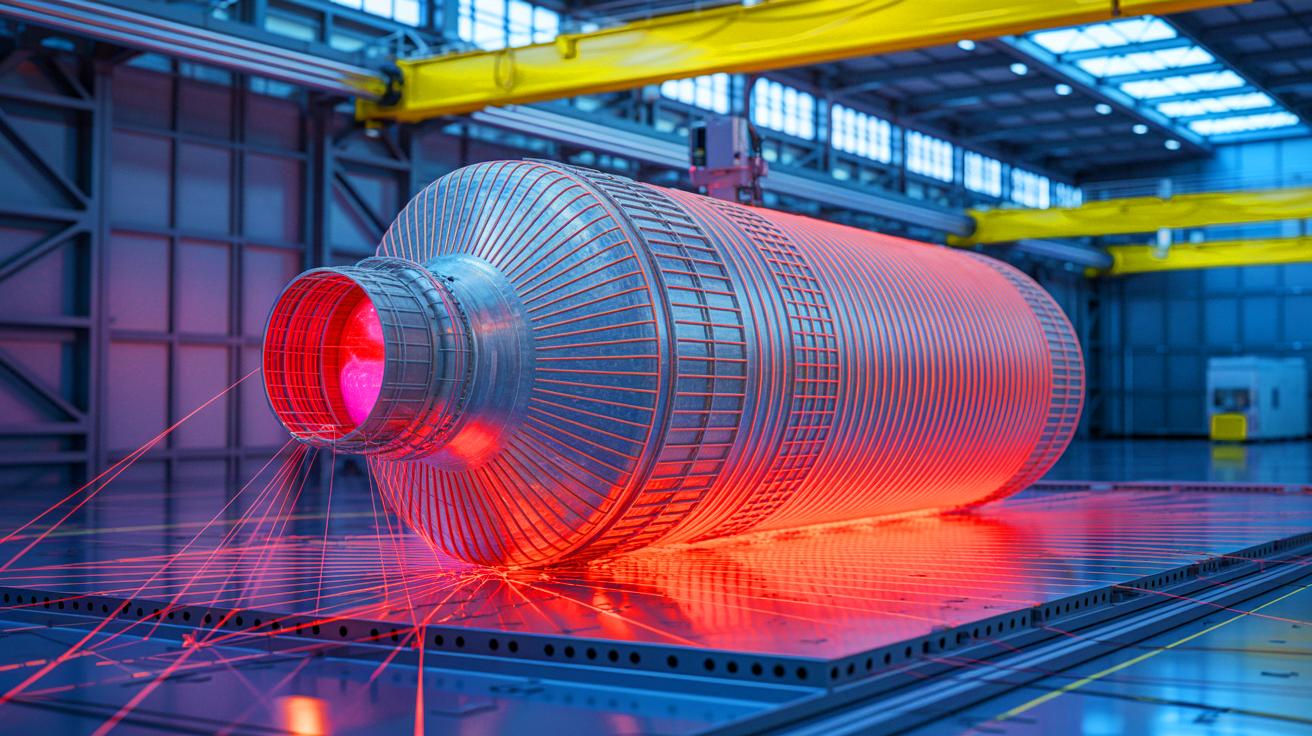
The KITECH team utilized the Directed Energy Deposition (DED) 3D printing process to create their titanium fuel tank. This method involves using a laser to melt a titanium wire, which is then layered to form the desired component. Measuring 25.2 inches in diameter, the tank was constructed using Ti64 titanium alloy, a material known for its strength and durability. The project was a collaborative effort involving the Korea Aerospace Research Institute (KARI), KP Aviation Industries, AM Solutions, and Hanyang University.
The DED method represents a significant departure from traditional manufacturing practices like forging, which require fixed molds. Such methods are less adaptable to the creation of custom parts of varying sizes. The 3D printing technique not only allows for greater flexibility in design but also accelerates the production process. The KITECH team’s achievement demonstrates the potential for 3D printing to produce large-scale aerospace components that can withstand the rigors of space travel.
Overcoming Challenges of Cryogenic Pressure
The titanium fuel tank underwent rigorous testing to prove its durability under extreme conditions. The test involved subjecting the tank to pressures of 330 bars while being cooled to -321°F using liquid nitrogen. These conditions simulate the harsh environment of space, where high-pressure components are crucial for the storage and supply of liquid fuel, as well as for maintaining vehicle attitude during flight.
Traditionally, producing such components with conventional methods posed significant challenges, including material supply issues, design limitations, and increased costs. By contrast, the 3D printing process employed by KITECH enables a more efficient production cycle. The entire manufacturing process, from design to completion, was accomplished in just a few weeks, compared to the extended timelines associated with traditional methods.
Implications for the Future of Space Manufacturing
Dr. Lee Hyub, a principal researcher at KITECH, emphasized the significance of this achievement in a statement:
“This demonstration proves that large-scale additively manufactured structures can reliably withstand cryogenic and high-pressure conditions that simulate actual operating environments. It lays the foundation for widespread aerospace applications of 3D printing.”
https://www.rudebaguette.com/en/2025/06/qatar-installs-giant-3d-beast-worlds-largest-construction-printer-could-reshape-cities-and-shake-up-the-global-building-industry/
The successful test of the titanium fuel tank is just the beginning. Further testing is required to ensure that the tank can endure the repetitive stresses of space travel. Plans are underway to conduct cyclic pressure tests at operating pressures and to pursue additional certifications for spaceflight.
The potential for 3D printing in aerospace goes beyond fuel tanks. The technology could be applied to a wide range of components, offering a more sustainable approach to manufacturing. As the industry continues to explore these possibilities, the collaboration between KITECH, KARI, and other partners will be crucial in advancing the application of 3D printing in space exploration.
The Path Forward for 3D Printing in Space
The implications of this successful test extend far beyond the immediate achievement. The ability to quickly and efficiently produce high-performance components using 3D printing could reshape the entire landscape of aerospace manufacturing. This shift not only has the potential to reduce costs and production times but also to enable new designs that were previously impractical with traditional manufacturing techniques.
As the aerospace industry looks to the future, the integration of 3D printing technology could lead to innovations that enhance the capabilities of spacecraft, satellites, and other space-bound technologies. The ongoing research and development efforts by institutions like KITECH and their collaborators will be pivotal in realizing the full potential of this technology.
The successful test of the 3D-printed titanium fuel tank represents a significant step forward in aerospace technology. As researchers continue to explore the capabilities of 3D printing, the question remains: How will this technology further transform the future of space exploration and manufacturing?

Impressionnant ! KITECH va révolutionner l’industrie aérospatiale avec cette innovation. Bravo ! 🚀
Comment ont-ils réussi à simuler les conditions spatiales sur Terre ? 😮
La prochaine étape c’est quoi ? Lancer le réservoir dans l’espace ?
Je suis sceptique. Est-ce que ce réservoir 3D peut vraiment être aussi fiable que les méthodes traditionnelles ? 🤔
Félicitations à toute l’équipe de KITECH pour cette avancée incroyable !
Est-ce que cette technologie pourrait être utilisée pour d’autres composants spatiaux à l’avenir ?
C’est génial de voir les progrès de la technologie 3D dans l’industrie spatiale, mais qu’en est-il des coûts ?
Utiliser un laser pour fondre le titane, ça doit être un spectacle fascinant à voir ! 🔥
La collaboration entre KITECH et KARI semble vraiment prometteuse pour l’avenir de l’aérospatiale.