





| IN A NUTSHELL |
|
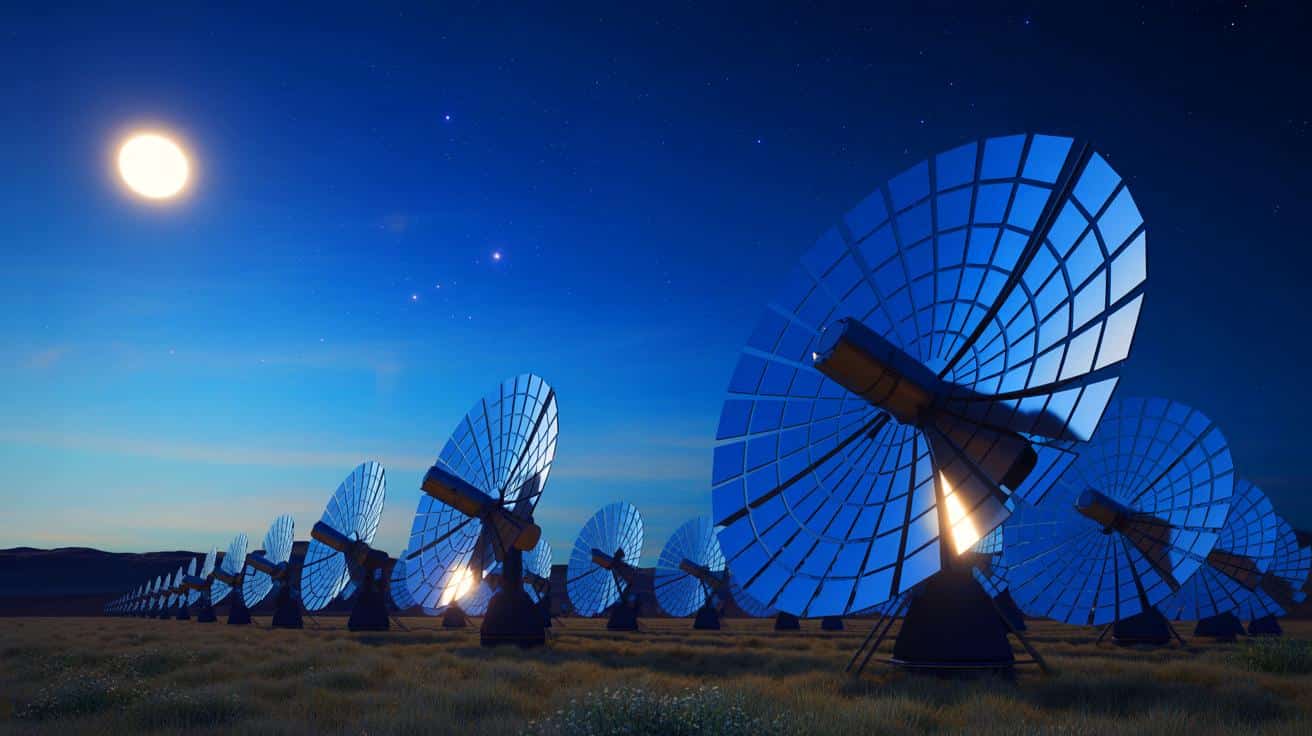
In the quest to maximize the utility of solar power stations, an innovative approach is being explored to turn these facilities into asteroid detection systems at night. Sandia National Laboratories in Albuquerque, New Mexico, is spearheading this unique endeavor under the guidance of scientist John Sandusky. By repurposing heliostat mirrors typically used for solar power generation, Sandusky aims to give these systems a dual purpose, potentially revolutionizing both energy and astronomical fields. This initiative not only seeks to enhance the efficiency of solar power plants but also aims to address the increasing need for asteroid detection, further showcasing the versatility of renewable energy technologies.
Revolutionizing Solar Power Stations
Solar power stations have long been limited by their inability to generate energy once the sun sets. This limitation has prompted scientists to explore innovative ways to extend the utility of these systems. At the National Solar Thermal Test Facility, Sandusky is testing the potential of heliostat mirrors to perform a secondary function during nighttime. Instead of lying dormant, these mirrors can be programmed to track celestial objects, leveraging their precise movement capabilities. By doing so, they can potentially detect asteroids, providing an additional use for the infrastructure.
The facility, with its 200-foot-high concrete tower and 218 mirrors spread across 398 square feet, is an ideal testing ground for this concept. Currently, it generates 6 megawatts of thermal power during daylight hours. However, Sandusky’s experiments aim to demonstrate that these heliostats can do more than just track the sun. By oscillating the mirrors over a one-minute cycle, the team has succeeded in creating conditions conducive for identifying asteroids. This dual-purpose approach not only enhances the value of solar power stations but also opens new avenues for astronomical research.
Asteroid Detection: A New Frontier
Asteroids pose both opportunities and threats, being potential sources of valuable minerals and potential hazards to Earth. Traditional asteroid detection relies on optical telescopes capturing time-lapse images. However, the vastness of the sky and the limited number of telescopes make this a challenging task. Sandusky’s approach offers a cost-effective alternative by utilizing existing solar power infrastructure for this purpose. By capturing the photocurrent power spectrum of incoming light, heliostats can detect frequency shifts caused by asteroids, indicating their presence without the need for conventional images.
This method, though less visually dramatic, provides valuable data that can supplement existing asteroid detection systems like NASA’s ATLAS. The ability to detect frequency shifts could also have military applications, potentially allowing for the detection of covert spacecraft activities. Sandusky’s research highlights the untapped potential of solar facilities to contribute to planetary defense and space exploration, offering a new tool in the ongoing quest to monitor near-Earth objects.
The Potential for Scaling Up
Sandusky’s experiments have shown promising results, but the true potential lies in scaling up the technology. By expanding from a single heliostat to multiple units, the detection capabilities could be significantly enhanced. Sandusky envisions a future where solar power facilities around the world contribute to a global network of asteroid detection systems. This would not only increase the chances of identifying potential threats but also advance our understanding of near-Earth objects.
For the technology to become practical, further development is necessary. This includes refining the detection technique and integrating it into existing systems. Sandusky’s work represents an important step in this direction, demonstrating the feasibility of using renewable energy technologies for diverse applications. As the scientific community continues to explore these possibilities, the intersection of solar energy and space exploration holds promise for future advancements.
Challenges and Future Prospects
While the potential benefits of this approach are significant, several challenges remain. Scaling up the technology will require overcoming technical and logistical hurdles. Additionally, integrating this system into existing solar facilities and ensuring its compatibility with current asteroid detection networks will be crucial. Collaboration between energy providers, research institutions, and governmental agencies will be essential to realize this vision.
Despite these challenges, the concept has garnered interest within the scientific community, as evidenced by its presentation at an international conference on optics and photonics. As Sandusky and his team continue their research, the possibility of transforming solar power stations into dual-purpose facilities remains an exciting prospect. This innovative approach not only enhances the utility of renewable energy systems but also contributes to global efforts in planetary defense and space exploration.
As we continue to explore the potential of combining solar energy with asteroid detection, the question remains: How can we further innovate to maximize the benefits of renewable energy technologies in other scientific endeavors?


Wow, who knew solar power stations could do so much more than just generate electricity! 🤩
Will this new method be more cost-effective than traditional asteroid detection systems?
I’m skeptical about the accuracy of using solar stations for detecting asteroids. Can they really be that precise?
Thank you Sandia Labs for pushing the boundaries of what’s possible! 🚀
Does this mean we’ll need to build more solar power stations to improve asteroid detection?
This is a brilliant idea! Dual-purpose technologies are the future. 😊
How long before we see this technology implemented on a global scale?
I’m curious, how do heliostat mirrors capture frequency shifts? 🤔
What happens if a solar power station is in a cloudy area? Does it affect detection?
Love the innovation, but can these systems actually prevent asteroids from hitting Earth? 😅
This could be a game-changer for planetary defense. Kudos to Sandia Labs!