




| IN A NUTSHELL |
|
In the world of space exploration, the quest for more efficient and cost-effective ways to launch payloads has never been more intense. Companies around the world are racing to innovate, moving away from traditional rocket boosters in favor of more cutting-edge technologies. One of the latest players in this arena is Auriga Space, a US-based firm that is developing a revolutionary launch system. This system utilizes powerful magnets to accelerate vehicles to hypersonic speeds before sending them into orbit. With a recent $6 million funding boost, Auriga Space is poised to change the way we think about space launches.
Auriga Space’s Space Ramp
The innovative approach taken by Auriga Space centers on minimizing the amount of propellant needed for space launches. Traditional rockets are heavily dependent on large quantities of fuel, but Auriga aims to drastically reduce this requirement with its magnetic launch track. This track features a steep ramp that uses electrical power to propel the vehicle skyward at incredible speeds, requiring only a final engine push to reach orbit.
What sets Auriga Space apart is the reusability of its launch system. With advances in power electronics, the company believes it can achieve a rapid and efficient launch process. While similar concepts have been proposed in the past, Auriga is committed to seeing its technology through to extensive testing. According to CEO Winnie Lai, the goal is to increase efficiency, reduce costs, and enable more frequent launches, thereby revolutionizing access to space.
Hypersonic Customers and Responsive Launch
In addition to its ambitious space ramp, Auriga Space is targeting hypersonic test customers. With its technology, the company promises to offer multiple tests on a single payload at a lower cost. This capability is particularly appealing to the US Space Force, which requires “responsive launch” capabilities to deploy payloads quickly and with minimal notice.
Financial backing has been robust, with a $4.6 million seed round concluded earlier this year and an additional $1.4 million from AFWERX and SpaceWERX contracts. Despite being in the development phase, Auriga Space’s vision has already garnered significant investor confidence. The company faces challenges similar to those encountered by SpinLaunch, such as managing high-G forces on payloads. However, the potential for rapid and low-cost launches remains a compelling proposition.
Next Steps in Auriga Space’s Journey
Auriga Space plans to begin its journey with hypersonic test systems named Prometheus and Thor. Prometheus will be an indoor, lab-scale track, while Thor will handle full-scale outdoor hypersonic tests. These initial phases will pave the way for the ultimate goal of deploying the Zeus orbital launch system, which aims to make space more accessible than ever before.
As the company progresses, it will need to finalize the size and specifications of its launch vehicle, ensuring it can handle the intense forces involved in such a fast-paced launch method. The success of this innovative approach could redefine how we access space, offering new opportunities for exploration and commercial ventures.
The Future of Space Launch Technology
The innovative approach of companies like Auriga Space is just the beginning of a new era in space travel. By reducing reliance on traditional rocket fuels and leveraging cutting-edge technology, these firms are paving the way for more sustainable and frequent launches. The implications of such advancements are vast, from reducing costs to increasing the frequency of space missions.
As Auriga Space and its competitors continue to push the boundaries of what is possible, the potential for space exploration and commercial opportunities is limitless. With the ongoing development of magnetic launch systems, the dream of accessible space travel is becoming more tangible by the day. What might the future hold as these technologies mature and become mainstream?

Wow! Electromagnets instead of rocket fuel? That’s insane! 😮
How does the maglev launcher handle payloads that are sensitive to high-G forces?
Is this the end of traditional rocket launches as we know them?
Sounds too good to be true. How realiable is this new technology?
I’m impressed by the innovative approach Auriga Space is taking. Keep it up! 👍
Will this maglev system be able to launch larger payloads like satellites?
I’m curious to see how this will revolutionize space access. 🚀
Imagine when we start building on the moon. Great way to launch with even less effort, more linear room, and less gravity. Read Heinlen’s The moon is a harsh mistress
6 million in funding is a good start, but is it really enough for such a project?
What are the environmental impacts of using electromagnetism for launches?
Heinlen used this to hurl payloads from the moon into LEO and subsequently bombing the Eartha part of a revolution. Moon is a harsh mistress.
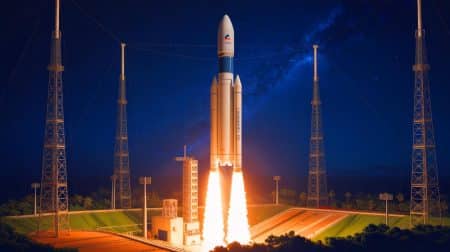
I guess nobody told the artist that the rocket does not need a exhaust plume. Or this is just now AI slop.
I guess nobody told the artist that, with a magnet propelled rocket, it doesn’t need an exhaust plume. More AI slop