





| IN A NUTSHELL |
|
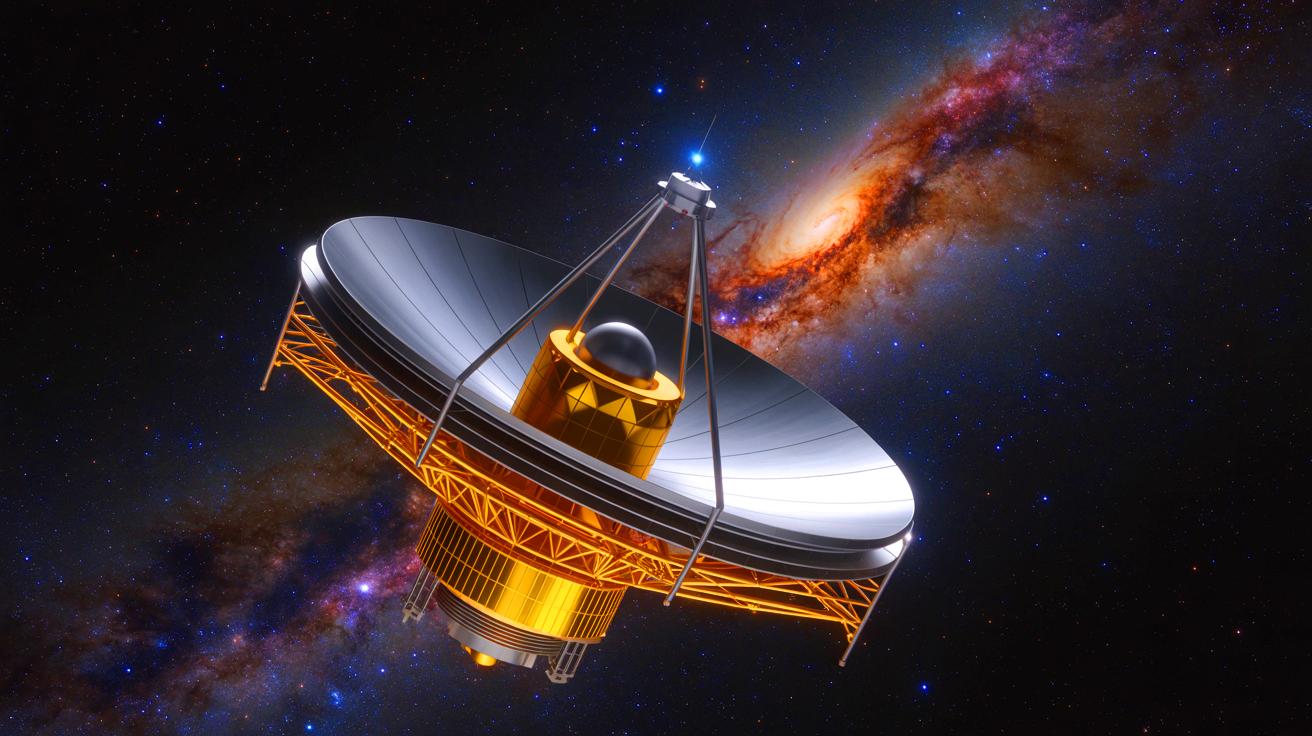
NASA’s SPHEREx telescope project is poised to redefine our understanding of the universe. With an investment of $488 million, this revolutionary telescope is set to create an unparalleled three-dimensional map of the cosmos. Launched aboard a SpaceX Falcon 9 rocket from Vandenberg Space Force Base in California, SPHEREx marks a groundbreaking advancement in space exploration. This mission will not only enhance our cosmic knowledge but also provide insights that could steer future space explorations. As we embark on this journey, the question remains: what new cosmic mysteries will SPHEREx unveil?
Revolutionary Mapping Technology Unveils Cosmic Mysteries
The SPHEREx telescope is equipped with state-of-the-art technology that allows it to observe wavelengths invisible to the human eye. Over its two-year mission, SPHEREx will meticulously scan the entire sky twice each year, capturing detailed images of different regions in space. This comprehensive approach enables scientists to analyze over 450 million galaxies and 100 million Milky Way stars with unmatched precision.
“SPHEREx demonstrates how big science can be accomplished with a relatively small telescope,” stated Beth Fabinsky, deputy project manager at NASA’s Jet Propulsion Laboratory. Despite its modest size of about 1,100 pounds—less than a grand piano—the telescope is highly efficient, operating on just 270-300 watts of power, which is less than a standard refrigerator consumes. The telescope’s spectrophotometer divides light into 102 distinct colors, allowing it to detect frozen molecules crucial for life within interstellar clouds. This capability provides researchers with the tools to track fundamental elements like hydrogen, carbon, and oxygen as they travel through space, potentially offering insights into mysterious deep space phenomena that have puzzled astronomers for years.
Tracing Cosmic Inflation and Universe Formation
A key objective of the SPHEREx mission is to study cosmic inflation—the rapid expansion that occurred moments after the Big Bang. By mapping the distribution patterns of hundreds of millions of galaxies, scientists hope to identify signatures from the universe’s earliest moments. This data could fundamentally transform our understanding of how the universe formed and why it appears as it does today.
SPHEREx’s capabilities extend beyond mere mapping. Its instruments will analyze stars that other telescopes cannot detect due to size or distance limitations. This comprehensive approach promises to deliver insights into how galaxies form and evolve over cosmic time. The mission builds upon discoveries made by other NASA observatories, such as the James Webb Telescope, which recently observed chaotic light shows from our galaxy’s central black hole. James Fanson, SPHEREx project manager, expressed excitement about the mission’s potential: “I expect the unexpected to come out of the data for this mission.” This sentiment reflects the transformative potential of the telescope’s observations for our cosmic understanding.
Building Blocks of Life Across the Universe
The unique instrumentation of SPHEREx allows it to detect frozen molecules that serve as the building blocks of life. By analyzing elements such as nitrogen, oxygen, carbon, and sulfur, scientists can trace how these essential ingredients travel through interstellar space and eventually reach planets.
This capability could prove crucial in identifying environments capable of supporting life beyond Earth. The mission might identify water sources throughout our solar system and beyond, offering clues about the origins of Earth’s water and the potential habitability of other worlds. Some astronomers even speculate that these observations might contribute to the search for our solar system’s theorized ninth planet, which has remained elusive despite compelling evidence of its existence. While mapping countless galaxies, SPHEREx may also provide new data on cosmic phenomena, such as massive black holes moving through space. The telescope’s comprehensive spectral data capturing across vast cosmic distances makes it uniquely suited to detect anomalies and unexpected features throughout the observable universe.
Navigating the Uncharted Cosmic Frontier
SPHEREx, with its innovative design and ambitious goals, exemplifies NASA’s commitment to pushing scientific boundaries. The treasure trove of data it produces will keep astronomers busy for decades, potentially answering fundamental questions about our cosmic origins while inevitably raising fascinating new ones. The mission’s success could serve as a catalyst for further exploration and discovery, expanding our understanding of the universe and our place within it.
As we stand at the brink of these new discoveries, we are reminded of the endless possibilities that space exploration holds. What unforeseen revelations will SPHEREx bring to light, and how will they shape our future understanding of the cosmos?


Wow, $488 million for a telescope! Hope it’s worth every penny. 🚀
This is truly groundbreaking. Can’t wait to see what cosmic mysteries are unveiled!
How does SPHEREx compare to the Hubble and James Webb telescopes?
450 million galaxies? That’s mind-blowing! 😲
Hope this doesn’t end up like another space junk… 🤔
Why is studying cosmic inflation important for us?
Merci NASA, for always pushing the boundaries of what’s possible!
Is it just me, or does this sound like the plot of a sci-fi movie? 🎬